(newspaper unidentified) · 6 September 2000
CP-2000-072
Israel is a stone's throw from Arab violence
MICHAEL GOODWIN
Transcribed from the clipping
Make no mistake: The barbarians are at the gate. The Fatma Gate, that is. The gate is the main border point between northern Israel and Lebanon, and I was there recently on a working vacation. The vacation part of the trip was thrilling: Israel is a fascinating country, full of wondrous achievements and baffling contradictions. The working part of the trip was sobering.
My visit to the Israeli watchtower on the Lebanese border, a bunker in the sky, brought home clearly the extent to which violence against Israel is not just an Arab strategy. It is *the* Arab strategy. Whether it's a stone in Lebanon or a terrorist bomb in Jerusalem, or just the threat of one, the tune is consistent. Violence seems the only card the Arabs play.
It's a point Palestinian leader Yasser Arafat underscored before his visit to New York, where he is to meet today with President Clinton. Any hopes that Arafat was bringing an olive branch were dashed by his fiery speech to Arab leaders Sunday that included explicit warnings of violence if there is no deal.
The miniature version of that sickening strategy is on daily display at the Fatma Gate, despite Israel's pulling all its troops out of Lebanon three months ago. Its 18-year occupation of a buffer zone was costly and unpopular, and Prime Minister Ehud Barak ordered an overnight withdrawal.
Hezbollah, the main terrorist group in Lebanon, failed to inflict a single casualty during the retreat, and its frustration is showing on the border. Donning the required army flak jackets, my wife and I had no sooner entered the bunker's main observation room when our Israeli Army host announced, “Be careful, now it begins.”
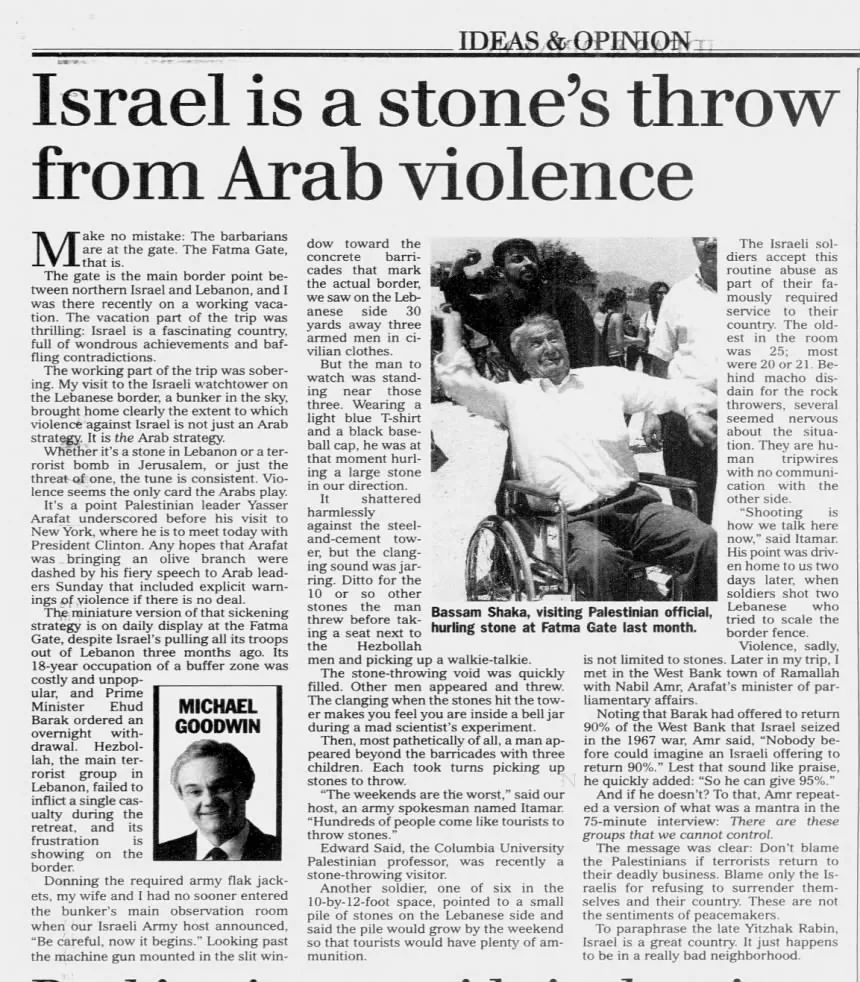
Looking past the machine gun mounted in the slit window toward the concrete barricades that mark the actual border, we saw on the Lebanese side 30 yards away three armed men in civilian clothes. But the man to watch was standing near those three. Wearing a light blue T-shirt and a black baseball cap, he was at that moment hurling a large stone in our direction.
It shattered harmlessly against the steel-and-cement tower, but the clanging sound was jarring. Ditto for the 10 or so other stones the man threw before taking a seat next to the Hezbollah men and picking up a walkie-talkie. The stone-throwing void was quickly filled. Other men appeared and threw.
The clanging when the stones hit the tower makes you feel you are inside a bell jar during a mad scientist's experiment. Then, most pathetically of all, a man appeared beyond the barricades with three children. Each took turns picking up stones to throw. “The weekends are the worst,” said our host, an army spokesman named Itamar.
“Hundreds of people come like tourists to throw stones.” Edward Said, the Columbia University Palestinian professor, was recently a stone-throwing visitor. Another soldier, one of six in the 10-by-12-foot space, pointed to a small pile of stones on the Lebanese side and said the pile would grow by the weekend so that tourists would have plenty of ammunition.
The Israeli soldiers accept this routine abuse as part of their famously required service to their country. The oldest in the room was 25; most were 20 or 21. Behind macho disdain for the rock throwers, several seemed nervous about the situation. They are human tripwires with no communication with the other side. “Shooting is how we talk here now,” said Itamar.
His point was driven home to us two days later, when soldiers shot two Lebanese who tried to scale the border fence. Violence, sadly, is not limited to stones. Later in my trip, I met in the West Bank town of Ramallah with Nabil Amr, Arafat's minister of parliamentary affairs.
Noting that Barak had offered to return 90% of the West Bank that Israel seized in the 1967 war, Amr said, “Nobody before could imagine an Israeli offering to return 90%.” Lest that sound like praise, he quickly added: “So he can give 95%.” And if he doesn't?
To that, Amr repeated a version of what was a mantra in the 75-minute interview: *There are these groups that we cannot control.* The message was clear: Don't blame the Palestinians if terrorists return to their deadly business. Blame only the Israelis for refusing to surrender themselves and their country. These are not the sentiments of peacemakers.
To paraphrase the late Yitzhak Rabin, Israel is a great country. It just happens to be in a really bad neighborhood.
How this transcription was made
Masthead not readable on the scan. The label on the slide read: [masthead not on clipping] — Single clipping, one opinion page with the start of a second headline visible at the foot. The slide's second image is a different paper and is recorded separately. — No masthead in frame. The page is headed with the section flag "IDEAS & OPINION" in a ruled band. Michael Goodwin was a Daily News columnist, and the column's New York framing is consistent with Maria's label, but neither the paper's name nor the page number appears on the clipping. — No printed date. The column says Arafat "is to meet today with President Clinton" in New York and refers to "his fiery speech to Arab leaders Sunday", and says Israel pulled out of Lebanon "three months ago" (the withdrawal was May 2000). That fits early September 2000 and Maria's label of 6 September 2000, which was the Wednesday of the UN Millennium Summit week. Not confirmed from the page. — Transcribed from magnified crops of all four text columns. Asterisks mark words the paper set in italic for emphasis: *the* Arab strategy, and the italicized sentence *There are these groups that we cannot control.* Percent signs are printed as the symbol (90%, 95%) as set. — Set over two lines: "Israel is a stone's throw" / "from Arab violence". — No deck. "IDEAS & OPINION" is the section flag across the top of the page, not a deck. "MICHAEL GOODWIN" appears in a ruled box with the columnist's portrait, set into the body — a standing column signature rather than a deck.
Cite this clipping
"Israel is a stone's throw from Arab violence," (newspaper unidentified), 6 September 2000. Covering Palestine archive, CP-2000-072. https://coveringpalestine.org/archive/cp-2000-072
More from (newspaper unidentified)
- Kaiser Wilhelm's Trip to Palestine(newspaper unidentified) · 9 April 1898
- States the Arab Point of View Concerning Palestine(newspaper unidentified) · 1 January 1946
- Forcing Palestine to Become a World Problem(newspaper unidentified) · 1 January 1947
- Arab Terrorist Spokesman Killed As Auto Explodes(newspaper unidentified) · 8 July 1972
- Bomb in car kills Arab guerrilla chief(newspaper unidentified) · 8 July 1972
- Arab Who Claimed Massacre Credit Dies(newspaper unidentified) · 8 July 1972
- 57 more from this paper in the full text →
More from the 2000s
- Are refugee camps still temporary?Pittsburgh Post-Gazette · 27 February 2000
- Building, like West Bank peace, still under constructionLansing State Journal · 29 February 2000
- No progress in peace missionLaredo Morning Times · 29 February 2000
- Some Palestinians fed up with ArafatLexington Herald-Leader · 29 February 2000
- Symbols, semantics key to Jerusalem peaceStaten Island Advance · 29 February 2000
- The poetry of Arab pain: Are Israeli students ready?The Bulletin · 7 March 2000
- All 516 clippings from the 2000s →
Last updated 2 November 2026
This record is part of Covering Palestine, an archive of American newspaper clippings about Palestinians, 1724 to 2023. Researched and assembled by Maria Robles.
The clipping belongs to the newspaper that printed it, or to the news agency that supplied the copy. It is reproduced here for research, criticism and commentary. A city here is where the newspaper was published, not where the story came from, and on most records it was taken from the masthead.
Something wrong here, or something you know about this clipping? The archive is still being built and corrections are wanted: maria@rozumstudio.com, quoting CP-2000-072.
Everything printed in 2000 · Printed on this day · See it in the archive reel · Full text of every clipping · Dataset