Southwest Daily News · Sulphur, Louisiana · 4 July 2002
CP-2002-013
Peace in the Middle East still proving to be very elusive
Morton Kondracke, syndicated columnist
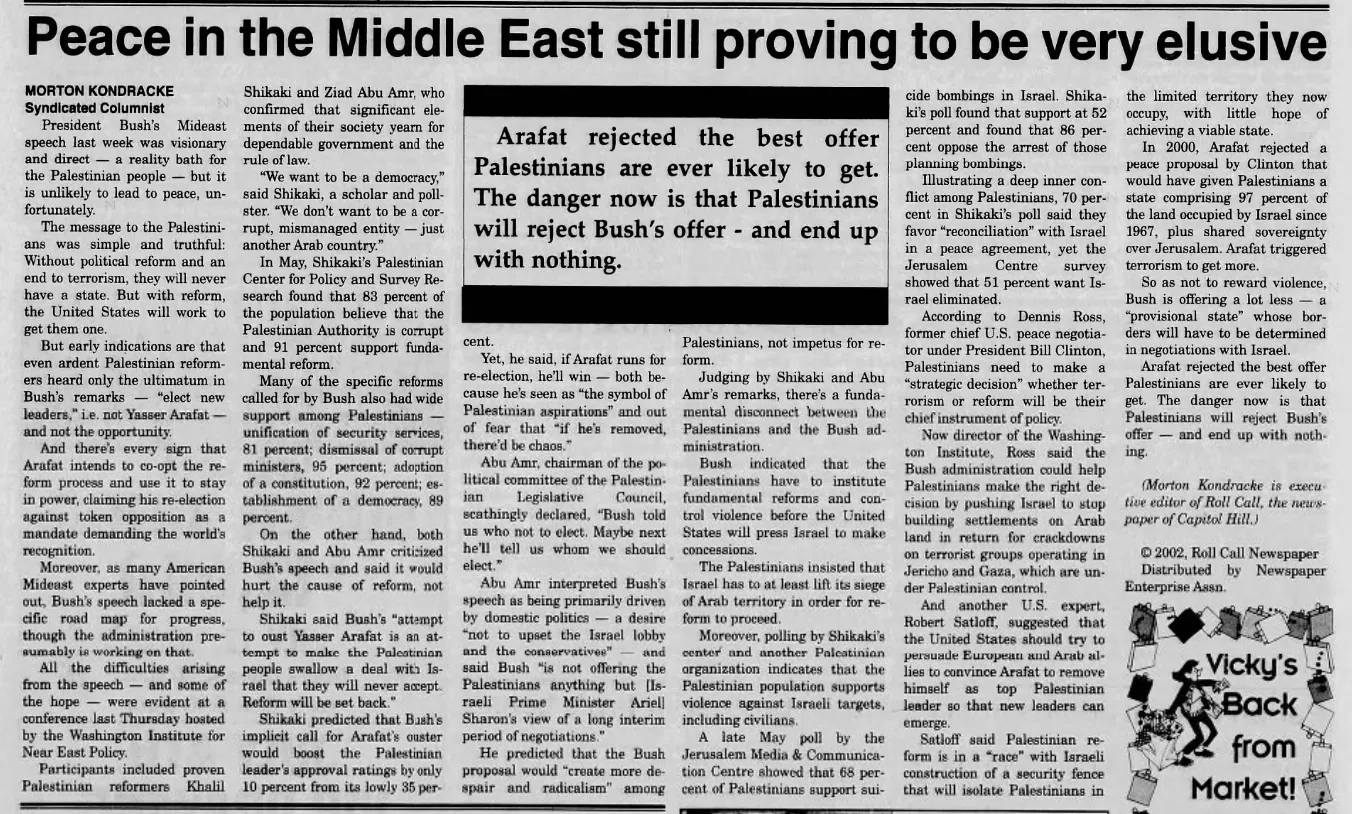
Transcribed from the clipping
“President Bush’s Mideast speech last week was visionary and direct — a reality bath for the Palestinian people — but it is unlikely to lead to peace, unfortunately. The message to the Palestinians was simple and truthful: Without political reform and an end to terrorism, they will never have a state.
But with reform, the United States will work to get them one.
But early indications are that even ardent Palestinian reformers heard only the ultimatum in Bush’s remarks — ‘elect new leaders,’ i.e. not Yasser Arafat — and not the opportunity… Participants included proven Palestinian reformers Khalil Shikaki and Ziad Abu Amr, who confirmed that significant elements of their society yearn for dependable government and the rule of law.
‘We want to be a democracy,’ said Shikaki, a scholar and pollster. ‘We don’t want to be a corrupt, mismanaged entity — just another Arab country.’
In May, Shikaki’s Palestinian Center for Policy and Survey Research found that 83 percent of the population believe that the Palestinian Authority is corrupt and 91 percent support fundamental reform.
Many of the specific reforms called for by Bush also had wide support among Palestinians — unification of security services, 81 percent; dismissal of corrupt ministers, 95 percent; adoption of a constitution, 92 percent; establishment of a democracy, 89 percent.
On the other hand, both Shikaki and Abu Amr criticized Bush’s speech and said it would hurt the cause of reform, not help it. Shikaki said Bush’s ‘attempt to oust Yasser Arafat is an attempt to make the Palestinian people swallow a deal with Israel that they will never accept. Reform will be set back.’
Shikaki predicted that Bush’s implicit call for Arafat’s ouster would boost the Palestinian leader’s approval ratings by only 10 percent from its lowly 35 percent.
Yet, he said, if Arafat runs for re-election, he’ll win — both because he’s seen as ‘the symbol of Palestinian aspirations’ and out of fear that ‘if he’s removed, there’d be chaos.’ Abu Amr, chairman of the political committee of the Palestinian Legislative Council, scathingly declared, ‘Bush told us who not to elect.
Maybe next he’ll tell us whom we should elect.’
Abu Amr interpreted Bush’s speech as being primarily driven by domestic politics — a desire ‘not to upset the Israel lobby and the conservatives’ — and said Bush ‘is not offering the Palestinians anything but [Israeli Prime Minister Ariel] Sharon’s view of a long interim period of negotiations.’
He predicted that the Bush proposal would ‘create more despair and radicalism’ among Palestinians, not impetus for reform… A late May poll by the Jerusalem Media & Communication Centre showed that 68 percent of Palestinians support suicide bombings in Israel.
Shikaki’s poll found that support at 52 percent and found that 86 percent oppose the arrest of those planning bombings.
Illustrating a deep inner conflict among Palestinians, 70 percent in Shikaki’s poll said they favor ‘reconciliation’ with Israel in a peace agreement, yet the Jerusalem Centre survey showed that 51 percent want Israel eliminated… In 2000, Arafat rejected a peace proposal by Clinton that would have given Palestinians a state comprising 97 percent of the land occupied by Israel since 1967, plus shared sovereignty over Jerusalem.
Arafat triggered terrorism to get more. So as not to reward violence, Bush is offering a lot less — a ‘provisional state’ whose borders will have to be determined in negotiations with Israel. Arafat rejected the best offer Palestinians are ever likely to get.
The danger now is that Palestinians will reject Bush’s offer — and end up with nothing.”
Context added by this archive
Two Palestinians quoted at length in an American column arguing against their leader: a pollster and a legislator, both named, both critical of the Palestinian Authority and of Bush. The polling figures point in opposite directions and the column prints both sets.
Cite this clipping
"Peace in the Middle East still proving to be very elusive," Southwest Daily News, 4 July 2002, p. 1. Covering Palestine archive, CP-2002-013. https://coveringpalestine.org/archive/cp-2002-013
This clipping is read closely in the section below
More from the 2000s
- Don’t forget it’s an Israeli occupationThe Daily Press · 1 January 2002
- Soothing Israel’s FearsThe New York Times · 7 January 2002
- Israel, in Reprisal for Killings, Razes Gaza Refugee HomesThe New York Times · 11 January 2002
- Refugees and Reparations in the MideastThe New York Times · 13 January 2002
- Israeli missiles strike naval baseThe Greenville News · 13 January 2002
- Friendship of Palestinian, architect defies oddsThe Bismarck Tribune · 17 January 2002
- All 516 clippings from the 2000s →
In these collections
Last updated 2 November 2026
This record is part of Covering Palestine, an archive of American newspaper clippings about Palestinians, 1724 to 2023. Researched and assembled by Maria Robles.
The clipping belongs to the newspaper that printed it, or to the news agency that supplied the copy. It is reproduced here for research, criticism and commentary. A city here is where the newspaper was published, not where the story came from, and on most records it was taken from the masthead.
Something wrong here, or something you know about this clipping? The archive is still being built and corrections are wanted: maria@rozumstudio.com, quoting CP-2002-013.
Read in: No partner for peace, and the answer printed beside it
Everything printed in 2002 · Printed on this day · See it in the archive reel · Full text of every clipping · Dataset