The New York Times · 10 April 2002
CP-2002-104
Life Under Siege
By Allegra Pacheco
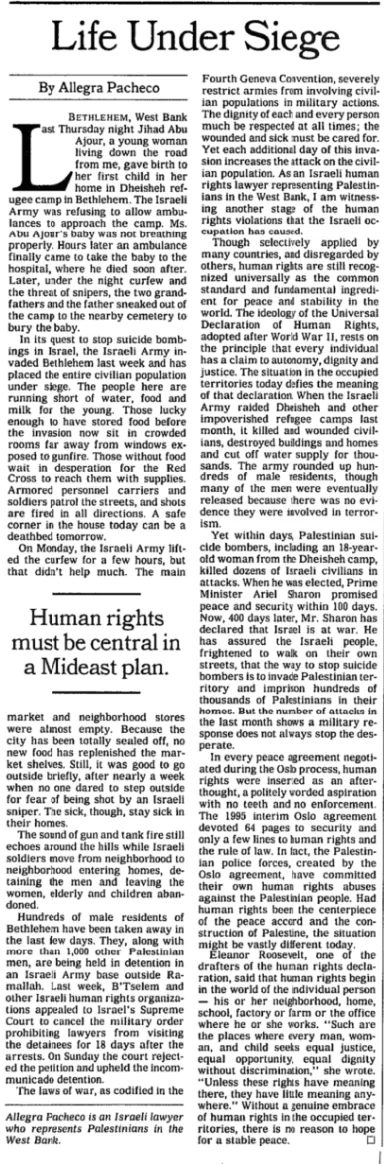
Shown from the top. The whole column — 3 times taller than it is wide — is in the enlargement.
Transcribed from the clipping
BETHLEHEM, West Bank Last Thursday night Jihad Abu Ajour, a young woman living down the road from me, gave birth to her first child in her home in Dheisheh refugee camp in Bethlehem. The Israeli Army was refusing to allow ambulances to approach the camp. Ms. Abu Ajour’s baby was not breathing properly.
Hours later an ambulance finally came to take the baby to the hospital, where he died soon after. Later, under the night curfew and the threat of snipers, the two grandfathers and the father sneaked out of the camp to the nearby cemetery to bury the baby.
In its quest to stop suicide bombings in Israel, the Israeli Army invaded Bethlehem last week and has placed the entire civilian population under siege. The people here are running short of water, food and milk for the young. Those lucky enough to have stored food before the invasion now sit in crowded rooms far away from windows exposed to gunfire.
Those without food wait in desperation for the Red Cross to reach them with supplies. Armored personnel carriers and soldiers patrol the streets, and shots are fired in all directions. A safe corner in the house today can be a deathbed tomorrow. On Monday, the Israeli Army lifted the curfew for a few hours, but that didn’t help much.
The main market and neighborhood stores were almost empty. Because the city has been totally sealed off, no new food has replenished the market shelves. Still, it was good to go outside briefly, after nearly a week when no one dared to step outside for fear of being shot by an Israeli sniper. The sick, though, stay sick in their homes.
The sound of gun and tank fire still echoes around the hills while Israeli soldiers move from neighborhood to neighborhood entering homes, detaining the men and leaving the women, elderly and children abandoned. Hundreds of male residents of Bethlehem have been taken away in the last few days.
They, along with more than 1,000 other Palestinian men, are being held in detention in an Israeli Army base outside Ramallah. Last week, B’Tselem and other Israeli human rights organizations appealed to Israel’s Supreme Court to cancel the military order prohibiting lawyers from visiting the detainees for 18 days after the arrests.
On Sunday the court rejected the petition and upheld the incommunicado detention. The laws of war, as codified in the Fourth Geneva Convention, severely restrict armies from involving civilian populations in military actions. The dignity of each and every person much be respected at all times; the wounded and sick must be cared for.
Yet each additional day of this invasion increases the attack on the civilian population. As an Israeli human rights lawyer representing Palestinians in the West Bank, I am witnessing another stage of the human rights violations that the Israeli occupation has caused.
How this transcription was made
Transcribed from the slide scan by a reader working off magnified crops, not by optical character recognition. NEITHER THE DATE NOR THE NEWSPAPER IS PRINTED ON THIS CLIPPING. There is no masthead, no folio, and the dateline gives the place only, “BETHLEHEM, West Bank”, with no day. Both the date and the paper recorded here come from the hand-typed slide label; the attribution is supported only by the page furniture being New York Times Op-Ed style. The article’s own references place it in the week of 8 to 12 April 2002: the Israeli Army invaded Bethlehem “last week” (2 April 2002), the curfew was lifted for a few hours “On Monday”, and Israel’s Supreme Court ruled “On Sunday”. This is a signed Op-Ed article by an Israeli human rights lawyer living in Bethlehem, not a news report. One printed error is kept as set: “The dignity of each and every person much be respected at all times”.
Cite this clipping
"Life Under Siege," The New York Times, 10 April 2002. Covering Palestine archive, CP-2002-104. https://coveringpalestine.org/archive/cp-2002-104
More from The New York Times
- The Maine Colony in PalestineThe New York Times · 12 November 1866
- Jewish Colonization in PalestineThe New York Times · 9 December 1883
- Jewish State in Palestine OpposedThe New York Times · 9 July 1897
- ZIONIST CONGRESS IN BASELThe New York Times · 31 August 1897
- ROME FEARS THE ZIONISTSThe New York Times · 12 September 1897
- PROGRESS OF ZIONISMThe New York Times · 16 December 1901
- 852 more from this paper in the full text →
More from the 2000s
- Don’t forget it’s an Israeli occupationThe Daily Press · 1 January 2002
- Soothing Israel’s FearsThe New York Times · 7 January 2002
- Israel, in Reprisal for Killings, Razes Gaza Refugee HomesThe New York Times · 11 January 2002
- Refugees and Reparations in the MideastThe New York Times · 13 January 2002
- Israeli missiles strike naval baseThe Greenville News · 13 January 2002
- Friendship of Palestinian, architect defies oddsThe Bismarck Tribune · 17 January 2002
- All 516 clippings from the 2000s →
Last updated 2 November 2026
This record is part of Covering Palestine, an archive of American newspaper clippings about Palestinians, 1724 to 2023. Researched and assembled by Maria Robles.
The clipping belongs to the newspaper that printed it, or to the news agency that supplied the copy. It is reproduced here for research, criticism and commentary. A city here is where the newspaper was published, not where the story came from, and on most records it was taken from the masthead.
Something wrong here, or something you know about this clipping? The archive is still being built and corrections are wanted: maria@rozumstudio.com, quoting CP-2002-104.
Everything printed in 2002 · Printed on this day · See it in the archive reel · Full text of every clipping · Dataset