The New York Times · 15 April 2002
CP-2002-105
Inside a Siege, Signs of Life and Loss
By TODD S. PURDUM
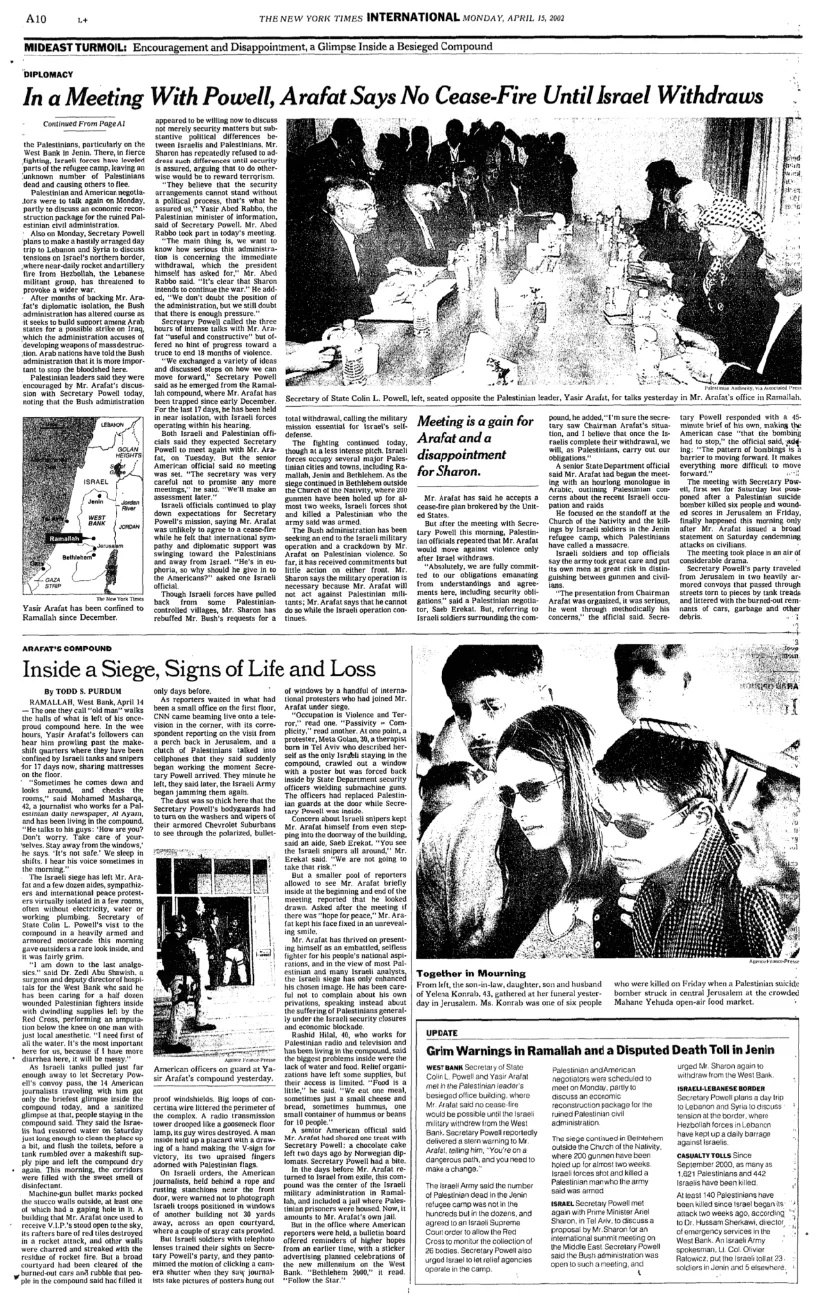
Transcribed from the clipping
RAMALLAH, West Bank, April 14 — The one they call “old man” walks the halls of what is left of his once-proud compound here. In the wee hours, Yasir Arafat’s followers can hear him prowling past the makeshift quarters where they have been confined by Israeli tanks and snipers for 17 days now, sharing mattresses on the floor.
“Sometimes he comes down and looks around, and checks the rooms,” said Mohamed Masharqa, 42, a journalist who works for a Palestinian daily newspaper, Al Ayam, and has been living in the compound. “He talks to his guys: ‘How are you? Don’t worry. Take care of yourselves. Stay away from the windows,’ he says.
‘It’s not safe.’ We sleep in shifts. I hear his voice sometimes in the morning.” The Israeli siege has left Mr. Arafat and a few dozen aides, sympathizers and international peace protesters virtually isolated in a few rooms, often without electricity, water or working plumbing. Secretary of State Colin L.
Powell’s visit to the compound in a heavily armed and armored motorcade this morning gave outsiders a rare look inside, and it was fairly grim. “I am down to the last analgesics,” said Dr.
Zedi Abu Shawish, a surgeon and deputy director of hospitals for the West Bank who said he has been caring for a half dozen wounded Palestinian fighters inside with dwindling supplies left by the Red Cross, performing an amputation below the knee on one man with just local anesthetic. “I need first of all the water.
It’s the most important here for us, because if I have more diarrhea here, it will be messy.” As Israeli tanks pulled just far enough away to let Secretary Powell’s convoy pass, the 14 American journalists traveling with him got only the briefest glimpse inside the compound today, and a sanitized glimpse at that, people staying in the compound said.
How this transcription was made
Transcribed from the slide scan by a reader working off magnified crops, not by optical character recognition. The date and the newspaper are both printed on the page: the page line across the top reads “THE NEW YORK TIMES INTERNATIONAL MONDAY, APRIL 15, 2002” with the folio A10 at left. 15 April 2002 was a Monday. Nothing about the date or the paper rests on the slide label. The scan is a whole page, not a single clipping: besides the article transcribed here it carries the jump of “In a Meeting With Powell, Arafat Says No Cease-Fire Until Israel Withdraws”, headed “Continued From Page A1”, whose opening is not in this deck.
Cite this clipping
"Inside a Siege, Signs of Life and Loss," The New York Times, 15 April 2002, p. A10. Covering Palestine archive, CP-2002-105. https://coveringpalestine.org/archive/cp-2002-105
More from The New York Times
- The Maine Colony in PalestineThe New York Times · 12 November 1866
- Jewish Colonization in PalestineThe New York Times · 9 December 1883
- Jewish State in Palestine OpposedThe New York Times · 9 July 1897
- ZIONIST CONGRESS IN BASELThe New York Times · 31 August 1897
- ROME FEARS THE ZIONISTSThe New York Times · 12 September 1897
- PROGRESS OF ZIONISMThe New York Times · 16 December 1901
- 852 more from this paper in the full text →
More from the 2000s
- Don’t forget it’s an Israeli occupationThe Daily Press · 1 January 2002
- Soothing Israel’s FearsThe New York Times · 7 January 2002
- Israel, in Reprisal for Killings, Razes Gaza Refugee HomesThe New York Times · 11 January 2002
- Refugees and Reparations in the MideastThe New York Times · 13 January 2002
- Israeli missiles strike naval baseThe Greenville News · 13 January 2002
- Friendship of Palestinian, architect defies oddsThe Bismarck Tribune · 17 January 2002
- All 516 clippings from the 2000s →
Last updated 2 November 2026
This record is part of Covering Palestine, an archive of American newspaper clippings about Palestinians, 1724 to 2023. Researched and assembled by Maria Robles.
The clipping belongs to the newspaper that printed it, or to the news agency that supplied the copy. It is reproduced here for research, criticism and commentary. A city here is where the newspaper was published, not where the story came from, and on most records it was taken from the masthead.
Something wrong here, or something you know about this clipping? The archive is still being built and corrections are wanted: maria@rozumstudio.com, quoting CP-2002-105.
Everything printed in 2002 · Printed on this day · See it in the archive reel · Full text of every clipping · Dataset