The New York Times · 1 August 2002
CP-2002-109
Drama as a DMZ in Israel
Arab and Jewish Actors Share the Stage as Partners in Provocative Works
By SAMUEL G. FREEDMAN
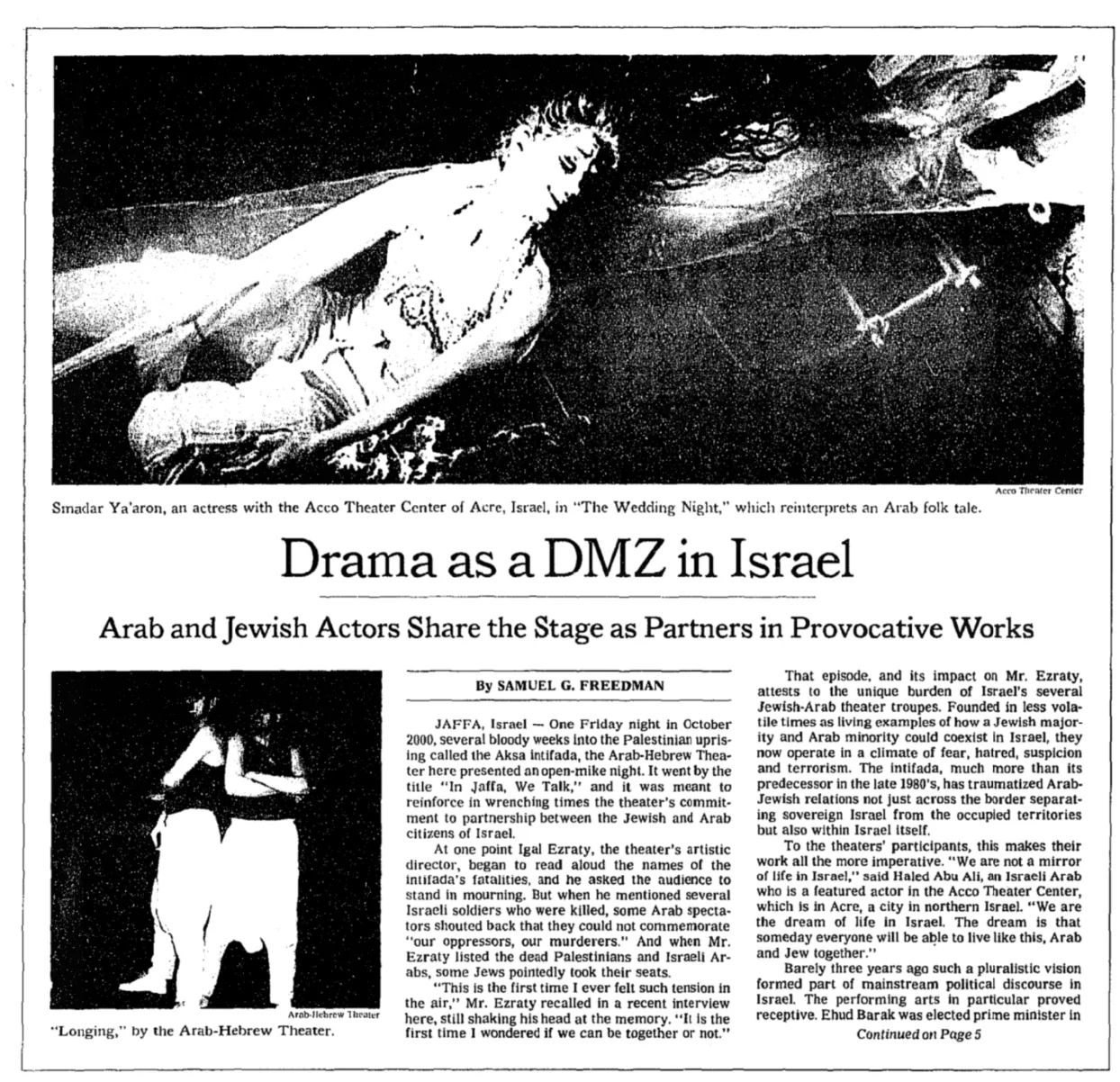
Transcribed from the clipping
JAFFA, Israel — One Friday night in October 2000, several bloody weeks into the Palestinian uprising called the Aksa intifada, the Arab-Hebrew Theater here presented an open-mike night.
It went by the title “In Jaffa, We Talk,” and it was meant to reinforce in wrenching times the theater’s commitment to partnership between the Jewish and Arab citizens of Israel. At one point Igal Ezraty, the theater’s artistic director, began to read aloud the names of the intifada’s fatalities, and he asked the audience to stand in mourning.
But when he mentioned several Israeli soldiers who were killed, some Arab spectators shouted back that they could not commemorate “our oppressors, our murderers.” And when Mr. Ezraty listed the dead Palestinians and Israeli Arabs, some Jews pointedly took their seats. “This is the first time I ever felt such tension in the air,” Mr.
Ezraty recalled in a recent interview here, still shaking his head at the memory. “It is the first time I wondered if we can be together or not.” That episode, and its impact on Mr. Ezraty, attests to the unique burden of Israel’s several Jewish-Arab theater troupes.
Founded in less volatile times as living examples of how a Jewish majority and Arab minority could coexist in Israel, they now operate in a climate of fear, hatred, suspicion and terrorism.
The intifada, much more than its predecessor in the late 1980’s, has traumatized Arab-Jewish relations not just across the border separating sovereign Israel from the occupied territories but also within Israel itself. To the theaters’ participants, this makes their work all the more imperative.
“We are not a mirror of life in Israel,” said Haled Abu Ali, an Israeli Arab who is a featured actor in the Acco Theater Center, which is in Acre, a city in northern Israel. “We are the dream of life in Israel. The dream is that someday everyone will be able to live like this, Arab and Jew together.”
Barely three years ago such a pluralistic vision formed part of mainstream political discourse in Israel. The performing arts in particular proved receptive. Ehud Barak was elected prime minister in
How this transcription was made
Transcribed from the slide scan by a reader working off magnified crops, not by optical character recognition. NO DATE IS PRINTED ON THIS CLIPPING: there is no masthead, no folio, and the dateline gives the place only, “JAFFA, Israel”, with no day. The date recorded here comes from the hand-typed slide label. The article’s own references — the Aksa intifada beginning in late 2000 and Ehud Barak’s May 1999 election described as barely three years past — place it in 2002 and so corroborate the year without fixing the day. The newspaper is likewise not named on the clipping; the attribution rests on the label and on the page’s typography. The two photographs are credited to the Acco Theater Center and the Arab-Hebrew Theater, not to the paper.
Cite this clipping
"Drama as a DMZ in Israel," The New York Times, 1 August 2002. Covering Palestine archive, CP-2002-109. https://coveringpalestine.org/archive/cp-2002-109
More from The New York Times
- The Maine Colony in PalestineThe New York Times · 12 November 1866
- Jewish Colonization in PalestineThe New York Times · 9 December 1883
- Jewish State in Palestine OpposedThe New York Times · 9 July 1897
- ZIONIST CONGRESS IN BASELThe New York Times · 31 August 1897
- ROME FEARS THE ZIONISTSThe New York Times · 12 September 1897
- PROGRESS OF ZIONISMThe New York Times · 16 December 1901
- 852 more from this paper in the full text →
More from the 2000s
- Don’t forget it’s an Israeli occupationThe Daily Press · 1 January 2002
- Soothing Israel’s FearsThe New York Times · 7 January 2002
- Israel, in Reprisal for Killings, Razes Gaza Refugee HomesThe New York Times · 11 January 2002
- Refugees and Reparations in the MideastThe New York Times · 13 January 2002
- Israeli missiles strike naval baseThe Greenville News · 13 January 2002
- Friendship of Palestinian, architect defies oddsThe Bismarck Tribune · 17 January 2002
- All 516 clippings from the 2000s →
Last updated 2 November 2026
This record is part of Covering Palestine, an archive of American newspaper clippings about Palestinians, 1724 to 2023. Researched and assembled by Maria Robles.
The clipping belongs to the newspaper that printed it, or to the news agency that supplied the copy. It is reproduced here for research, criticism and commentary. A city here is where the newspaper was published, not where the story came from, and on most records it was taken from the masthead.
Something wrong here, or something you know about this clipping? The archive is still being built and corrections are wanted: maria@rozumstudio.com, quoting CP-2002-109.
Everything printed in 2002 · Printed on this day · See it in the archive reel · Full text of every clipping · Dataset