The Retort · 22 January 2009
CP-2009-026
Israel & Palestine, The Aftermath
By Bailey Martin, Of The Retort Staff
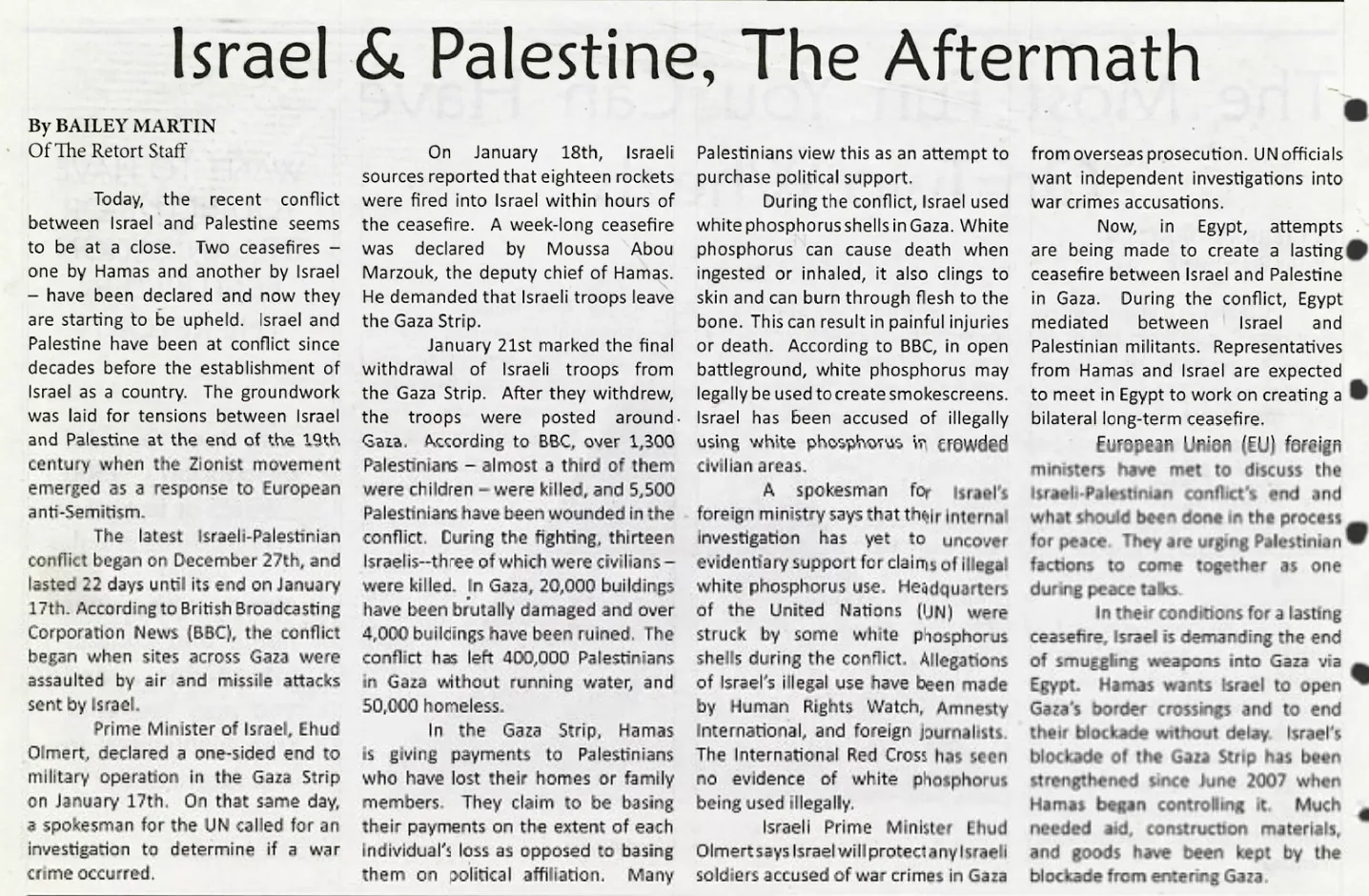
Transcribed from the clipping
“Today, the recent conflict between Israel and Palestine seems to be at a close. Two ceasefires — one by Hamas and another by Israel — have been declared and now they are starting to be upheld. Israel and Palestine have been at conflict since decades before the establishment of Israel as a country.
The groundwork was laid for tensions between Israel and Palestine at the end of the 19th century when the Zionist movement emerged as a response to European anti-Semitism. The latest Israeli-Palestinian conflict began on December 27th, and lasted 22 days until its end on January 17th.
According to British Broadcasting Corporation News (BBC), the conflict began when sites across Gaza were assaulted by air and missile attacks sent by Israel. Prime Minister of Israel, Ehud Olmert, declared a one-sided end to military operation in the Gaza Strip on January 17th.
On that same day, a spokesman for the UN called for an investigation to determine if a war crime occurred. On January 18th, Israeli sources reported that eighteen rockets were fired into Israel within hours of the ceasefire. A week-long ceasefire was declared by Moussa Abou Marzouk, the deputy chief of Hamas. He demanded that Israeli troops leave the Gaza Strip.
January 21st marked the final withdrawal of Israeli troops from the Gaza Strip. After they withdrew, the troops were posted around Gaza. According to BBC, over 1,300 Palestinians — almost a third of them were children — were killed, and 5,500 Palestinians have been wounded in the conflict.
During the fighting, thirteen Israelis — three of which were civilians — were killed. In Gaza, 20,000 buildings have been brutally damaged and over 4,000 buildings have been ruined. The conflict has left 400,000 Palestinians in Gaza without running water, and 50,000 homeless.
In the Gaza Strip, Hamas is giving payments to Palestinians who have lost their homes or family members. They claim to be basing their payments on the extent of each individual’s loss as opposed to basing them on political affiliation. Many Palestinians view this as an attempt to purchase political support.
During the conflict, Israel used white phosphorus shells in Gaza. White phosphorus can cause death when ingested or inhaled, it also clings to skin and can burn through flesh to the bone. This can result in painful injuries or death. According to BBC, in open battleground, white phosphorus may legally be used to create smokescreens.
Israel has been accused of illegally using white phosphorus in crowded civilian areas. A spokesman for Israel’s foreign ministry says that their internal investigation has yet to uncover evidentiary support for claims of illegal white phosphorus use. Headquarters of the United Nations (UN) were struck by some white phosphorus shells during the conflict.
Allegations of Israel’s illegal use have been made by Human Rights Watch, Amnesty International, and foreign journalists. The International Red Cross has seen no evidence of white phosphorus being used illegally. Israeli Prime Minister Ehud Olmert says Israel will protect any Israeli soldiers accused of war crimes in Gaza from overseas prosecution.
UN officials want independent investigations into war crimes accusations. Now, in Egypt, attempts are being made to create a lasting ceasefire between Israel and Palestine in Gaza. During the conflict, Egypt mediated between Israel and Palestinian militants. Representatives from Hamas and Israel are expected to meet in Egypt to work on creating a bilateral long-term ceasefire.
European Union (EU) foreign ministers have met to discuss the Israeli-Palestinian conflict’s end and what should been done in the process for peace. They are urging Palestinian factions to come together as one during peace talks. In their conditions for a lasting ceasefire, Israel is demanding the end of smuggling weapons into Gaza via Egypt.
Hamas wants Israel to open Gaza’s border crossings and to end their blockade without delay. Israel’s blockade of the Gaza Strip has been strengthened since June 2007 when Hamas began controlling it. Much needed aid, construction materials, and goods have been kept by the blockade from entering Gaza.”
Context added by this archive
A student paper working through the January 2009 war on Gaza with the BBC as its source and the numbers kept in the copy: 1,300 Palestinians killed, almost a third of them children, 5,500 wounded, 13 Israelis killed, 400,000 without running water, 50,000 homeless. White phosphorus is named, explained and attributed, and the last paragraph is about the blockade.
A correction
{'note': 'Captioned 20 January 2009. The copy reports the final Israeli withdrawal of 21 January, so it was printed later than that date and the day is marked estimated.'}
Cite this item
"Israel & Palestine, The Aftermath," The Retort, 22 January 2009. Covering Palestine archive, CP-2009-026. https://coveringpalestine.org/archive/cp-2009-026
More from the 2000s
- Stop genocide in PalestineArgus Leader · 1 January 2009
- Re: Stop genocide in PalestineArgus Leader · 3 January 2009
- Israeli ground operation cuts Gaza Strip in twoThe Philadelphia Inquirer · 5 January 2009
- Diplomats converge on Israel in push for truce as Gaza death toll mountsFort McMurray Today · 5 January 2009
- Israeli troops and tanks slice deep into GazaDayton Daily News · 5 January 2009
- Palestinians carry the bodies of three toddlers Ahmed, Mohamed, and Issa Samouni, killed in an Israeli strike, during their funeral in Gaza CityFort McMurray Today · 5 January 2009
- All 137 clippings from the 2000s →
This record is part of Covering Palestine, an archive of American and Anglophone newspaper clippings about Palestinians, 1799 to 2023. Researched and assembled by Maria Robles.
The clipping belongs to the newspaper that printed it, or to the news agency that supplied the copy. It is reproduced here for research, criticism and commentary. The city is derived from the masthead, not read off the clipping.
Something wrong here, or something you know about this clipping? The archive is still being built and corrections are wanted: maria@rozumstudio.com, quoting CP-2009-026.
See it in the archive reel · Full text of every clipping · Dataset