St. Louis Post-Dispatch · St. Louis, MO (per the printed folio) · 18 October 2015
CP-2015-019
Black Lives Matter backers join forces with Palestinians
Activists talk about common oppression of blacks in the United States and Arabs by Israelis
BY ISHAAN THAROOR • Washington Post
Transcribed from the clipping
A video published on YouTube on Wednesday features dozens of Black Lives Matter and Palestinian activists delivering a joint message: "When I see them, I see us." These include prominent African-American celebrities and thinkers, such as Danny Glover, Lauryn Hill, Alice Walker, Angela Davis and Cornel West. They are accompanied by well-known Palestinian activists and writers.
Over the course of a couple of minutes, they unite their perceived struggles through photos, slogans and a shared story of state oppression. They talk of black youths killed by police and Palestinian children bombed by Israeli warplanes. "When I see them, I see us," the narrative goes.
"Harassed, beaten, tortured, dehumanized, stopped and frisked, searched at checkpoints." It may seem a bit of a stretch to equate the grievances of Palestinians with questions of institutionalized racism in the United States.
The legacy of African slavery and systemic racism in the United States seems a world away from the ongoing Israeli occupation of the Palestinian territories.
But Noura Erakat, an assistant professor at George Mason University and one of the organizers of the video project, argues that although these experiences are separated by distance and history, underlying themes bring them together.
"Here were two groups of people dealing with completely different historical trajectories, but both which resulted in a process of dehumanization that criminalized them and that subject their bodies as expendable," Erakat told Al Jazeera America.
"Not only were their lives more vulnerable and disposable, but that even in their death, they were blamed for their own death." The video project emerged last year in the aftermath of the Ferguson protests in the United States and the Gaza war in the Middle East, where more than 2,100 Palestinians died, the majority of whom were civilians.
The protests in Ferguson began in August 2014 after teenager Michael Brown was fatally shot by then-Ferguson police Officer Darren Wilson. Activists on either side of the world began connecting. As the Ferguson protests intensified, Palestinians reached out to those on the streets of the St. Louis suburb.
Some even offered advice over how to deal with tear gas (in both instances, the canisters fired by Israeli and American police were U.S.-made). In April, Ethiopian Israelis protested police brutality in Jerusalem by reportedly chanting "Baltimore is here!"
How this transcription was made
Date confirmed on the page (eva-folio). Adjudicated corrected against the printed page: Folio rule across the top of the page: left end "10.18.2015 • SUNDAY • M 2", centre section flag "WORLD", right end "ST. LOUIS POST-DISPATCH • A7". Both ends crisp. 18 October 2015 was a Sunday..
Context added by this archive
MARIA'S NOTE on this slide reads: "this is a good one to add to our pattern section about Black american and palestinian solidarity." What the clipping actually supports: a mainstream American daily, in its World section, running a Washington Post story that takes the solidarity seriously rather than treating it as a curiosity.
It prints the shared-struggle argument from a named Palestinian scholar, reports the concrete reciprocity (Palestinians sending tear-gas advice to Ferguson), and notes that the canisters fired in Ferguson and in Palestine were both U.S.-made.
It also records Ethiopian Israelis in Jerusalem chanting "Baltimore is here!" The paper does hedge once — "It may seem a bit of a stretch" — before letting Erakat answer the hedge. The Post-Dispatch is the Ferguson hometown paper, which is why this ran on A7 there.
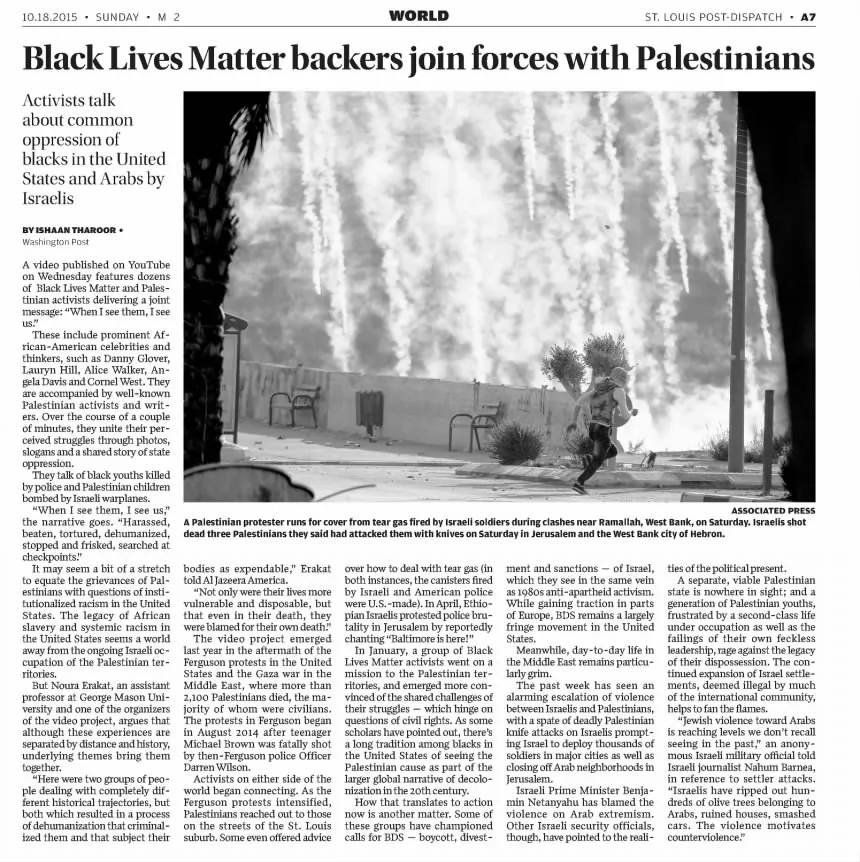
Photo caption: "A Palestinian protester runs for cover from tear gas fired by Israeli soldiers during clashes near Ramallah, West Bank, on Saturday. Israelis shot dead three Palestinians they said had attacked them with knives on Saturday in Jerusalem and the West Bank city of Hebron." Credit: ASSOCIATED PRESS.
Also quoted at the end of the story: an anonymous Israeli military official quoting journalist Nahum Barnea — "Israelis have ripped out hundreds of olive trees belonging to Arabs, ruined houses, smashed cars. The violence motivates counterviolence."
Cite this clipping
"Black Lives Matter backers join forces with Palestinians," St. Louis Post-Dispatch, 18 October 2015, p. A7 (per the printed folio). Covering Palestine archive, CP-2015-019. https://coveringpalestine.org/archive/cp-2015-019
More from St. Louis Post-Dispatch
- U.N. Starts On-the-Spot Inquiry In Israeli Shooting of 30 ArabsSt. Louis Post-Dispatch · 18 November 1956
- U.S. Nurse Tells Israelis Of Sabra Camp MassacreSt. Louis Post-Dispatch · 2 November 1982
- Rioting, gunfire in Gaza, West Bank leave 12 deadSt. Louis Post-Dispatch · 1 October 2000
- Group sees possible war crimes but no massacreSt. Louis Post-Dispatch · 3 May 2002
- Better educated women make their own choicesSt. Louis Post-Dispatch · 21 January 2007
- U.S. Joint Chiefs chairman is in Israel for meetingsSt. Louis Post-Dispatch · 18 October 2015
- 1 more from this paper in the full text →
More from the 2010s
- Palestinian move to court is a mistakeThe Daily Times · 8 January 2015
- Palestinian Official Says Fisherman Shot Dead By Israeli NavyPonca City Daily Courier · 8 March 2015
- Winds of war still blowing through Gaza's rubbleTri-City Herald · 10 March 2015
- A long way to go to make a differenceThe Press · 1 May 2015
- Push on to boot Israel in soccerLos Angeles Times · 24 May 2015
- Hamas entrenched; frustration growsDaily American Republic · 3 July 2015
- All 321 clippings from the 2010s →
Last updated 2 November 2026
This record is part of Covering Palestine, an archive of American newspaper clippings about Palestinians, 1724 to 2023. Researched and assembled by Maria Robles.
The clipping belongs to the newspaper that printed it, or to the news agency that supplied the copy. It is reproduced here for research, criticism and commentary. A city here is where the newspaper was published, not where the story came from, and on most records it was taken from the masthead.
Something wrong here, or something you know about this clipping? The archive is still being built and corrections are wanted: maria@rozumstudio.com, quoting CP-2015-019.
Everything printed in 2015 · Printed on this day · See it in the archive reel · Full text of every clipping · Dataset