The Cincinnati Enquirer · Cincinnati, Ohio · 20 March 1910
CP-1910-001
Customs as in the Time of Christ
Life and religion of the fellaheen — or peasants — of Palestine who represent the aboriginal inhabitants of the Holy Land
Evangeline Ben-Oliel
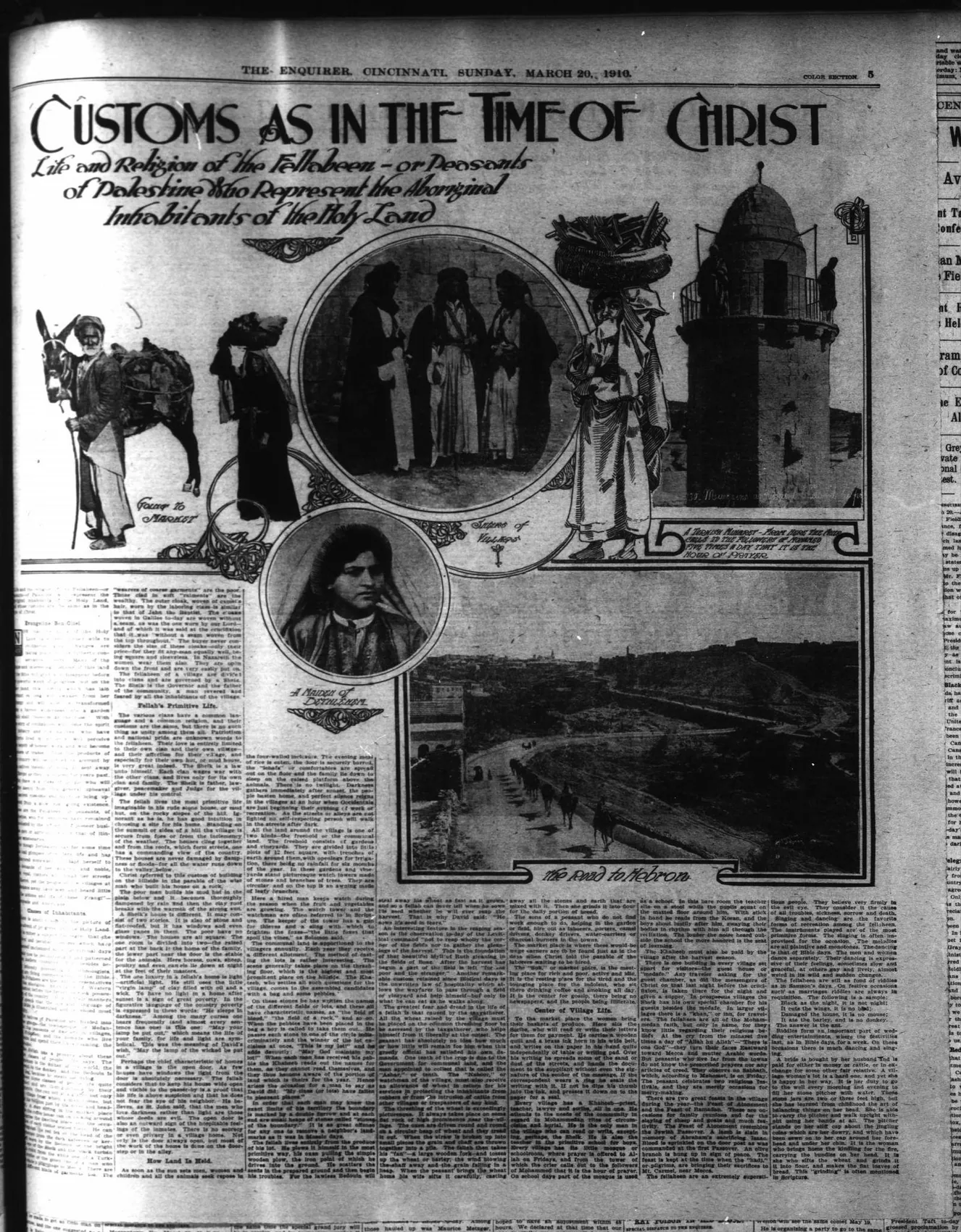
Transcribed from the clipping
On land: “All the land around the village is one of two kinds—the freehold or the communal land.” “The communal land is apportioned to the villagers annually. Each year they receive a different allotment.” On government: “The fellaheen of a village are divided into clans and are governed by a Sheik. The Sheik is the Governor and the father of the community, a man revered and feared by all the inhabitants of the village.” On hospitality: “There is one building in every village set apart for visitors—the guest house, or ‘medafe’.”
Context added by this archive
The word in the subheading is aboriginal. By the same writer as the Oregonian page the year before, and this time she sets out the whole apparatus of a society: who owns the land, how it is reallocated, who governs, where a stranger sleeps.
Cite this item
"Customs as in the Time of Christ," The Cincinnati Enquirer, 20 March 1910. Covering Palestine archive, CP-1910-001. https://coveringpalestine.org/archive/cp-1910-001
Elsewhere in the archive
- ZIONISTS IN CONVENTIONThe New York Times · 4 July 1910 · the same year
This record is part of Covering Palestine, an archive of American and Anglophone newspaper clippings about Palestinians, 1812 to 2022. Researched and assembled by Maria Robles.
The clipping belongs to the newspaper that printed it, or to the wire service that supplied the copy. It is reproduced here for research, criticism and commentary. The city is derived from the masthead, not read off the clipping.
Something wrong here, or something you know about this clipping? The archive is still being built and corrections are wanted: maria@rozumstudio.com, quoting CP-1910-001.
See it in the archive reel · Full text of every clipping · Dataset