Wisconsin Jewish Chronicle · Milwaukee, Wisconsin · 24 June 1927
CP-1927-026
Bad Times in Palestine
Crisis in Palestine Calls for Concerted Action of Palestine Government and Jewish People Throughout World · A Letter from Palestine
S. Schwartz
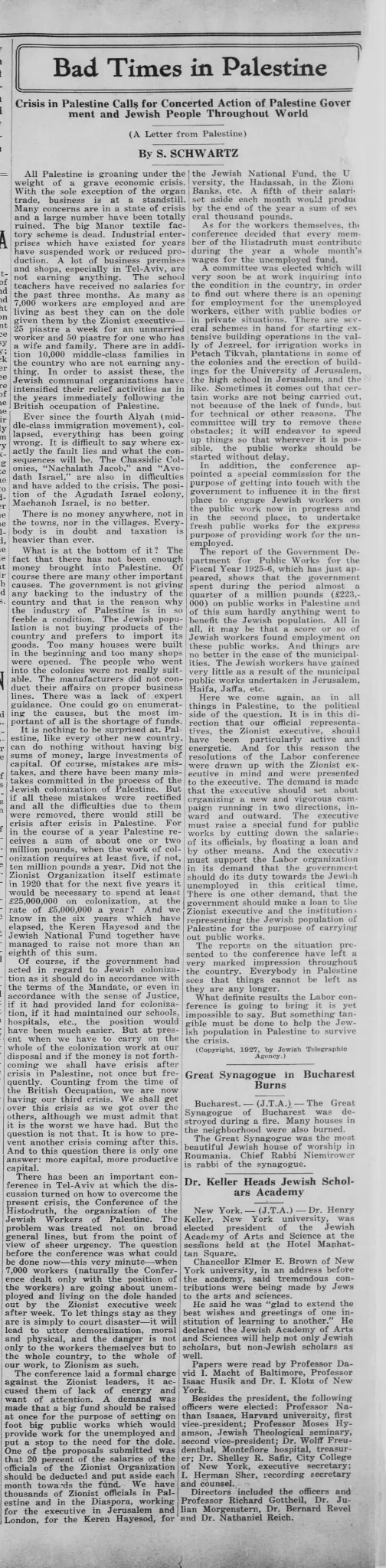
Shown from the top. The whole column — 4.1 times taller than it is wide — is in the enlargement.
Transcribed from the clipping
“All Palestine is groaning under the weight of a grave economic crisis. With the sole exception of the organ trade, business is at a standstill. Many concerns are in a state of crisis and a large number have been totally ruined.
The big Manor textile factory scheme is dead. Industrial enterprises which have existed for years have suspended work or reduced production. A lot of business premises and shops, especially in Tel-Aviv, are not earning anything. The school teachers have received no salaries for the past three months.
As many as 7,000 workers are employed and are living as best they can on the dole given them by the Zionist executive — 25 piastre a week for an unmarried worker and 50 piastre for one who has a wife and family.
There are in addition 10,000 middle-class families in the country who are not earning anything. Ever since the fourth Aliyah (middle-class immigration movement), collapsed, everything has been going wrong… There is no money anywhere, not in the towns, nor in the villages. Everybody is in doubt and taxation is heavier than ever. What is at the bottom of it?
The fact that there has not been enough money brought into Palestine… The Jewish population is not buying products of the country and prefers to import its goods. Too many houses were built in the beginning and too many shops were opened.
The people who went into the colonies were not really suitable.… In the course of a year Palestine receives a sum of about one or two million pounds, when the work of colonization requires at least five, if not, ten million pounds a year.
Did not the Zionist Organization itself estimate in 1920 that for the next five years it would be necessary to spend at least £25,000,000 on colonization, at the rate of £5,000,000 a year?
And we know in the six years which have elapsed, the Keren Hayesod and the Jewish National Fund together have managed to raise not more than an eighth of this sum.… Counting from the time of the British Occupation, we are now having our third crisis.
We shall get over this crisis as we got over the others, although we must admit that it is the worst we have had… One of the proposals submitted was that 20 percent of the salaries of the officials of the Zionist Organization should be deducted and put aside each month towards the fund… The report of the Government Department for Public Works for the Fiscal Year 1925-6, which has just appeared, shows that the government spent during the period almost a quarter of a million pounds (£223,000) on public works in Palestine and of this sum hardly anything went to benefit the Jewish population.
All in all, it may be that a score or so of Jewish workers found employment on these public works. And things are no better in the case of the municipalities. The Jewish workers have gained very little as a result of the municipal public works undertaken in Jerusalem, Haifa, Jaffa, etc.”
Context added by this archive
A letter from Palestine, printed in the same paper and the same year as the Balfour anniversary tributes and the Ruppin address, and it reads like a different country.
Teachers three months unpaid, seven thousand workers on a dole of twenty-five piastres a week, ten thousand middle-class families earning nothing, no money in the towns or the villages, and the writer counting it as the third crisis since the British arrived.
The figure at the end is the useful one: of £223,000 the government spent on public works in 1925-6, the writer complains that hardly any of it reached Jewish workers — which is, from an unfriendly witness, a record of where the mandate’s public money actually went.
Cite this clipping
"Bad Times in Palestine," Wisconsin Jewish Chronicle, 24 June 1927, p. 1. Covering Palestine archive, CP-1927-026. https://coveringpalestine.org/archive/cp-1927-026
More from Wisconsin Jewish Chronicle
- Peace in Palestine When Balfour Party ArrivesWisconsin Jewish Chronicle · 27 March 1925
- House of Lords Hears Figures on Cultivatable Land In PalestineWisconsin Jewish Chronicle · 29 May 1925
- A. L. Saltzstein Tells Story Of Trip To PalestineWisconsin Jewish Chronicle · 26 June 1925
- 88 Jews Left Palestine in MayWisconsin Jewish Chronicle · 7 August 1925
- The Evil Eye in PalestineWisconsin Jewish Chronicle · 18 September 1925
- Palestine Arab Executive Makes Issue of Haifa Court SentenceWisconsin Jewish Chronicle · 26 February 1926
- 27 more from this paper in the full text →
More from the 1920s
- League Commission Inquires Into Phases of Palestine DevelopmentWisconsin Jewish Chronicle · 7 January 1927
- Palestine Arabs Friendly To JewThe Birmingham News · 17 January 1927
- Glory Of Ancient Palestine May Be Restored By JewsThe News Journal · 13 March 1927
- Bishop Dunn Denies Modernization of Palestine by Jews Reduces Sanctity of Holy LandBuffalo Jewish Review · 29 April 1927
- World Zionist Org. Seeks Palestine Economic FactsWisconsin Jewish Chronicle · 20 May 1927
- Arabs In Palestine Protest Zion PolicySt. Louis Globe-Democrat · 25 May 1927
- All 120 clippings from the 1920s →
In these collections
Last updated 17 November 2026
This record is part of Covering Palestine, an archive of American newspaper clippings about Palestinians, 1724 to 2023. Researched and assembled by Maria Robles.
The clipping belongs to the newspaper that printed it, or to the news agency that supplied the copy. It is reproduced here for research, criticism and commentary. A city here is where the newspaper was published, not where the story came from, and on most records it was taken from the masthead.
Something wrong here, or something you know about this clipping? The archive is still being built and corrections are wanted: maria@rozumstudio.com, quoting CP-1927-026.
Everything printed in 1927 · Printed on this day · See it in the archive reel · Full text of every clipping · Dataset