The New York Times · New York, New York · 5 November 1961
CP-1961-010
Israel’s Nomads
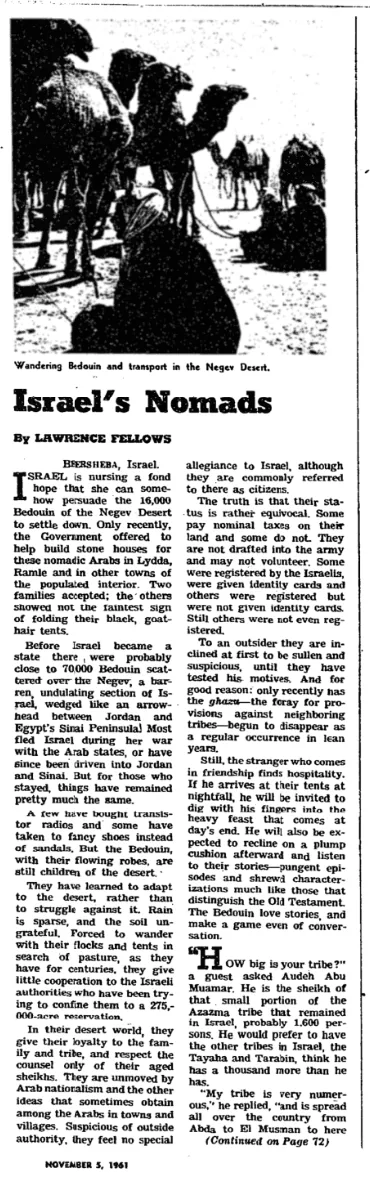
Shown from the top. The whole column — 3.2 times taller than it is wide — is in the enlargement.
Transcribed from the clipping
BEERSHEBA, Israel. ISRAEL is nursing a fond hope that she can somehow persuade the 16,000 Bedouin of the Negev Desert to settle down. Only recently, the Government offered to help build stone houses for these nomadic Arabs in Lydda, Ramle and in other towns of the populated interior.
Two families accepted; the others showed not the faintest sign of folding their black, goat-hair tents. Before Israel became a state there were probably close to 70,000 Bedouin scattered over the Negev, a barren, undulating section of Israel, wedged like an arrowhead between Jordan and Egypt’s Sinai Peninsula.
Most fled Israel during her war with the Arab states, or have since been driven into Jordan and Sinai. But for those who stayed, things have remained pretty much the same. A few have bought transistor radios and some have taken to fancy shoes instead of sandals. But the Bedouin, with their flowing robes, are still children of the desert.
They have learned to adapt to the desert, rather than to struggle against it. Rain is sparse, and the soil ungrateful. Forced to wander with their flocks and tents in search of pasture, as they have for centuries, they give little cooperation to the Israeli authorities who have been trying to confine them to a 275,000-acre reservation.
… (Continued from Page 69) in Wadi Shegheb, which is very near Beersheba.” “How long would it take to walk to Beersheba from here?” “About the time to smoke two cigarettes.” The Bedouin measure many things in cigarettes, even the height of the scraggly barley, wheat and durra they plant in the spring and fall.
The men do the plowing, for the plow is pulled by camel and no woman handles this noble animal. Anyway, the women already are burdened with drawing water and almost all other routine labor. DESPITE their wanderings the Bedouin now plant about 10,000 acres.
But when the sowing is done they feel freed from any further obligation to the soil and return happily to their flocks and the unending search for pasture. Packing everything, to the last battered cooking pot, they follow the ancient routes the patriarchs took—southward into Sinai, and northward into Judaea and Samaria, returning, finally, in time for the harvest.
Their social culture is deep and their sense of humor is nothing short of magnificent: a group of Bedouin, having noticed that the small water line into the Negev is extended only in election years, has just petitioned the Government to hold elections every year. While the Bedouin stick as much as they can to their nomadic ways, they have more trouble with each passing year.
For one thing, the Jewish settlements in Judaea and Samaria do not exactly welcome these wanderers to their new fields and orchards. For another, part of old Judaea is now Jordanian territory, and the Israeli authorities are no happier about the traffic into Jordan than they are about the traffic into Sinai.
FLOUR, sugar and kerosene flow out of Israel with the Bedouin, and animals, playing cards, demitasse sets and sundry other items are brought back. Families are split and reunited, wives are bought and sold—and the Government just can’t keep up with it all. The Israeli Army says frankly it is unable to stop the crossings.
However, Israel has not given up its desire to see its Bedouin settled and it is now working on a long-range program to entice them into five or six centers in the Negev where they can be watched more easily. Eventually, water will be drawn, roads laid, schools and clinics built. Those tribesmen wishing to build houses anywhere else will be forbidden to do so.
Perhaps the Bedouin will move their tents closer to the amenities. Perhaps, in time, they will live in houses of stone. The desert has taught them not to struggle against their environment. The Israeli Government is counting on this.
How this transcription was made
Read from the scan by a machine looking at the image of the page, not by optical character recognition and not by a person. The clipping carries no masthead or date line, so its date and newspaper rest on the record it arrived with, not on anything visible in the scan. The other part of this article was added on 2 November 2026 from a second clipping (m002_2.png).
Context added by this archive
Date check: DATE CONFIRMED ON THE PAGE. A folio line at the foot of the clipping reads “NOVEMBER 5, 1961”, which matches the slide-label date of 1961-11-05 exactly.
No paper name appears anywhere on the scan; the page furniture (a magazine folio date with no running head, a drop-cap opening and “Continued on Page 72”) is that of a Sunday magazine section.
Cite this clipping
"Israel’s Nomads," The New York Times, 5 November 1961. Covering Palestine archive, CP-1961-010. https://coveringpalestine.org/archive/cp-1961-010
More from The New York Times
- The Maine Colony in PalestineThe New York Times · 12 November 1866
- Jewish Colonization in PalestineThe New York Times · 9 December 1883
- Jewish State in Palestine OpposedThe New York Times · 9 July 1897
- ZIONIST CONGRESS IN BASELThe New York Times · 31 August 1897
- ROME FEARS THE ZIONISTSThe New York Times · 12 September 1897
- PROGRESS OF ZIONISMThe New York Times · 16 December 1901
- 852 more from this paper in the full text →
More from the 1960s
- Israelis Kill 2 BedouinThe New York Times · 2 February 1961
- Cairo Scores Johnson PlanThe New York Times · 14 March 1961
- Eichmann Judge Showed Independence In Arab CaseCourier-Journal · 9 April 1961
- U.S. Seeks to Widen Palestine DebateThe New York Times · 13 April 1961
- ISRAEL DROPS PLAN TO MOVE BEDOUINSThe New York Times · 30 April 1961
- Arabs Get Kennedy Palestine MessageThe Olympian · 23 May 1961
- All 227 clippings from the 1960s →
Last updated 2 November 2026
This record is part of Covering Palestine, an archive of American newspaper clippings about Palestinians, 1724 to 2023. Researched and assembled by Maria Robles.
The clipping belongs to the newspaper that printed it, or to the news agency that supplied the copy. It is reproduced here for research, criticism and commentary. A city here is where the newspaper was published, not where the story came from, and on most records it was taken from the masthead.
Something wrong here, or something you know about this clipping? The archive is still being built and corrections are wanted: maria@rozumstudio.com, quoting CP-1961-010.
Everything printed in 1961 · Printed on this day · See it in the archive reel · Full text of every clipping · Dataset