The New York Times · 25 July 1972
CP-1972-027
Israel Intensifying Settlement of Seized Territories
By PETER GROSE
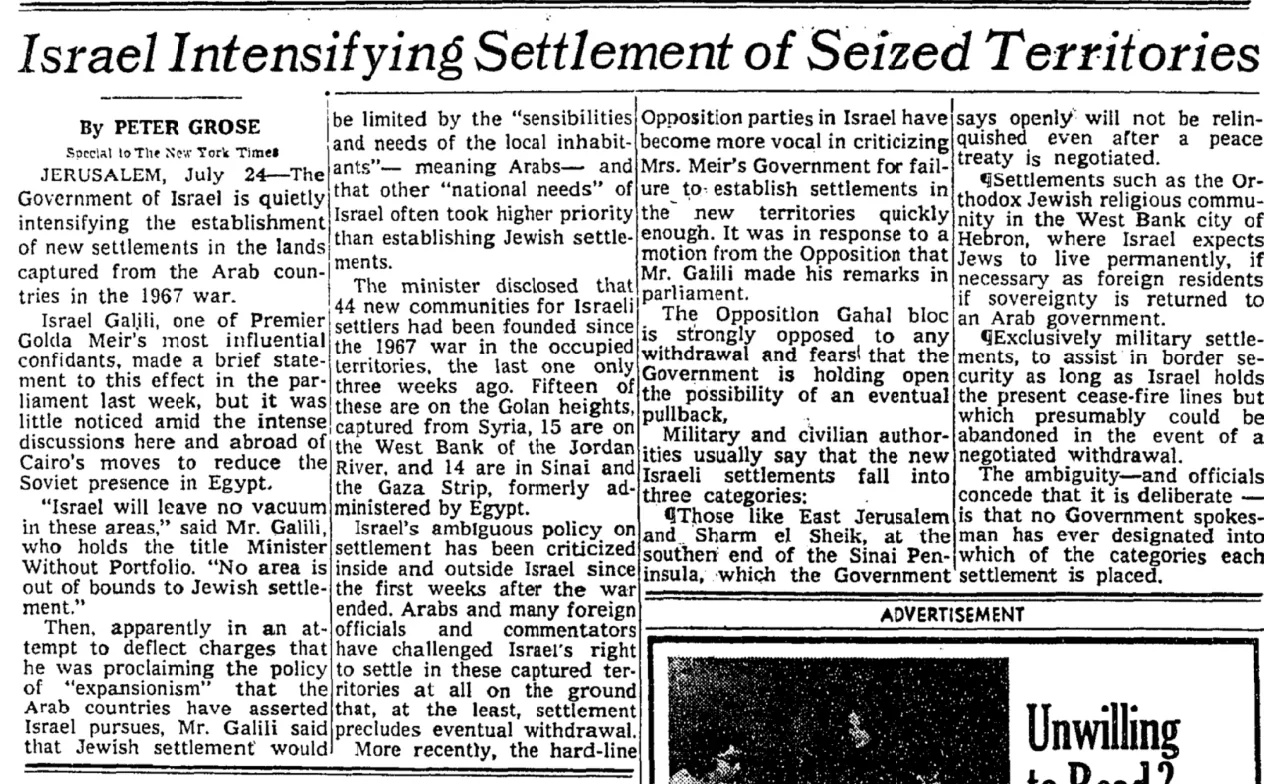
Transcribed from the clipping
JERUSALEM, July 24—The Government of Israel is quietly intensifying the establishment of new settlements in the lands captured from the Arab countries in the 1967 war.
Israel Galili, one of Premier Golda Meir’s most influential confidants, made a brief statement to this effect in the parliament last week, but it was little noticed amid the intense discussions here and abroad of Cairo’s moves to reduce the Soviet presence in Egypt. “Israel will leave no vacuum in these areas,” said Mr.
Galili, who holds the title Minister Without Portfolio. “No area is out of bounds to Jewish settlement.” Then, apparently in an attempt to deflect charges that he was proclaiming the policy of “expansionism” that the Arab countries have asserted Israel pursues, Mr.
Galili said that Jewish settlement would be limited by the “sensibilities and needs of the local inhabitants”— meaning Arabs— and that other “national needs” of Israel often took higher priority than establishing Jewish settlements.
The minister disclosed that 44 new communities for Israeli settlers had been founded since the 1967 war in the occupied territories, the last one only three weeks ago. Fifteen of these are on the Golan heights, captured from Syria, 15 are on the West Bank of the Jordan River, and 14 are in Sinai and the Gaza Strip, formerly administered by Egypt.
Israel’s ambiguous policy on settlement has been criticized inside and outside Israel since the first weeks after the war ended. Arabs and many foreign officials and commentators have challenged Israel’s right to settle in these captured territories at all on the ground that, at the least, settlement precludes eventual withdrawal.
More recently, the hard-line Opposition parties in Israel have become more vocal in criticizing Mrs. Meir’s Government for failure to establish settlements in the new territories quickly enough. It was in response to a motion from the Opposition that Mr. Galili made his remarks in parliament.
The Opposition Gahal bloc is strongly opposed to any withdrawal and fears that the Government is holding open the possibility of an eventual pullback.
Military and civilian authorities usually say that the new Israeli settlements fall into three categories: Those like East Jerusalem and Sharm el Sheik, at the southern end of the Sinai Peninsula, which the Government says openly will not be relinquished even after a peace treaty is negotiated.
Settlements such as the Orthodox Jewish religious community in the West Bank city of Hebron, where Israel expects Jews to live permanently, if necessary as foreign residents if sovereignty is returned to an Arab government.
Exclusively military settlements, to assist in border security as long as Israel holds the present cease-fire lines but which presumably could be abandoned in the event of a negotiated withdrawal. The ambiguity—and officials concede that it is deliberate — is that no Government spokesman has ever designated into which of the categories each settlement is placed.
Cite this clipping
"Israel Intensifying Settlement of Seized Territories," The New York Times, 25 July 1972. Covering Palestine archive, CP-1972-027. https://coveringpalestine.org/archive/cp-1972-027
More from The New York Times
- The Maine Colony in PalestineThe New York Times · 12 November 1866
- Jewish Colonization in PalestineThe New York Times · 9 December 1883
- Jewish State in Palestine OpposedThe New York Times · 9 July 1897
- ZIONIST CONGRESS IN BASELThe New York Times · 31 August 1897
- ROME FEARS THE ZIONISTSThe New York Times · 12 September 1897
- PROGRESS OF ZIONISMThe New York Times · 16 December 1901
- 852 more from this paper in the full text →
More from the 1970s
- Beirut Moves Against Guerrillas To Quell Israeli RaidsThe Times · 29 February 1972
- Giant Step for Arab WomenThe New York Times · 29 February 1972
- Israeli Raid Forces Beirut To Face Up To Guerrilla ProblemColumbia Record · 3 March 1972
- Israel to Discipline Officers In Bedouins’ DisplacementThe New York Times · 27 March 1972
- Artist Seeking Mideast TogethernessThe Daily Progress · 3 May 1972
- Israel cites POW torture; Palestinians ask statehoodThe Morning Call · 10 June 1972
- All 338 clippings from the 1970s →
Last updated 2 November 2026
This record is part of Covering Palestine, an archive of American newspaper clippings about Palestinians, 1724 to 2023. Researched and assembled by Maria Robles.
The clipping belongs to the newspaper that printed it, or to the news agency that supplied the copy. It is reproduced here for research, criticism and commentary. A city here is where the newspaper was published, not where the story came from, and on most records it was taken from the masthead.
Something wrong here, or something you know about this clipping? The archive is still being built and corrections are wanted: maria@rozumstudio.com, quoting CP-1972-027.
Everything printed in 1972 · Printed on this day · See it in the archive reel · Full text of every clipping · Dataset