The New York Times · 11 April 1973
CP-1973-020
Three Slain Were Prominent Commandos
Special to The New York Times
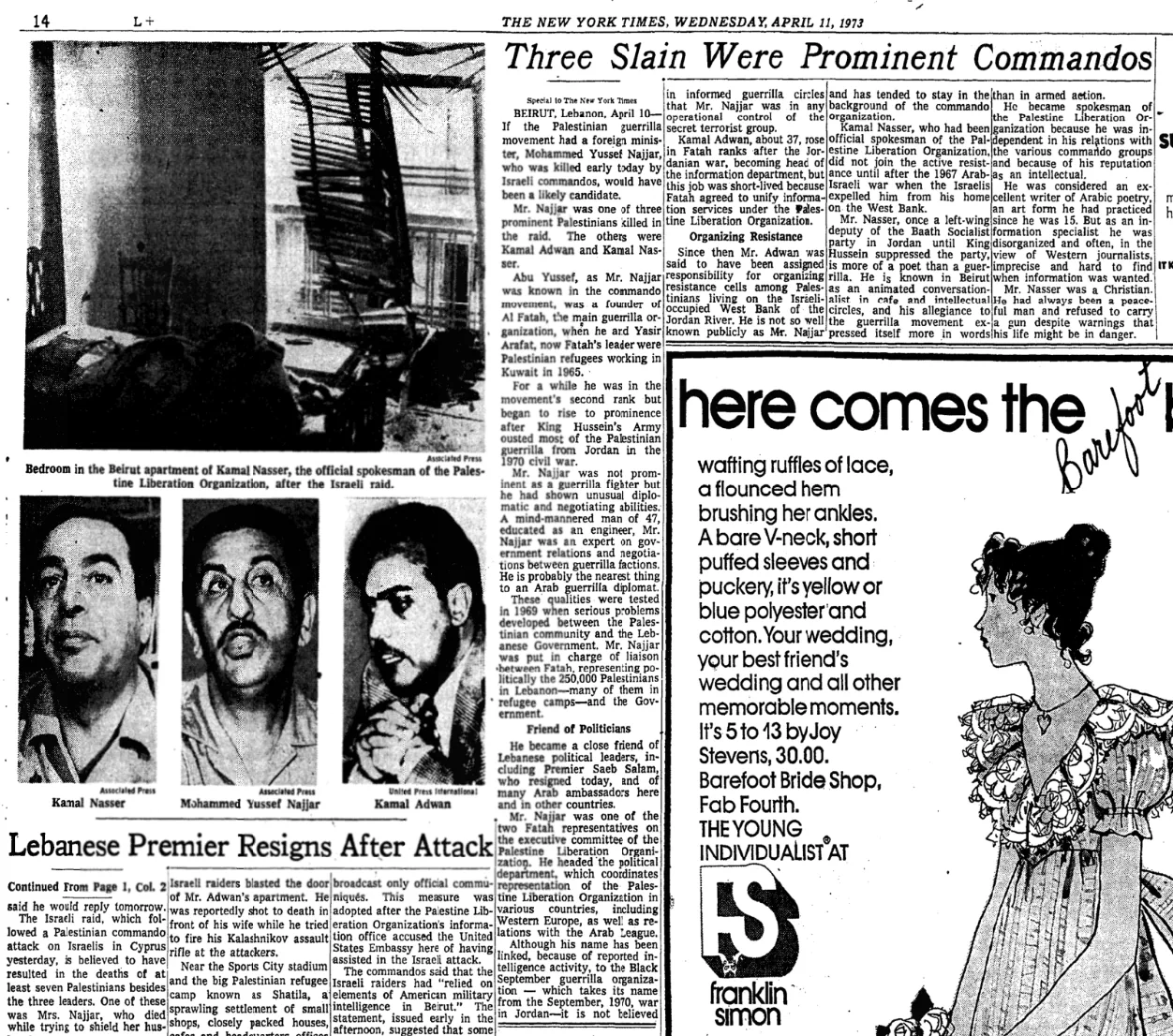
Transcribed from the clipping
BEIRUT, Lebanon, April 10—If the Palestinian guerrilla movement had a foreign minister, Mohammed Yussef Najjar, who was killed early today by Israeli commandos, would have been a likely candidate. Mr. Najjar was one of three prominent Palestinians killed in the raid. The others were Kamal Adwan and Kamal Nasser. Abu Yussef, as Mr.
Najjar was known in the commando movement, was a founder of Al Fatah, the main guerrilla organization, when he and Yasir Arafat, now Fatah's leader were Palestinian refugees working in Kuwait in 1965.
For a while he was in the movement's second rank but began to rise to prominence after King Hussein's Army ousted most of the Palestinian guerrilla from Jordan in the 1970 civil war. Mr. Najjar was not prominent as a guerrilla fighter but he had shown unusual diplomatic and negotiating abilities. A mind-mannered man of 47, educated as an engineer, Mr.
Najjar was an expert on government relations and negotiations between guerrilla factions. He is probably the nearest thing to an Arab guerrilla diplomat. These qualities were tested in 1969 when serious problems developed between the Palestinian community and the Lebanese Government. Mr.
Najjar was put in charge of liaison between Fatah, representing politically the 250,000 Palestinians in Lebanon—many of them in refugee camps—and the Government. Friend of Politicians He became a close friend of Lebanese political leaders, including Premier Saeb Salam, who resigned today, and of many Arab ambassadors here and in other countries. Mr.
Najjar was one of the two Fatah representatives on the executive committee of the Palestine Liberation Organization. He headed the political department, which coordinates representation of the Palestine Liberation Organization in various countries, including Western Europe, as well as relations with the Arab League.
Although his name has been linked, because of reported intelligence activity, to the Black September guerrilla organization — which takes its name from the September, 1970, war in Jordan—it is not believed in informed guerrilla circles that Mr. Najjar was in any operational control of the secret terrorist group.
Kamal Adwan, about 37, rose in Fatah ranks after the Jordanian war, becoming head of the information department, but this job was short-lived because Fatah agreed to unify information services under the Palestine Liberation Organization. Organizing Resistance Since then Mr.
Adwan was said to have been assigned responsibility for organizing resistance cells among Palestinians living on the Israeli-occupied West Bank of the Jordan River. He is not so well known publicly as Mr. Najjar and has tended to stay in the background of the commando organization.
Kamal Nasser, who had been official spokesman of the Palestine Liberation Organization, did not join the active resistance until after the 1967 Arab-Israeli war when the Israelis expelled him from his home on the West Bank. Mr. Nasser, once a left-wing deputy of the Baath Socialist party in Jordan until King Hussein suppressed the party, is more of a poet than a guerrilla.
He is known in Beirut as an animated conversationalist in cafe and intellectual circles, and his allegiance to the guerrilla movement expressed itself more in words than in armed action. He became spokesman of the Palestine Liberation Organization because he was independent in his relations with the various commando groups and because of his reputation as an intellectual.
He was considered an excellent writer of Arabic poetry, an art form he had practiced since he was 15. But as an information specialist he was disorganized and often, in the view of Western journalists, imprecise and hard to find when information was wanted. Mr. Nasser was a Christian.
He had always been a peaceful man and refused to carry a gun despite warnings that his life might be in danger.
How this transcription was made
One scan of a full page (page 14, edition mark L+), read at 7x-10x in four columns. Masthead strip across the top reads THE NEW YORK TIMES, WEDNESDAY, APRIL 11, 1973. The page also carries a SECOND, separate article at the bottom left, "Lebanese Premier Resigns After Attack" (a jump from page 1), recorded here as its own entry, and a Franklin Simon dress advertisement occupying the lower right, which is not transcribed. Maria's slide label names only one item for this slide.
Cite this clipping
"Three Slain Were Prominent Commandos," The New York Times, 11 April 1973, p. 14. Covering Palestine archive, CP-1973-020. https://coveringpalestine.org/archive/cp-1973-020
More from The New York Times
- The Maine Colony in PalestineThe New York Times · 12 November 1866
- Jewish Colonization in PalestineThe New York Times · 9 December 1883
- Jewish State in Palestine OpposedThe New York Times · 9 July 1897
- ZIONIST CONGRESS IN BASELThe New York Times · 31 August 1897
- ROME FEARS THE ZIONISTSThe New York Times · 12 September 1897
- PROGRESS OF ZIONISMThe New York Times · 16 December 1901
- 852 more from this paper in the full text →
More from the 1970s
- French Plan Protection For Israeli(newspaper unidentified) · 10 January 1973
- Paris Police Plan Special Security Measures for Meir(newspaper unidentified) · 10 January 1973
- Mrs. Meir's Safety StudiedLos Angeles Times · 11 January 1973
- Cases of senseless murder and wanton destructionWisconsin Jewish Chronicle · 19 January 1973
- Palestinian Runs : Arab Newspaper In E. JerusalemDuluth News-Tribune · 4 February 1973
- Israeli Arabs and Jews unite for right of villagers to returnDaily World · 23 February 1973
- All 338 clippings from the 1970s →
Last updated 2 November 2026
This record is part of Covering Palestine, an archive of American newspaper clippings about Palestinians, 1724 to 2023. Researched and assembled by Maria Robles.
The clipping belongs to the newspaper that printed it, or to the news agency that supplied the copy. It is reproduced here for research, criticism and commentary. A city here is where the newspaper was published, not where the story came from, and on most records it was taken from the masthead.
Something wrong here, or something you know about this clipping? The archive is still being built and corrections are wanted: maria@rozumstudio.com, quoting CP-1973-020.
Everything printed in 1973 · Printed on this day · See it in the archive reel · Full text of every clipping · Dataset