The New York Times · 17 October 1973
CP-1973-024
Israeli Press Curb Illustrates Problems in Coverage of War
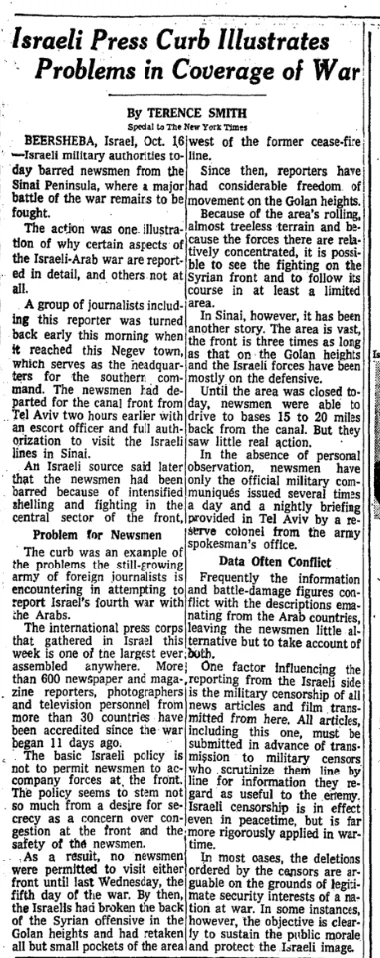
Transcribed from the clipping
BEERSHEBA, Israel, Oct. 16 — Israeli military authorities today barred newsmen from the Sinai Peninsula, where a major battle of the war remains to be fought. The action was one illustration of why certain aspects of the Israeli-Arab war are reported in detail, and others not at all.
A group of journalists including this reporter was turned back early this morning when it reached this Negev town, which serves as the headquarters for the southern command. The newsmen had departed for the canal front from Tel Aviv two hours earlier with an escort officer and full authorization to visit the Israeli lines in Sinai.
An Israeli source said later that the newsmen had been barred because of intensified shelling and fighting in the central sector of the front. Problem for Newsmen The curb was an example of the problems the still-growing army of foreign journalists is encountering in attempting to report Israel’s fourth war with the Arabs.
The international press corps that gathered in Israel this week is one of the largest ever assembled anywhere. More than 600 newspaper and magazine reporters, photographers and television personnel from more than 30 countries have been accredited since the war began 11 days ago. The basic Israeli policy is not to permit newsmen to accompany forces at the front.
The policy seems to stem not so much from a desire for secrecy as a concern over congestion at the front and the safety of the newsmen. As a result, no newsmen were permitted to visit either front until last Wednesday, the fifth day of the war.
By then, the Israelis had broken the back of the Syrian offensive in the Golan heights and had retaken all but small pockets of the area west of the former cease-fire line. Since then, reporters have had considerable freedom of movement on the Golan heights.
Because of the area’s rolling, almost treeless terrain and because the forces there are relatively concentrated, it is possible to see the fighting on the Syrian front and to follow its course in at least a limited area. In Sinai, however, it has been another story.
The area is vast, the front is three times as long as that on the Golan heights and the Israeli forces have been mostly on the defensive. Until the area was closed today, newsmen were able to drive to bases 15 to 20 miles back from the canal. But they saw little real action.
In the absence of personal observation, newsmen have only the official military communiqués issued several times a day and a nightly briefing provided in Tel Aviv by a reserve colonel from the army spokesman’s office.
Data Often Conflict Frequently the information and battle-damage figures conflict with the descriptions emanating from the Arab countries, leaving the newsmen little alternative but to take account of both. One factor influencing the reporting from the Israeli side is the military censorship of all news articles and film transmitted from here.
All articles, including this one, must be submitted in advance of transmission to military censors who scrutinize them line by line for information they regard as useful to the enemy. Israeli censorship is in effect even in peacetime, but is far more rigorously applied in wartime.
In most cases, the deletions ordered by the censors are arguable on the grounds of legitimate security interests of a nation at war. In some instances, however, the objective is clearly to sustain the public morale and protect the Israeli image.
How this transcription was made
No masthead, folio or printed date on the cut. The dateline is “BEERSHEBA, Israel, Oct. 16,” and the body says the war “began 11 days ago,” which from the 6 October 1973 start gives 17 October — so the dateline day is internally consistent and publication on 17 October 1973 follows. That matches Maria’s third label. See the label-order note on s067_1: her four labels for this slide are not in the same order as the four images. — Complete article, both columns, ending at the foot of the second column.
Cite this clipping
"Israeli Press Curb Illustrates Problems in Coverage of War," The New York Times, 17 October 1973. Covering Palestine archive, CP-1973-024. https://coveringpalestine.org/archive/cp-1973-024
More from The New York Times
- The Maine Colony in PalestineThe New York Times · 12 November 1866
- Jewish Colonization in PalestineThe New York Times · 9 December 1883
- Jewish State in Palestine OpposedThe New York Times · 9 July 1897
- ZIONIST CONGRESS IN BASELThe New York Times · 31 August 1897
- ROME FEARS THE ZIONISTSThe New York Times · 12 September 1897
- PROGRESS OF ZIONISMThe New York Times · 16 December 1901
- 852 more from this paper in the full text →
More from the 1970s
- French Plan Protection For Israeli(newspaper unidentified) · 10 January 1973
- Paris Police Plan Special Security Measures for Meir(newspaper unidentified) · 10 January 1973
- Mrs. Meir's Safety StudiedLos Angeles Times · 11 January 1973
- Cases of senseless murder and wanton destructionWisconsin Jewish Chronicle · 19 January 1973
- Palestinian Runs : Arab Newspaper In E. JerusalemDuluth News-Tribune · 4 February 1973
- Israeli Arabs and Jews unite for right of villagers to returnDaily World · 23 February 1973
- All 338 clippings from the 1970s →
Last updated 2 November 2026
This record is part of Covering Palestine, an archive of American newspaper clippings about Palestinians, 1724 to 2023. Researched and assembled by Maria Robles.
The clipping belongs to the newspaper that printed it, or to the news agency that supplied the copy. It is reproduced here for research, criticism and commentary. A city here is where the newspaper was published, not where the story came from, and on most records it was taken from the masthead.
Something wrong here, or something you know about this clipping? The archive is still being built and corrections are wanted: maria@rozumstudio.com, quoting CP-1973-024.
Everything printed in 1973 · Printed on this day · See it in the archive reel · Full text of every clipping · Dataset