The New York Times · 13 April 1973
CP-1973-027
Slain Palestinian Leaders Are Buried in Lebanon
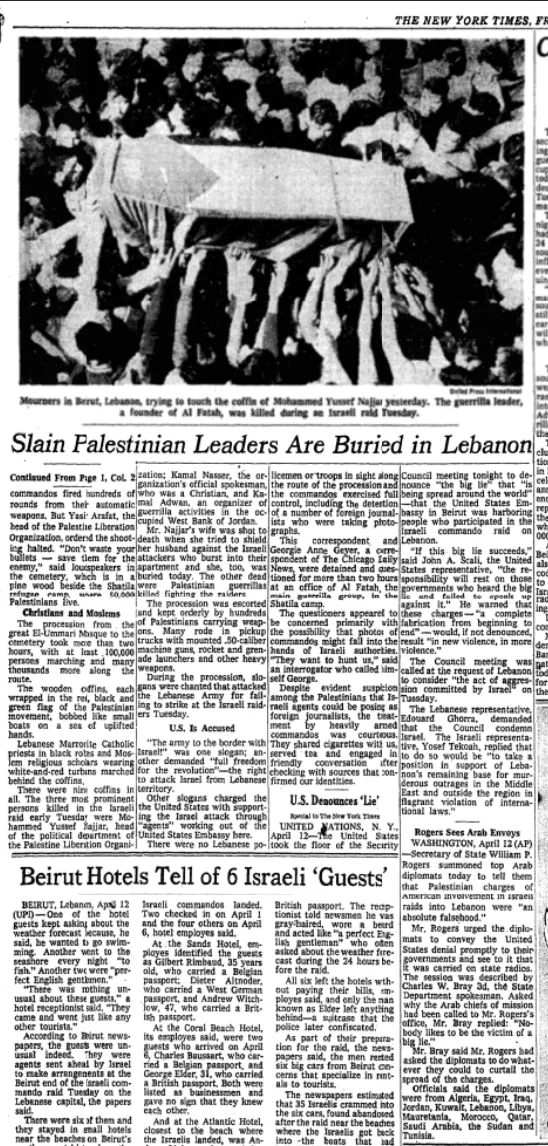
Transcribed from the clipping
...commandos fired hundreds of rounds from their automatic weapons. But Yasir Arafat, the head of the Palestine Liberation Organization, ordered the shooting halted. “Don’t waste your bullets — save them for the enemy,” said loudspeakers in the cemetery, which is in a pine wood beside the Shatila refugee camp, where [illegible]0,000 Palestinians live.
The procession from the great El-Ummari Mosque to the cemetery took more than two hours, with at least 100,000 persons marching and many thousands more along the route. The wooden coffins, each wrapped in the red, black and green flag of the Palestinian movement, bobbed like small boats on a sea of uplifted hands.
Lebanese Marronite Catholic priests in black robes and Moslem religious scholars wearing white-and-red turbans marched behind the coffins. There were nine coffins in all.
The three most prominent persons killed in the Israeli raid early Tuesday were Mohammed Yussef Najjar, head of the political department of the Palestine Liberation Organization; Kamal Nasser, the organization’s official spokesman, who was a Christian, and Kamal Adwan, an organizer of guerrilla activities in the occupied West Bank of Jordan. Mr.
Najjar’s wife was shot to death when she tried to shield her husband against the Israeli attackers who burst into their apartment and she, too, was buried today. The other dead were Palestinian guerrillas killed fighting the raiders. The procession was escorted and kept orderly by hundreds of Palestinians carrying weapons.
Many rode in pickup trucks with mounted .50-caliber machine guns, rocket and grenade launchers and other heavy weapons. During the procession, slogans were chanted that attacked the Lebanese Army for failing to strike at the Israeli raiders Tuesday.
“The army to the border with Israel!” was one slogan; another demanded “full freedom for the revolution”—the right to attack Israel from Lebanese territory. ... [no] policemen or troops in sight along the route of the procession and the commandos exercised full control, including the detention of a number of foreign journalists who were taking photographs.
This correspondent and Georgie Anne Geyer, a correspondent of The Chicago Daily News, were detained and questioned for more than two hours at an office of Al Fatah, the main guerrilla group, in the Shatila camp. The questioners appeared to be concerned primarily with the possibility that photos of commandos might fall into the hands of Israeli authorities.
“They want to hunt us,” said an interrogator who called himself George. Despite evident suspicion among the Palestinians that Israeli agents could be posing as foreign journalists, the treatment by heavily armed commandos was courteous. They shared cigarettes with us, served tea and engaged in friendly conversation after checking with sources that confirmed our identities.
How this transcription was made
Single scan of a broadsheet page; read in six column crops at 7x–9x plus separate crops of the running head, the photo caption and the credit line. — The running head is printed across the top of the scan and reads “THE NEW YORK TIMES, FR” — the numeric date runs off the right edge of the cut, but the masthead name is unambiguous and the day begins FR. Both datelines on the page read April 12, the burial is “yesterday” and the raid is “Tuesday” (10 April). Friday 13 April 1973 is the only date that satisfies all four. Maria’s label is confirmed. — ['The population figure for the Shatila camp: a fold or crease runs through the line and the leading digit will not resolve at 30x. It reads “[5 or 8]0,000 Palestinians live.” Transcribed as “[illegible]0,000”; do not publish a number from this scan.']
Cite this clipping
"Slain Palestinian Leaders Are Buried in Lebanon," The New York Times, 13 April 1973. Covering Palestine archive, CP-1973-027. https://coveringpalestine.org/archive/cp-1973-027
More from The New York Times
- The Maine Colony in PalestineThe New York Times · 12 November 1866
- Jewish Colonization in PalestineThe New York Times · 9 December 1883
- Jewish State in Palestine OpposedThe New York Times · 9 July 1897
- ZIONIST CONGRESS IN BASELThe New York Times · 31 August 1897
- ROME FEARS THE ZIONISTSThe New York Times · 12 September 1897
- PROGRESS OF ZIONISMThe New York Times · 16 December 1901
- 852 more from this paper in the full text →
More from the 1970s
- French Plan Protection For Israeli(newspaper unidentified) · 10 January 1973
- Paris Police Plan Special Security Measures for Meir(newspaper unidentified) · 10 January 1973
- Mrs. Meir's Safety StudiedLos Angeles Times · 11 January 1973
- Cases of senseless murder and wanton destructionWisconsin Jewish Chronicle · 19 January 1973
- Palestinian Runs : Arab Newspaper In E. JerusalemDuluth News-Tribune · 4 February 1973
- Israeli Arabs and Jews unite for right of villagers to returnDaily World · 23 February 1973
- All 338 clippings from the 1970s →
Last updated 2 November 2026
This record is part of Covering Palestine, an archive of American newspaper clippings about Palestinians, 1724 to 2023. Researched and assembled by Maria Robles.
The clipping belongs to the newspaper that printed it, or to the news agency that supplied the copy. It is reproduced here for research, criticism and commentary. A city here is where the newspaper was published, not where the story came from, and on most records it was taken from the masthead.
Something wrong here, or something you know about this clipping? The archive is still being built and corrections are wanted: maria@rozumstudio.com, quoting CP-1973-027.
Everything printed in 1973 · Printed on this day · See it in the archive reel · Full text of every clipping · Dataset