(newspaper unidentified) · 10 April 1973
CP-1973-029
Raiders leave little town a blood-filled shambles
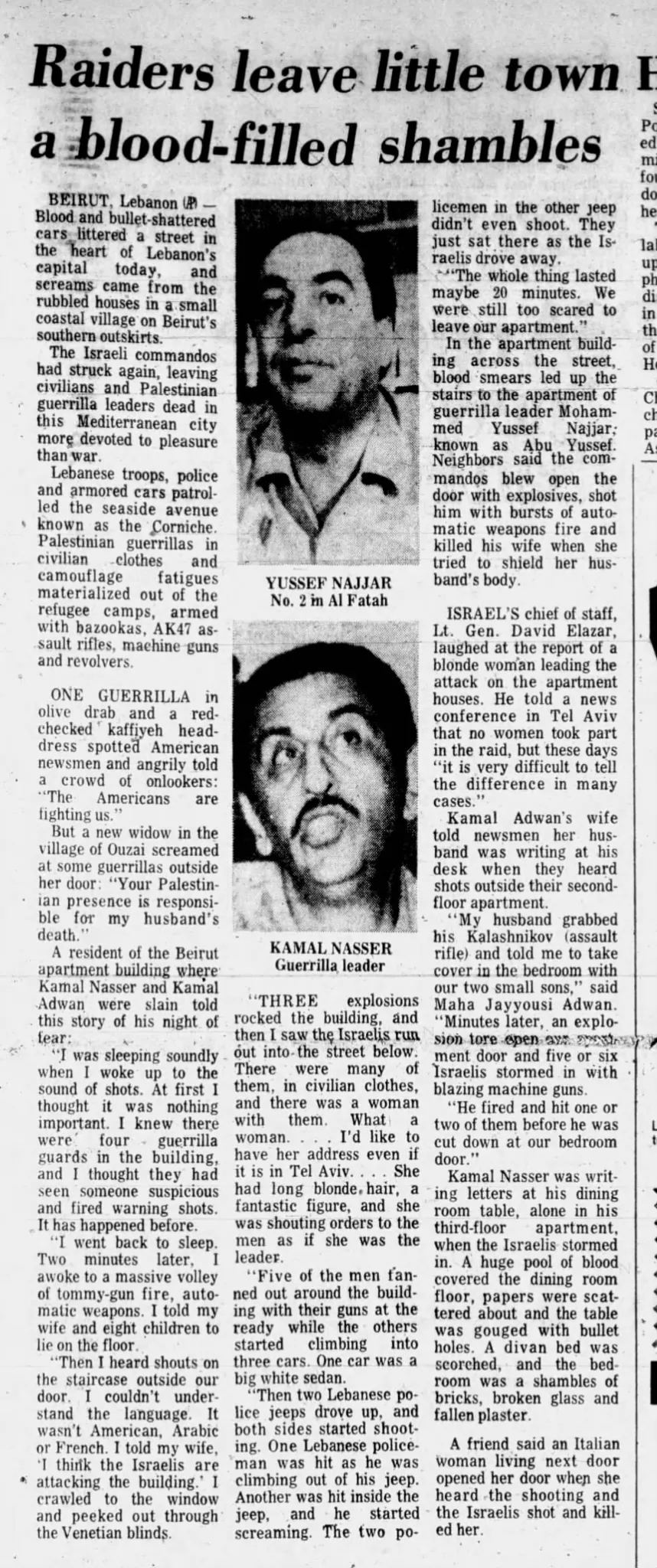
Transcribed from the clipping
BEIRUT, Lebanon (AP) — Blood and bullet-shattered cars littered a street in the heart of Lebanon's capital today, and screams came from the rubbled houses in a small coastal village on Beirut's southern outskirts. The Israeli commandos had struck again, leaving civilians and Palestinian guerrilla leaders dead in this Mediterranean city more devoted to pleasure than war.
Lebanese troops, police and armored cars patrolled the seaside avenue known as the Corniche. Palestinian guerrillas in civilian clothes and camouflage fatigues materialized out of the refugee camps, armed with bazookas, AK47 assault rifles, machine guns and revolvers.
ONE GUERRILLA in olive drab and a red-checked kaffiyeh headdress spotted American newsmen and angrily told a crowd of onlookers: “The Americans are fighting us.” But a new widow in the village of Ouzai screamed at some guerrillas outside her door: “Your Palestinian presence is responsible for my husband's death.”
A resident of the Beirut apartment building where Kamal Nasser and Kamal Adwan were slain told this story of his night of fear: “I was sleeping soundly when I woke up to the sound of shots. At first I thought it was nothing important. I knew there were four guerrilla guards in the building, and I thought they had seen someone suspicious and fired warning shots.
It has happened before. “I went back to sleep. Two minutes later, I awoke to a massive volley of tommy-gun fire, automatic weapons. I told my wife and eight children to lie on the floor. “Then I heard shouts on the staircase outside our door. I couldn't understand the language. It wasn't American, Arabic or French.
I told my wife, 'I think the Israelis are attacking the building.' I crawled to the window and peeked out through the Venetian blinds. “THREE explosions rocked the building, and then I saw the Israelis run out into the street below. There were many of them, in civilian clothes, and there was a woman with them. What a woman. . . .
I'd like to have her address even if it is in Tel Aviv. . . . She had long blonde hair, a fantastic figure, and she was shouting orders to the men as if she was the leader. “Five of the men fanned out around the building with their guns at the ready while the others started climbing into three cars. One car was a big white sedan.
“Then two Lebanese police jeeps drove up, and both sides started shooting. One Lebanese policeman was hit as he was climbing out of his jeep. Another was hit inside the jeep, and he started screaming. The two policemen in the other jeep didn't even shoot. They just sat there as the Israelis drove away. “The whole thing lasted maybe 20 minutes.
We were still too scared to leave our apartment.” In the apartment building across the street, blood smears led up the stairs to the apartment of guerrilla leader Mohammed Yussef Najjar; known as Abu Yussef.
Neighbors said the commandos blew open the door with explosives, shot him with bursts of automatic weapons fire and killed his wife when she tried to shield her husband's body. ISRAEL'S chief of staff, Lt. Gen. David Elazar, laughed at the report of a blonde woman leading the attack on the apartment houses.
He told a news conference in Tel Aviv that no women took part in the raid, but these days “it is very difficult to tell the difference in many cases.” Kamal Adwan's wife told newsmen her husband was writing at his desk when they heard shots outside their second-floor apartment.
“My husband grabbed his Kalashnikov (assault rifle) and told me to take cover in the bedroom with our two small sons,” said Maha Jayyousi Adwan. “Minutes later, an explosion tore open [our apart]ment door and five or six Israelis stormed in with blazing machine guns. “He fired and hit one or two of them before he was cut down at our bedroom door.”
Kamal Nasser was writing letters at his dining room table, alone in his third-floor apartment, when the Israelis stormed in. A huge pool of blood covered the dining room floor, papers were scattered about and the table was gouged with bullet holes. A divan bed was scorched, and the bedroom was a shambles of bricks, broken glass and fallen plaster.
A friend said an Italian woman living next door opened her door when she heard the shooting and the Israelis shot and killed her.
How this transcription was made
Masthead not readable on the scan. The label on the slide read: [masthead not on clipping] — Single clipping, three columns plus two portraits. The slide's other image is a different paper on the same raid and is recorded separately. — No masthead in frame. The clipping is cut to the story; the only self-identification is the AP credit in the dateline. Maria's label says Press Telegram and nothing on the page contradicts it, but nothing on the page confirms it either. — No printed date anywhere on the clipping. The dateline says the street was littered "today" and the piece reports the Israeli raid of the night of 9-10 April 1973 as having just happened, with Elazar's Tel Aviv news conference already given. That puts it on 10 April, consistent with Maria's label. Year not printed. — Transcribed from magnified crops of all three columns. One passage is physically damaged on the scan: in Maha Jayyousi Adwan's quote, the line reading "sion tore open ___ _____t." is abraded across two words. "open" is legible; the following short word has the length and shape of "our" but I cannot read it; the hyphenated word that follows resolves on the next line, which plainly reads "ment door", so the word is "apartment". I have set the unread portion in square brackets as [our apart] so it is visible as inference, not reading. The damage is an abrasion or scuff in the newsprint, confined to this column at that height — it is not a censor's mark and not a deletion: the surrounding columns at the same height are clean. — Set over two lines: "Raiders leave little town" / "a blood-filled shambles". A capital H sits at the right edge of the first line; it belongs to the headline of the adjacent column's unrelated story, which the clipping clips into, and is not part of this headline.
Cite this clipping
"Raiders leave little town a blood-filled shambles," (newspaper unidentified), 10 April 1973. Covering Palestine archive, CP-1973-029. https://coveringpalestine.org/archive/cp-1973-029
More from (newspaper unidentified)
- Kaiser Wilhelm's Trip to Palestine(newspaper unidentified) · 9 April 1898
- States the Arab Point of View Concerning Palestine(newspaper unidentified) · 1 January 1946
- Forcing Palestine to Become a World Problem(newspaper unidentified) · 1 January 1947
- Arab Terrorist Spokesman Killed As Auto Explodes(newspaper unidentified) · 8 July 1972
- Bomb in car kills Arab guerrilla chief(newspaper unidentified) · 8 July 1972
- Arab Who Claimed Massacre Credit Dies(newspaper unidentified) · 8 July 1972
- 57 more from this paper in the full text →
More from the 1970s
- French Plan Protection For Israeli(newspaper unidentified) · 10 January 1973
- Paris Police Plan Special Security Measures for Meir(newspaper unidentified) · 10 January 1973
- Mrs. Meir's Safety StudiedLos Angeles Times · 11 January 1973
- Cases of senseless murder and wanton destructionWisconsin Jewish Chronicle · 19 January 1973
- Palestinian Runs : Arab Newspaper In E. JerusalemDuluth News-Tribune · 4 February 1973
- Israeli Arabs and Jews unite for right of villagers to returnDaily World · 23 February 1973
- All 338 clippings from the 1970s →
Last updated 2 November 2026
This record is part of Covering Palestine, an archive of American newspaper clippings about Palestinians, 1724 to 2023. Researched and assembled by Maria Robles.
The clipping belongs to the newspaper that printed it, or to the news agency that supplied the copy. It is reproduced here for research, criticism and commentary. A city here is where the newspaper was published, not where the story came from, and on most records it was taken from the masthead.
Something wrong here, or something you know about this clipping? The archive is still being built and corrections are wanted: maria@rozumstudio.com, quoting CP-1973-029.
Everything printed in 1973 · Printed on this day · See it in the archive reel · Full text of every clipping · Dataset