The Miami Herald · Miami, Florida · 21 September 1982
CP-1982-035
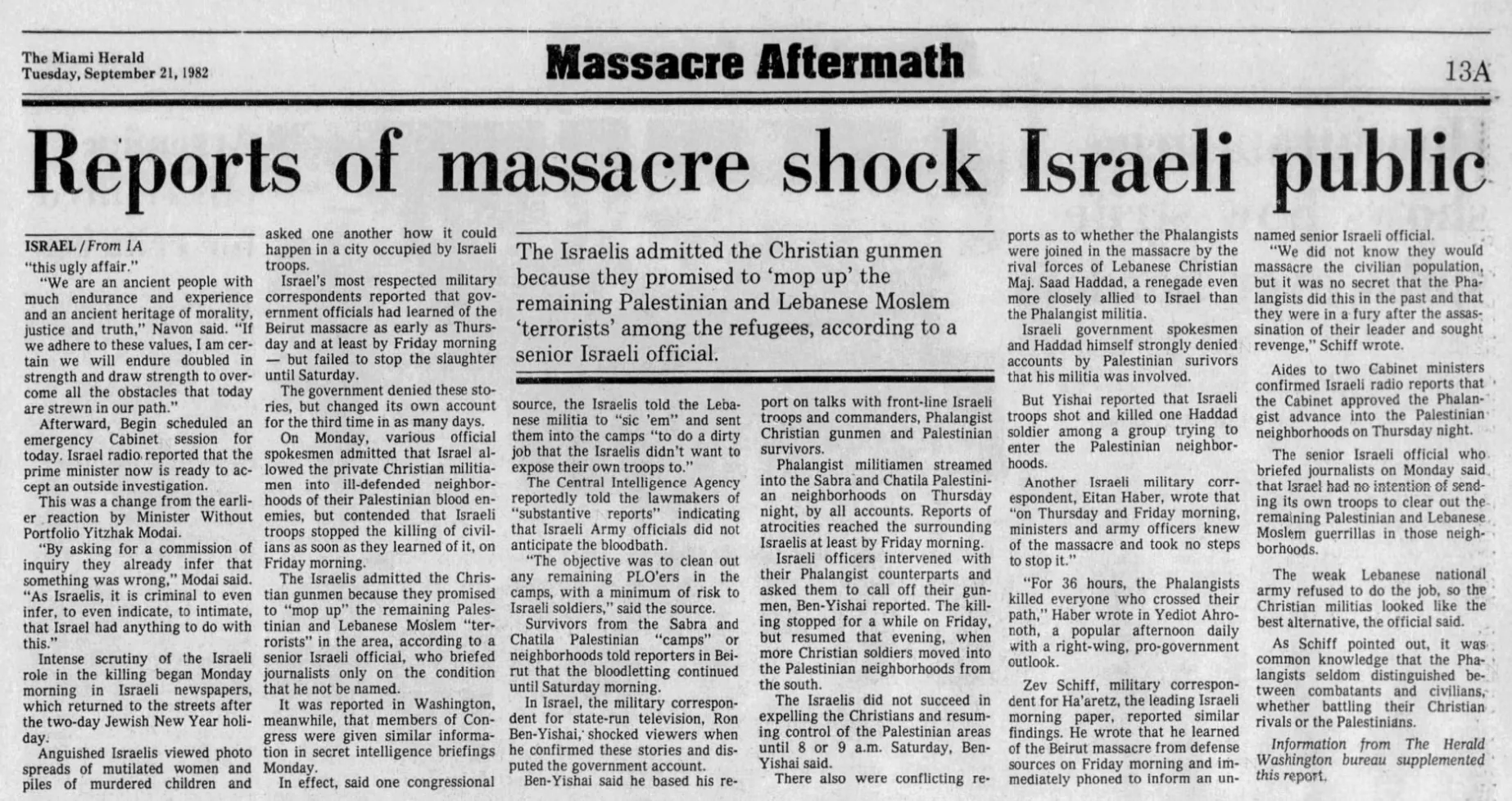
Reports of massacre shock Israeli public
Massacre Aftermath
Transcribed from the clipping
“this ugly affair.” “We are an ancient people with much endurance and experience and an ancient heritage of morality, justice and truth,” Navon said. “If we adhere to these values, I am certain we will endure doubled in strength and draw strength to overcome all the obstacles that today are strewn in our path.”
Afterward, Begin scheduled an emergency Cabinet session for today. Israel radio reported that the prime minister now is ready to accept an outside investigation. This was a change from the earlier reaction by Minister Without Portfolio Yitzhak Modai. “By asking for a commission of inquiry they already infer that something was wrong,” Modai said.
“As Israelis, it is criminal to even infer, to even indicate, to intimate, that Israel had anything to do with this.” Intense scrutiny of the Israeli role in the killing began Monday morning in Israeli newspapers, which returned to the streets after the two-day Jewish New Year holiday.
Anguished Israelis viewed photo spreads of mutilated women and piles of murdered children and asked one another how it could happen in a city occupied by Israeli troops.
Israel’s most respected military correspondents reported that government officials had learned of the Beirut massacre as early as Thursday and at least by Friday morning — but failed to stop the slaughter until Saturday. The government denied these stories, but changed its own account for the third time in as many days.
On Monday, various official spokesmen admitted that Israel allowed the private Christian militiamen into ill-defended neighborhoods of their Palestinian blood enemies, but contended that Israeli troops stopped the killing of civilians as soon as they learned of it, on Friday morning.
The Israelis admitted the Christian gunmen because they promised to “mop up” the remaining Palestinian and Lebanese Moslem “terrorists” in the area, according to a senior Israeli official, who briefed journalists only on the condition that he not be named.
It was reported in Washington, meanwhile, that members of Congress were given similar information in secret intelligence briefings Monday. In effect, said one congressional source, the Israelis told the Lebanese militia to “sic ’em” and sent them into the camps “to do a dirty job that the Israelis didn’t want to expose their own troops to.”
The Central Intelligence Agency reportedly told the lawmakers of “substantive reports” indicating that Israeli Army officials did not anticipate the bloodbath. “The objective was to clean out any remaining PLO’ers in the camps, with a minimum of risk to Israeli soldiers,” said the source.
Survivors from the Sabra and Chatila Palestinian “camps” or neighborhoods told reporters in Beirut that the bloodletting continued until Saturday morning. In Israel, the military correspondent for state-run television, Ron Ben-Yishai, shocked viewers when he confirmed these stories and disputed the government account.
Ben-Yishai said he based his report on talks with front-line Israeli troops and commanders, Phalangist Christian gunmen and Palestinian survivors. Phalangist militiamen streamed into the Sabra and Chatila Palestinian neighborhoods on Thursday night, by all accounts. Reports of atrocities reached the surrounding Israelis at least by Friday morning.
Israeli officers intervened with their Phalangist counterparts and asked them to call off their gunmen, Ben-Yishai reported. The killing stopped for a while on Friday, but resumed that evening, when more Christian soldiers moved into the Palestinian neighborhoods from the south.
The Israelis did not succeed in expelling the Christians and resuming control of the Palestinian areas until 8 or 9 a.m. Saturday, Ben-Yishai said. There also were conflicting reports as to whether the Phalangists were joined in the massacre by the rival forces of Lebanese Christian Maj. Saad Haddad, a renegade even more closely allied to Israel than the Phalangist militia.
Israeli government spokesmen and Haddad himself strongly denied accounts by Palestinian surivors that his militia was involved. But Yishai reported that Israeli troops shot and killed one Haddad soldier among a group trying to enter the Palestinian neighborhoods.
Another Israeli military correspondent, Eitan Haber, wrote that “on Thursday and Friday morning, ministers and army officers knew of the massacre and took no steps to stop it.” “For 36 hours, the Phalangists killed everyone who crossed their path,” Haber wrote in Yediot Ahronoth, a popular afternoon daily with a right-wing, pro-government outlook.
Zev Schiff, military correspondent for Ha’aretz, the leading Israeli morning paper, reported similar findings. He wrote that he learned of the Beirut massacre from defense sources on Friday morning and immediately phoned to inform an unnamed senior Israeli official.
“We did not know they would massacre the civilian population, but it was no secret that the Phalangists did this in the past and that they were in a fury after the assassination of their leader and sought revenge,” Schiff wrote.
Aides to two Cabinet ministers confirmed Israeli radio reports that the Cabinet approved the Phalangist advance into the Palestinian neighborhoods on Thursday night.
The senior Israeli official who briefed journalists on Monday said that Israel had no intention of sending its own troops to clear out the remaining Palestinian and Lebanese Moslem guerrillas in those neighborhoods. The weak Lebanese national army refused to do the job, so the Christian militias looked like the best alternative, the official said.
As Schiff pointed out, it was common knowledge that the Phalangists seldom distinguished between combatants and civilians, whether battling their Christian rivals or the Palestinians. Information from The Herald Washington bureau supplemented this report.
Context added by this archive
Printed four days after Sabra and Chatila, and what it is actually reporting is a fight over the record.
The Israeli government changed its account three times in three days; the papers that broke it were Israeli, and the correspondents named here — Ron Ben-Yishai on state television, Eitan Haber in Yediot Ahronoth, Zev Schiff in Ha’aretz — are reporting against their own defense ministry with sources inside it.
The one sentence set in large type across the middle of the page is the admission, and it is sourced to an official who would speak only if he were not named.
Cite this item
"Reports of massacre shock Israeli public," The Miami Herald, 21 September 1982. Covering Palestine archive, CP-1982-035. https://coveringpalestine.org/archive/cp-1982-035
More from The Miami Herald
- Irgun Takes Arab City In Night BattleThe Miami Herald · 5 May 1948
- Downing Airliner Also TerrorismThe Miami Herald · 14 March 1973
- The PalestiniansThe Miami Herald · 29 May 1977
- The oppressive Israeli occupationThe Miami Herald · 20 December 1987
- Islamic resistance covenant rules out deal with IsraelThe Miami Herald · 6 September 1988
- Jewish settler violence claims 1st Arab victimThe Miami Herald · 20 November 1993
- 6 more from this paper in the full text →
More from the 1980s
- Even Israelis protest West Bank university shutdownThe Evening Sun · 11 January 1982
- art review/Childhood reflectionsNewsday · 12 March 1982
- Begin will stay on despite voteStamford Advocate · 24 March 1982
- Three more Palestinians killedMontana Standard · 25 March 1982
- Israeli troops kill boy, hurt 17 in Arab unrestThe Star-Ledger · 14 April 1982
- Israeli troops fire into protesters, killing boyBryan College Station Eagle · 14 April 1982
- All 165 clippings from the 1980s →
This record is part of Covering Palestine, an archive of American and Anglophone newspaper clippings about Palestinians, 1799 to 2023. Researched and assembled by Maria Robles.
The clipping belongs to the newspaper that printed it, or to the news agency that supplied the copy. It is reproduced here for research, criticism and commentary. The city is derived from the masthead, not read off the clipping.
Something wrong here, or something you know about this clipping? The archive is still being built and corrections are wanted: maria@rozumstudio.com, quoting CP-1982-035.
See it in the archive reel · Full text of every clipping · Dataset