The New York Times · 10 July 1983
CP-1983-021
Life and Death of a Terrorist
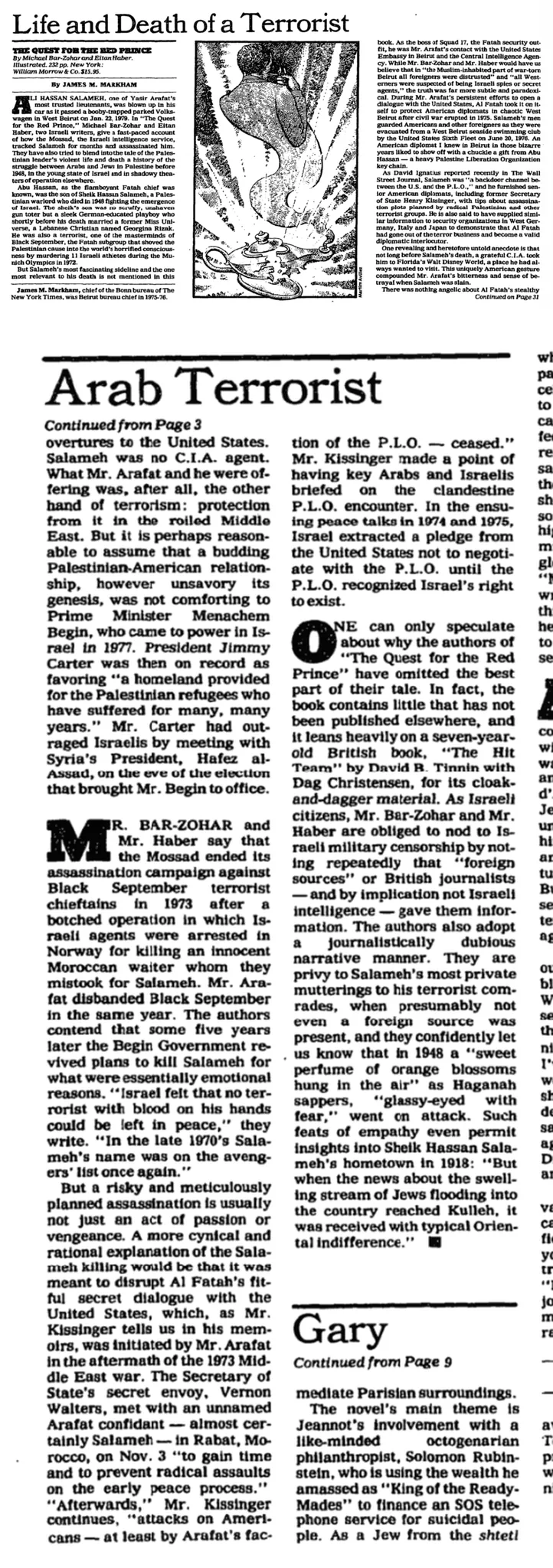
Transcribed from the clipping
ALI HASSAN SALAMEH, one of Yasir Arafat's most trusted lieutenants, was blown up in his car as it passed a booby-trapped parked Volkswagen in West Beirut on Jan. 22, 1979.
In “The Quest for the Red Prince,” Michael Bar-Zohar and Eitan Haber, two Israeli writers, give a fast-paced account of how the Mossad, the Israeli intelligence service, tracked Salameh for months and assassinated him.
They have also tried to blend into the tale of the Palestinian leader's violent life and death a history of the struggle between Arabs and Jews in Palestine before 1948, in the young state of Israel and in shadowy theaters of operation elsewhere.
Abu Hassan, as the flamboyant Fatah chief was known, was the son of Sheik Hassan Salameh, a Palestinian warlord who died in 1948 fighting the emergence of Israel. The sheik's son was no scruffy, unshaven gun toter but a sleek German-educated playboy who shortly before his death married a former Miss Universe, a Lebanese Christian named Georgina Rizak.
He was also a terrorist, one of the masterminds of Black September, the Fatah subgroup that shoved the Palestinian cause into the world's horrified consciousness by murdering 11 Israeli athletes during the Munich Olympics in 1972. But Salameh's most fascinating sideline and the one most relevant to his death is not mentioned in this book.
As the boss of Squad 17, the Fatah security outfit, he was Mr. Arafat's contact with the United States Embassy in Beirut and the Central Intelligence Agency. While Mr. Bar-Zohar and Mr.
Haber would have us believe that in “the Muslim-inhabited part of war-torn Beirut all foreigners were distrusted” and “all Westerners were suspected of being Israeli spies or secret agents,” the truth was far more subtle and paradoxical. During Mr.
Arafat's persistent efforts to open a dialogue with the United States, Al Fatah took it on itself to protect American diplomats in chaotic West Beirut after civil war erupted in 1975. Salameh's men guarded Americans and other foreigners as they were evacuated from a West Beirut seaside swimming club by the United States Sixth Fleet on June 20, 1976.
An American diplomat I knew in Beirut in those bizarre years liked to show off with a chuckle a gift from Abu Hassan — a heavy Palestine Liberation Organization key chain.
As David Ignatius reported recently in The Wall Street Journal, Salameh was “a backdoor channel between the U.S. and the P.L.O.,” and he furnished senior American diplomats, including former Secretary of State Henry Kissinger, with tips about assassination plots planned by radical Palestinian and other terrorist groups.
He is also said to have supplied similar information to security organizations in West Germany, Italy and Japan to demonstrate that Al Fatah had gone out of the terror business and become a valid diplomatic interlocutor.
One revealing and heretofore untold anecdote is that not long before Salameh's death, a grateful C.I.A. took him to Florida's Walt Disney World, a place he had always wanted to visit. This uniquely American gesture compounded Mr. Arafat's bitterness and sense of betrayal when Salameh was slain. There was nothing angelic about Al Fatah's stealthy overtures to the United States.
Salameh was no C.I.A. agent. What Mr. Arafat and he were offering was, after all, the other hand of terrorism: protection from it in the roiled Middle East. But it is perhaps reasonable to assume that a budding Palestinian-American relationship, however unsavory its genesis, was not comforting to Prime Minister Menachem Begin, who came to power in Israel in 1977.
President Jimmy Carter was then on record as favoring “a homeland provided for the Palestinian refugees who have suffered for many, many years.” Mr. Carter had outraged Israelis by meeting with Syria's President, Hafez al-Assad, on the eve of the election that brought Mr. Begin to office. MR. BAR-ZOHAR and Mr.
Haber say that the Mossad ended its assassination campaign against Black September terrorist chieftains in 1973 after a botched operation in which Israeli agents were arrested in Norway for killing an innocent Moroccan waiter whom they mistook for Salameh. Mr. Arafat disbanded Black September in the same year.
The authors contend that some five years later the Begin Government revived plans to kill Salameh for what were essentially emotional reasons. “Israel felt that no terrorist with blood on his hands could be left in peace,” they write. “In the late 1970's Salameh's name was on the avengers' list once again.”
But a risky and meticulously planned assassination is usually not just an act of passion or vengeance. A more cynical and rational explanation of the Salameh killing would be that it was meant to disrupt Al Fatah's fitful secret dialogue with the United States, which, as Mr. Kissinger tells us in his memoirs, was initiated by Mr.
Arafat in the aftermath of the 1973 Middle East war. The Secretary of State's secret envoy, Vernon Walters, met with an unnamed Arafat confidant — almost certainly Salameh — in Rabat, Morocco, on Nov. 3 “to gain time and to prevent radical assaults on the early peace process.” “Afterwards,” Mr.
Kissinger continues, “attacks on Americans — at least by Arafat's faction of the P.L.O. — ceased.” Mr. Kissinger made a point of having key Arabs and Israelis briefed on the clandestine P.L.O. encounter.
In the ensuing peace talks in 1974 and 1975, Israel extracted a pledge from the United States not to negotiate with the P.L.O. until the P.L.O. recognized Israel's right to exist. ONE can only speculate about why the authors of “The Quest for the Red Prince” have omitted the best part of their tale.
In fact, the book contains little that has not been published elsewhere, and it leans heavily on a seven-year-old British book, “The Hit Team” by David B. Tinnin with Dag Christensen, for its cloak-and-dagger material. As Israeli citizens, Mr. Bar-Zohar and Mr.
Haber are obliged to nod to Israeli military censorship by noting repeatedly that “foreign sources” or British journalists — and by implication not Israeli intelligence — gave them information. The authors also adopt a journalistically dubious narrative manner.
They are privy to Salameh's most private mutterings to his terrorist comrades, when presumably not even a foreign source was present, and they confidently let us know that in 1948 a “sweet perfume of orange blossoms hung in the air” as Haganah sappers, “glassy-eyed with fear,” went on attack.
Such feats of empathy even permit insights into Sheik Hassan Salameh's hometown in 1918: “But when the news about the swelling stream of Jews flooding into the country reached Kulleh, it was received with typical Oriental indifference.”
How this transcription was made
Assembled from 2 scans: the opening on page 3 (s062_1) and the jump on page 31 (s062_2). The page-3 cut ends 'There was nothing angelic about Al Fatah's stealthy / Continued on Page 31' and the jump cut opens 'Continued from Page 3 / overtures to the United States.' — the sentence completes across the break, so the join is certain. Maria's 'same article keep together' is right. The jump page also carries the unrelated tail of a piece headed 'Gary / Continued from Page 9', which is left out. — Not printed as a masthead on either cut, but the reviewer's identification line names it: 'James M. Markham, chief of the Bonn bureau of The New York Times, was Beirut bureau chief in 1975-76.' The page furniture (Continued on Page 3 / Page 31, the closing square dingbat) is Book Review make-up. — No printed date on either cut. Internal evidence fixes the year within a narrow band: the reviewed book is dated by its $15.95 price and 232 pages, Kissinger's memoirs are referred to as published, David Ignatius's Wall Street Journal piece is 'recent', and 'The Hit Team' (1976) is called 'a seven-year-old British book' — which puts the review in 1983. Maria's July 10 1983 label is consistent; the day is not on the page. — The complete review, read at magnification across both scans and joined at the Page 3 / Page 31 break. The review ends with a square dingbat. The page-3 cut also carries an illustration credited in the gutter to 'Martin Avilez' — a pen drawing of a figure rising from a genie's lamp in a shaft of light — with no caption. — No deck. Below the headline sits the book's bibliographic block: 'THE QUEST FOR THE RED PRINCE / By Michael Bar-Zohar and Eitan Haber. / Illustrated. 232 pp. New York: / William Morrow & Co. $15.95.' That is a book-review slug, not a deck. — Two clippings of one article, joined into a single image for the record (s062_1.png, s062_2.png).
Cite this clipping
"Life and Death of a Terrorist," The New York Times, 10 July 1983, p. 3. Covering Palestine archive, CP-1983-021. https://coveringpalestine.org/archive/cp-1983-021
More from The New York Times
- The Maine Colony in PalestineThe New York Times · 12 November 1866
- Jewish Colonization in PalestineThe New York Times · 9 December 1883
- Jewish State in Palestine OpposedThe New York Times · 9 July 1897
- ZIONIST CONGRESS IN BASELThe New York Times · 31 August 1897
- ROME FEARS THE ZIONISTSThe New York Times · 12 September 1897
- PROGRESS OF ZIONISMThe New York Times · 16 December 1901
- 852 more from this paper in the full text →
More from the 1980s
- 3 Days of Terror, Panic and DeathThe New York Times · 9 February 1983
- 4 Israeli Soldiers Guilty in Hebron HarassmentThe New York Times · 18 February 1983
- Hebron Mayor Says Israelis Kidnapped 2 Arab Teen-AgersThe New York Times · 2 March 1983
- Hundreds Fall Sick in West Bank; Poison SuspectedThe New York Times · 28 March 1983
- Arafat rejects Reagan's Palestine proposalThe Macon News · 4 April 1983
- U.S. Doctors Study Mystery In West BankSan Francisco Chronicle · 5 April 1983
- All 527 clippings from the 1980s →
Last updated 2 November 2026
This record is part of Covering Palestine, an archive of American newspaper clippings about Palestinians, 1724 to 2023. Researched and assembled by Maria Robles.
The clipping belongs to the newspaper that printed it, or to the news agency that supplied the copy. It is reproduced here for research, criticism and commentary. A city here is where the newspaper was published, not where the story came from, and on most records it was taken from the masthead.
Something wrong here, or something you know about this clipping? The archive is still being built and corrections are wanted: maria@rozumstudio.com, quoting CP-1983-021.
Everything printed in 1983 · Printed on this day · See it in the archive reel · Full text of every clipping · Dataset