The Plain Dealer · 18 July 1986
CP-1986-023
Let tears be shed for Alex Odeh
By STEVE LERNER
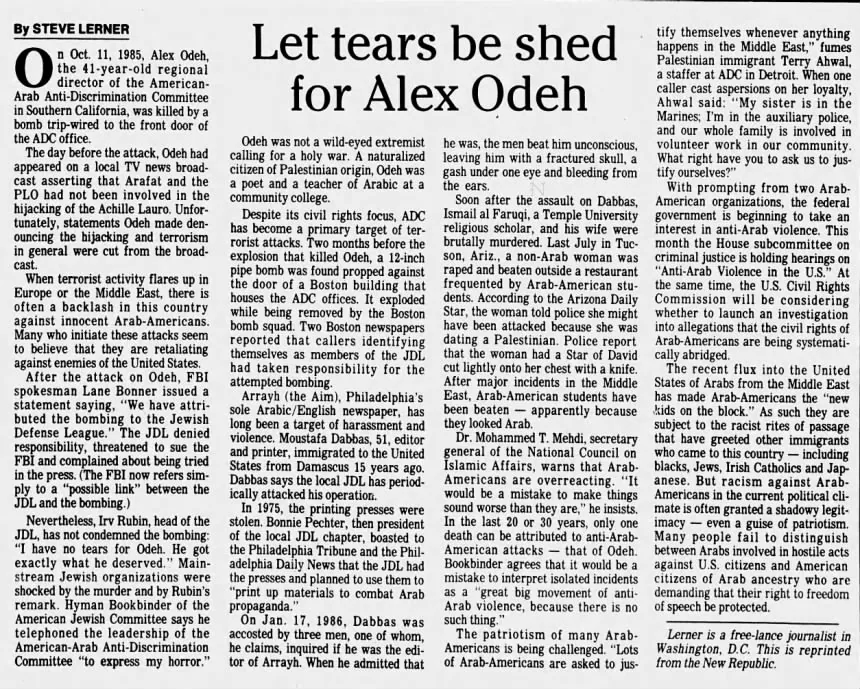
Transcribed from the clipping
On Oct. 11, 1985, Alex Odeh, the 41-year-old regional director of the American-Arab Anti-Discrimination Committee in Southern California, was killed by a bomb trip-wired to the front door of the ADC office. The day before the attack, Odeh had appeared on a local TV news broadcast asserting that Arafat and the PLO had not been involved in the hijacking of the Achille Lauro.
Unfortunately, statements Odeh made denouncing the hijacking and terrorism in general were cut from the broadcast. When terrorist activity flares up in Europe or the Middle East, there is often a backlash in this country against innocent Arab-Americans. Many who initiate these attacks seem to believe that they are retaliating against enemies of the United States.
After the attack on Odeh, FBI spokesman Lane Bonner issued a statement saying, “We have attributed the bombing to the Jewish Defense League.” The JDL denied responsibility, threatened to sue the FBI and complained about being tried in the press. (The FBI now refers simply to a “possible link” between the JDL and the bombing.)
Nevertheless, Irv Rubin, head of the JDL, has not condemned the bombing: “I have no tears for Odeh. He got exactly what he deserved.” Mainstream Jewish organizations were shocked by the murder and by Rubin’s remark.
Hyman Bookbinder of the American Jewish Committee says he telephoned the leadership of the American-Arab Anti-Discrimination Committee “to express my horror.” Odeh was not a wild-eyed extremist calling for a holy war. A naturalized citizen of Palestinian origin, Odeh was a poet and a teacher of Arabic at a community college.
Despite its civil rights focus, ADC has become a primary target of terrorist attacks. Two months before the explosion that killed Odeh, a 12-inch pipe bomb was found propped against the door of a Boston building that houses the ADC offices. It exploded while being removed by the Boston bomb squad.
Two Boston newspapers reported that callers identifying themselves as members of the JDL had taken responsibility for the attempted bombing. Arrayh (the Aim), Philadelphia’s sole Arabic/English newspaper, has long been a target of harassment and violence. Moustafa Dabbas, 51, editor and printer, immigrated to the United States from Damascus 15 years ago.
Dabbas says the local JDL has periodically attacked his operation. In 1975, the printing presses were stolen. Bonnie Pechter, then president of the local JDL chapter, boasted to the Philadelphia Tribune and the Philadelphia Daily News that the JDL had the presses and planned to use them to “print up materials to combat Arab propaganda.” On Jan.
17, 1986, Dabbas was accosted by three men, one of whom, he claims, inquired if he was the editor of Arrayh. When he admitted that he was, the men beat him unconscious, leaving him with a fractured skull, a gash under one eye and bleeding from the ears.
Soon after the assault on Dabbas, Ismail al Faruqi, a Temple University religious scholar, and his wife were brutally murdered. Last July in Tucson, Ariz., a non-Arab woman was raped and beaten outside a restaurant frequented by Arab-American students. According to the Arizona Daily Star, the woman told police she might have been attacked because she was dating a Palestinian.
Police report that the woman had a Star of David cut lightly onto her chest with a knife. After major incidents in the Middle East, Arab-American students have been beaten — apparently because they looked Arab. Dr. Mohammed T. Mehdi, secretary general of the National Council on Islamic Affairs, warns that Arab-Americans are overreacting.
“It would be a mistake to make things sound worse than they are,” he insists. In the last 20 or 30 years, only one death can be attributed to anti-Arab-American attacks — that of Odeh. Bookbinder agrees that it would be a mistake to interpret isolated incidents as a “great big movement of anti-Arab violence, because there is no such thing.”
The patriotism of many Arab-Americans is being challenged. “Lots of Arab-Americans are asked to justify themselves whenever anything happens in the Middle East,” fumes Palestinian immigrant Terry Ahwal, a staffer at ADC in Detroit.
When one caller cast aspersions on her loyalty, Ahwal said: “My sister is in the Marines; I’m in the auxiliary police, and our whole family is involved in volunteer work in our community. What right have you to ask us to justify ourselves?” Lerner is a free-lance journalist in Washington, D.C. This is reprinted from the New Republic.
Cite this clipping
"Let tears be shed for Alex Odeh," The Plain Dealer, 18 July 1986. Covering Palestine archive, CP-1986-023. https://coveringpalestine.org/archive/cp-1986-023
This clipping is read closely in the section below
More from The Plain Dealer
- Arab Women Protest.The Plain Dealer · 28 October 1929
- Rabbi ‘Warns’ U.S. Jews About FundThe Plain Dealer · 23 October 1963
- Israel Integrating Druze AreasThe Plain Dealer · 1969
- Israel bars hunger strike by Arab mayors in GazaThe Plain Dealer · 18 November 1979
- Jordan no Palestine state, Hussein saysThe Plain Dealer · 3 August 1982
- Israeli says he attacked Palestinians for revengeThe Plain Dealer · 5 November 1984
- 9 more from this paper in the full text →
More from the 1980s
- In West Bank, Israeli Policies to Improve the ‘Quality of Life’ Get Mixed ReviewsThe New York Times · 5 January 1986
- Marilyn Klinghoffer Dies at 58; Wife of Victim of Ship HijackersThe New York Times · 10 February 1986
- Jews Are Not Helped by Rewriting HistorySt. Louis Jewish Light · 5 March 1986
- F.B.I. Chief Doubts Anti-Arab Terrorists Caused Capital FireThe New York Times · 15 March 1986
- Views on terrorism differThe Daily Ledger · 18 April 1986
- Italians Say Abbas Masterminded Ship HijackingThe New York Times · 11 June 1986
- All 527 clippings from the 1980s →
In these collections
Last updated 2 November 2026
This record is part of Covering Palestine, an archive of American newspaper clippings about Palestinians, 1724 to 2023. Researched and assembled by Maria Robles.
The clipping belongs to the newspaper that printed it, or to the news agency that supplied the copy. It is reproduced here for research, criticism and commentary. A city here is where the newspaper was published, not where the story came from, and on most records it was taken from the masthead.
Something wrong here, or something you know about this clipping? The archive is still being built and corrections are wanted: maria@rozumstudio.com, quoting CP-1986-023.
Read in: Two Americans killed in one week, and the papers that said so
Everything printed in 1986 · Printed on this day · See it in the archive reel · Full text of every clipping · Dataset