The Berkshire Eagle · 6 April 1988
CP-1988-116
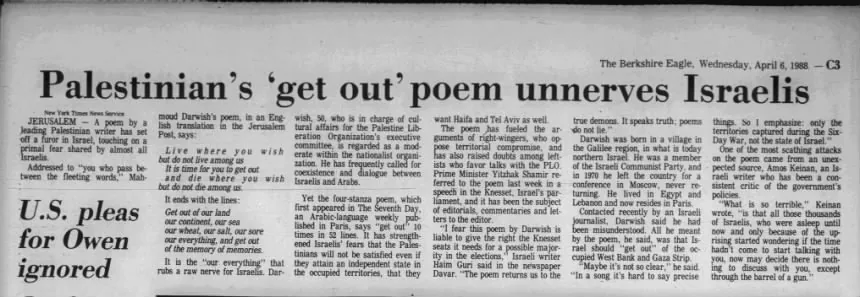
Palestinian's ‘get out’ poem unnerves Israelis
Transcribed from the clipping
JERUSALEM — A poem by a leading Palestinian writer has set off a furor in Israel, touching on a primal fear shared by almost all Israelis.
Addressed to “you who pass between the fleeting words,” Mahmoud Darwish's poem, in an English translation in the Jerusalem Post, says: Live where you wish but do not live among us It is time for you to get out and die where you wish but do not die among us It ends with the lines: Get out of our land our continent, our sea our wheat, our salt, our sore our everything, and get out of the memory of memories It is the “our everything” that rubs a raw nerve for Israelis.
Darwish, 50, who is in charge of cultural affairs for the Palestine Liberation Organization's executive committee, is regarded as a moderate within the nationalist organization. He has frequently called for coexistence and dialogue between Israelis and Arabs.
Yet the four-stanza poem, which first appeared in The Seventh Day, an Arabic-language weekly published in Paris, says “get out” 10 times in 52 lines. It has strengthened Israelis' fears that the Palestinians will not be satisfied even if they attain an independent state in the occupied territories, that they want Haifa and Tel Aviv as well.
The poem has fueled the arguments of right-wingers, who oppose territorial compromise, and has also raised doubts among leftists who favor talks with the PLO. Prime Minister Yitzhak Shamir referred to the poem last week in a speech in the Knesset, Israel's parliament, and it has been the subject of editorials, commentaries and letters to the editor.
“I fear this poem by Darwish is liable to give the right the Knesset seats it needs for a possible majority in the elections,” Israeli writer Haim Guri said in the newspaper Davar. “The poem returns us to the true demons. It speaks truth; poems do not lie.” Darwish was born in a village in the Galilee region, in what is today northern Israel.
He was a member of the Israeli Communist Party, and in 1970 he left the country for a conference in Moscow, never returning. He lived in Egypt and Lebanon and now resides in Paris. Contacted recently by an Israeli journalist, Darwish said he had been misunderstood. All he meant by the poem, he said, was that Israel should “get out” of the occupied West Bank and Gaza Strip.
“Maybe it's not so clear,” he said. “In a song it's hard to say precise things. So I emphasize: only the territories captured during the Six-Day War, not the state of Israel.” One of the most scathing attacks on the poem came from an unexpected source, Amos Keinan, an Israeli writer who has been a consistent critic of the government's policies.
“What is so terrible,” Keinan wrote, “is that all those thousands of Israelis, who were asleep until now and only because of the uprising started wondering if the time hadn't come to start talking with you, now may decide there is nothing to discuss with you, except through the barrel of a gun.”
Cite this clipping
"Palestinian's ‘get out’ poem unnerves Israelis," The Berkshire Eagle, 6 April 1988, p. C3. Covering Palestine archive, CP-1988-116. https://coveringpalestine.org/archive/cp-1988-116
More from The Berkshire Eagle
- Israelis Disclose KillingThe Berkshire Eagle · 13 December 1956
- Guerrillas intercepted in IsraelThe Berkshire Eagle · 27 December 1987
- How the Palestinians became refugeesThe Berkshire Eagle · 11 April 1988
- Israeli raids, riots leave 20 woundedThe Berkshire Eagle · 23 August 1988
More from the 1980s
- Moderation Silenced by Israel RiotsThe Buffalo News · 3 January 1988
- Gaza Strip: the forgotten stepchildNorthwest Herald · 4 January 1988
- 'Iron Fist' Enslaves Gazans In Their LandThe Herald Sun · 6 January 1988
- Israel condemns U.N. vote on deportationsThe Birmingham News · 6 January 1988
- Israeli soldiers fire on protestersCarroll County Times · 6 January 1988
- Undaunted Palestinians resume violenceThe News & Observer · 6 January 1988
- All 527 clippings from the 1980s →
Last updated 2 November 2026
This record is part of Covering Palestine, an archive of American newspaper clippings about Palestinians, 1724 to 2023. Researched and assembled by Maria Robles.
The clipping belongs to the newspaper that printed it, or to the news agency that supplied the copy. It is reproduced here for research, criticism and commentary. A city here is where the newspaper was published, not where the story came from, and on most records it was taken from the masthead.
Something wrong here, or something you know about this clipping? The archive is still being built and corrections are wanted: maria@rozumstudio.com, quoting CP-1988-116.
Everything printed in 1988 · Printed on this day · See it in the archive reel · Full text of every clipping · Dataset