St. Petersburg Times · 7 April 1988
CP-1988-123
Be gone, but who and where?
WILBUR G. LANDREY
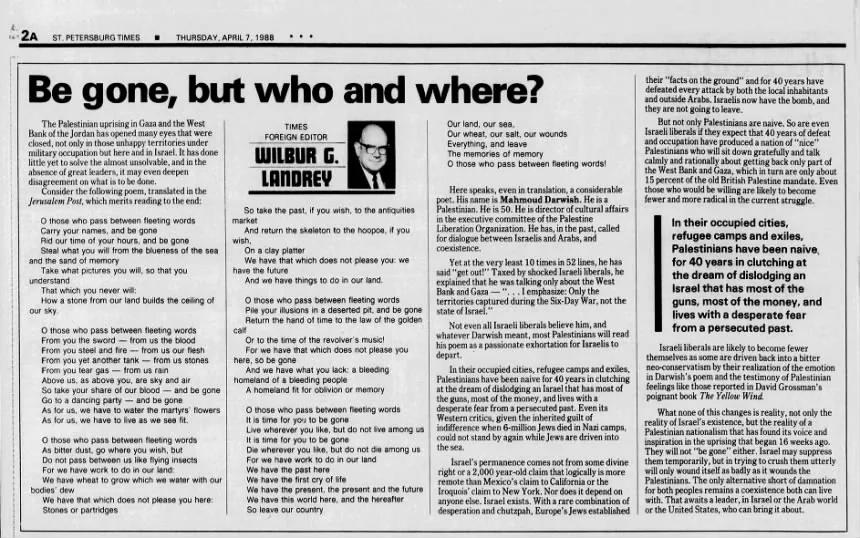
Transcribed from the clipping
The Palestinian uprising in Gaza and the West Bank of the Jordan has opened many eyes that were closed, not only in those unhappy territories under military occupation but here and in Israel. It has done little yet to solve the almost unsolvable, and in the absence of great leaders, it may even deepen disagreement on what is to be done.
Consider the following poem, translated in the Jerusalem Post, which merits reading to the end: O those who pass between fleeting words From you the sword — from us the blood From you steel and fire — from us our flesh From you yet another tank — from us stones From you tear gas — from us rain Above us, as above you, are sky and air So take your share of our blood — and be gone Go to a dancing party — and be gone As for us, we have to water the martyrs’ flowers As for us, we have to live as we see fit. [… the poem continues for a further 45 lines, not reproduced here — see the scan] O those who pass between fleeting words!
Here speaks, even in translation, a considerable poet. His name is Mahmoud Darwish. He is a Palestinian. He is 50. He is director of cultural affairs in the executive committee of the Palestine Liberation Organization. He has, in the past, called for dialogue between Israelis and Arabs, and coexistence. Yet at the very least 10 times in 52 lines, he has said “get out!”
Taxed by shocked Israeli liberals, he explained that he was talking only about the West Bank and Gaza — “. . . I emphasize: Only the territories captured during the Six-Day War, not the state of Israel.” Not even all Israeli liberals believe him, and whatever Darwish meant, most Palestinians will read his poem as a passionate exhortation for Israelis to depart.
In their occupied cities, refugee camps and exiles, Palestinians have been naive for 40 years in clutching at the dream of dislodging an Israel that has most of the guns, most of the money, and lives with a desperate fear from a persecuted past.
Even its Western critics, given the inherited guilt of indifference when 6-million Jews died in Nazi camps, could not stand by again while Jews are driven into the sea. Israel’s permanence comes not from some divine right or a 2,000 year-old claim that logically is more remote than Mexico’s claim to California or the Iroquois’ claim to New York.
Nor does it depend on anyone else. Israel exists. With a rare combination of desperation and chutzpah, Europe’s Jews established their “facts on the ground” and for 40 years have defeated every attack by both the local inhabitants and outside Arabs. Israelis now have the bomb, and they are not going to leave. But not only Palestinians are naive.
So are even Israeli liberals if they expect that 40 years of defeat and occupation have produced a nation of “nice” Palestinians who will sit down gratefully and talk calmly and rationally about getting back only part of the West Bank and Gaza, which in turn are only about 15 percent of the old British Palestine mandate.
Even those who would be willing are likely to become fewer and more radical in the current struggle. Israeli liberals are likely to become fewer themselves as some are driven back into a bitter neo-conservatism by their realization of the emotion in Darwish’s poem and the testimony of Palestinian feelings like those reported in David Grossman’s poignant book The Yellow Wind.
What none of this changes is reality, not only the reality of Israel’s existence, but the reality of a Palestinian nationalism that has found its voice and inspiration in the uprising that began 16 weeks ago. They will not “be gone” either. Israel may suppress them temporarily, but in trying to crush them utterly will only wound itself as badly as it wounds the Palestinians.
The only alternative short of damnation for both peoples remains a coexistence both can live with. That awaits a leader, in Israel or the Arab world or the United States, who can bring it about.
How this transcription was made
The clipping prints Mahmoud Darwish’s poem complete, 52 lines, across two columns and the top of a third, under the line “Consider the following poem, translated in the Jerusalem Post, which merits reading to the end”. The poem is still in copyright, so the excerpt here carries the column’s argument and the opening stanza only; the rest of the poem is not reproduced. The full text is on the scan. Maria can restore it in one edit if she decides the archive should carry it. Read directly from the folio line: “THURSDAY, APRIL 7, 1988”. 7 April 1988 was a Thursday. The body also says the uprising “began 16 weeks ago,” which puts its start in mid-December 1987 — consistent. Agrees with Maria’s label exactly. — Complete column, all four columns, including the poem as the paper set it. The poem is printed in a sans-serif face distinct from the commentary; line breaks follow the printed lines, and where a poem line was too long for the measure the paper ran it over without indentation, which I have joined back into the single line it plainly is (for example “Steal what you will from the blueness of the sea and the sand of memory”). “Jerusalem Post” and “The Yellow Wind” are set in italic in the original. The ellipsis inside the Darwish quotation is set with spaced periods, as here.
Cite this clipping
"Be gone, but who and where?," St. Petersburg Times, 7 April 1988, p. 2A. Covering Palestine archive, CP-1988-123. https://coveringpalestine.org/archive/cp-1988-123
More from St. Petersburg Times
- Mideast violenceSt. Petersburg Times · 4 October 2000
- Sides look to U.S. to help end killingSt. Petersburg Times · 4 October 2000
More from the 1980s
- Moderation Silenced by Israel RiotsThe Buffalo News · 3 January 1988
- Gaza Strip: the forgotten stepchildNorthwest Herald · 4 January 1988
- 'Iron Fist' Enslaves Gazans In Their LandThe Herald Sun · 6 January 1988
- Israel condemns U.N. vote on deportationsThe Birmingham News · 6 January 1988
- Israeli soldiers fire on protestersCarroll County Times · 6 January 1988
- Undaunted Palestinians resume violenceThe News & Observer · 6 January 1988
- All 527 clippings from the 1980s →
Last updated 2 November 2026
This record is part of Covering Palestine, an archive of American newspaper clippings about Palestinians, 1724 to 2023. Researched and assembled by Maria Robles.
The clipping belongs to the newspaper that printed it, or to the news agency that supplied the copy. It is reproduced here for research, criticism and commentary. A city here is where the newspaper was published, not where the story came from, and on most records it was taken from the masthead.
Something wrong here, or something you know about this clipping? The archive is still being built and corrections are wanted: maria@rozumstudio.com, quoting CP-1988-123.
Everything printed in 1988 · Printed on this day · See it in the archive reel · Full text of every clipping · Dataset