(newspaper unidentified) · 9 April 1988
CP-1988-125
Why do the Israeli ‘boys’ fight?
Cal Thomas [set beside a portrait photograph of the columnist, in the standing column slug rather than as a conventional byline line]
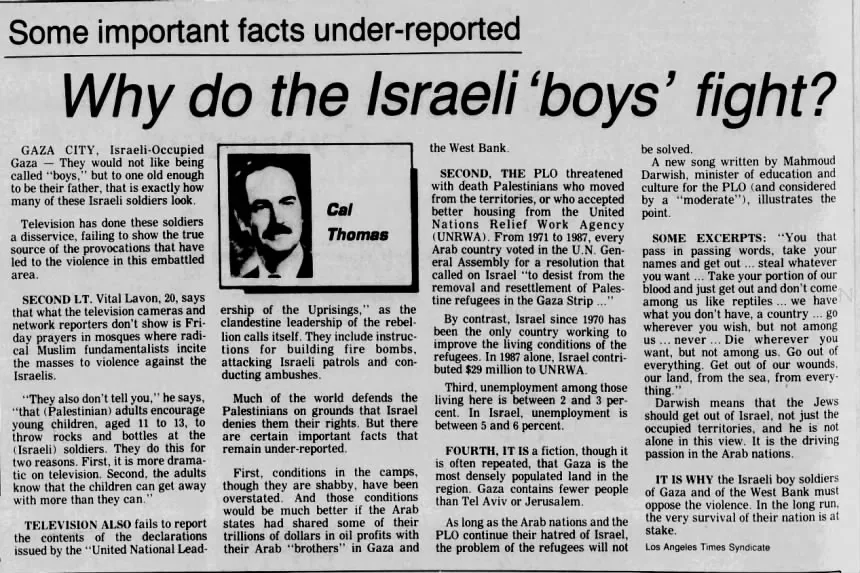
Transcribed from the clipping
GAZA CITY, Israeli-Occupied Gaza — They would not like being called “boys,” but to one old enough to be their father, that is exactly how many of these Israeli soldiers look. Television has done these soldiers a disservice, failing to show the true source of the provocations that have led to the violence in this embattled area. SECOND LT.
Vital Lavon, 20, says that what the television cameras and network reporters don’t show is Friday prayers in mosques where radical Muslim fundamentalists incite the masses to violence against the Israelis. “They also don’t tell you,” he says, “that (Palestinian) adults encourage young children, aged 11 to 13, to throw rocks and bottles at the (Israeli) soldiers.
They do this for two reasons. First, it is more dramatic on television. Second, the adults know that the children can get away with more than they can.” TELEVISION ALSO fails to report the contents of the declarations issued by the “United National Leadership of the Uprisings,” as the clandestine leadership of the rebellion calls itself.
They include instructions for building fire bombs, attacking Israeli patrols and conducting ambushes. Much of the world defends the Palestinians on grounds that Israel denies them their rights. But there are certain important facts that remain under-reported. First, conditions in the camps, though they are shabby, have been overstated.
And those conditions would be much better if the Arab states had shared some of their trillions of dollars in oil profits with their Arab “brothers” in Gaza and the West Bank. SECOND, THE PLO threatened with death Palestinians who moved from the territories, or who accepted better housing from the United Nations Relief Work Agency (UNRWA).
From 1971 to 1987, every Arab country voted in the U.N. General Assembly for a resolution that called on Israel “to desist from the removal and resettlement of Palestine refugees in the Gaza Strip ...” By contrast, Israel since 1970 has been the only country working to improve the living conditions of the refugees. In 1987 alone, Israel contributed $29 million to UNRWA.
Third, unemployment among those living here is between 2 and 3 percent. In Israel, unemployment is between 5 and 6 percent. FOURTH, IT IS a fiction, though it is often repeated, that Gaza is the most densely populated land in the region. Gaza contains fewer people than Tel Aviv or Jerusalem.
As long as the Arab nations and the PLO continue their hatred of Israel, the problem of the refugees will not be solved. A new song written by Mahmoud Darwish, minister of education and culture for the PLO (and considered by a “moderate”), illustrates the point. SOME EXCERPTS: “You that pass in passing words, take your names and get out ... steal whatever you want ...
Take your portion of our blood and just get out and don’t come among us like reptiles ... we have what you don’t have, a country ... go wherever you wish, but not among us ... never ... Die wherever you want, but not among us. Go out of everything. Get out of our wounds, our land, from the sea, from everything.”
Darwish means that the Jews should get out of Israel, not just the occupied territories, and he is not alone in this view. It is the driving passion in the Arab nations. IT IS WHY the Israeli boy soldiers of Gaza and of the West Bank must oppose the violence. In the long run, the very survival of their nation is at stake.
How this transcription was made
Masthead not readable on the scan. The label on the slide read: [no masthead on clipping; the column is credited at the foot to the Los Angeles Times Syndicate] — Single scan of a four-column opinion piece; read in four column crops at 8x. — No masthead, running head or printed date on the cut. Nothing in the column fixes a day — it is a syndicated opinion piece with no news peg tied to a date. The date is carried entirely from Maria’s label and cannot be checked against the page. Flag for a date check against a database before publishing.
Cite this clipping
"Why do the Israeli ‘boys’ fight?," (newspaper unidentified), 9 April 1988. Covering Palestine archive, CP-1988-125. https://coveringpalestine.org/archive/cp-1988-125
More from (newspaper unidentified)
- Kaiser Wilhelm's Trip to Palestine(newspaper unidentified) · 9 April 1898
- States the Arab Point of View Concerning Palestine(newspaper unidentified) · 1 January 1946
- Forcing Palestine to Become a World Problem(newspaper unidentified) · 1 January 1947
- Arab Terrorist Spokesman Killed As Auto Explodes(newspaper unidentified) · 8 July 1972
- Bomb in car kills Arab guerrilla chief(newspaper unidentified) · 8 July 1972
- Arab Who Claimed Massacre Credit Dies(newspaper unidentified) · 8 July 1972
- 57 more from this paper in the full text →
More from the 1980s
- Moderation Silenced by Israel RiotsThe Buffalo News · 3 January 1988
- Gaza Strip: the forgotten stepchildNorthwest Herald · 4 January 1988
- 'Iron Fist' Enslaves Gazans In Their LandThe Herald Sun · 6 January 1988
- Israel condemns U.N. vote on deportationsThe Birmingham News · 6 January 1988
- Israeli soldiers fire on protestersCarroll County Times · 6 January 1988
- Undaunted Palestinians resume violenceThe News & Observer · 6 January 1988
- All 527 clippings from the 1980s →
Last updated 2 November 2026
This record is part of Covering Palestine, an archive of American newspaper clippings about Palestinians, 1724 to 2023. Researched and assembled by Maria Robles.
The clipping belongs to the newspaper that printed it, or to the news agency that supplied the copy. It is reproduced here for research, criticism and commentary. A city here is where the newspaper was published, not where the story came from, and on most records it was taken from the masthead.
Something wrong here, or something you know about this clipping? The archive is still being built and corrections are wanted: maria@rozumstudio.com, quoting CP-1988-125.
Everything printed in 1988 · Printed on this day · See it in the archive reel · Full text of every clipping · Dataset