(newspaper unidentified) · 11 April 1988
CP-1988-124
Middle Ground Erodes as Uprising Alienates Moderates
By GLENN FRANKEL / L.A. Times-Washington Post News Service
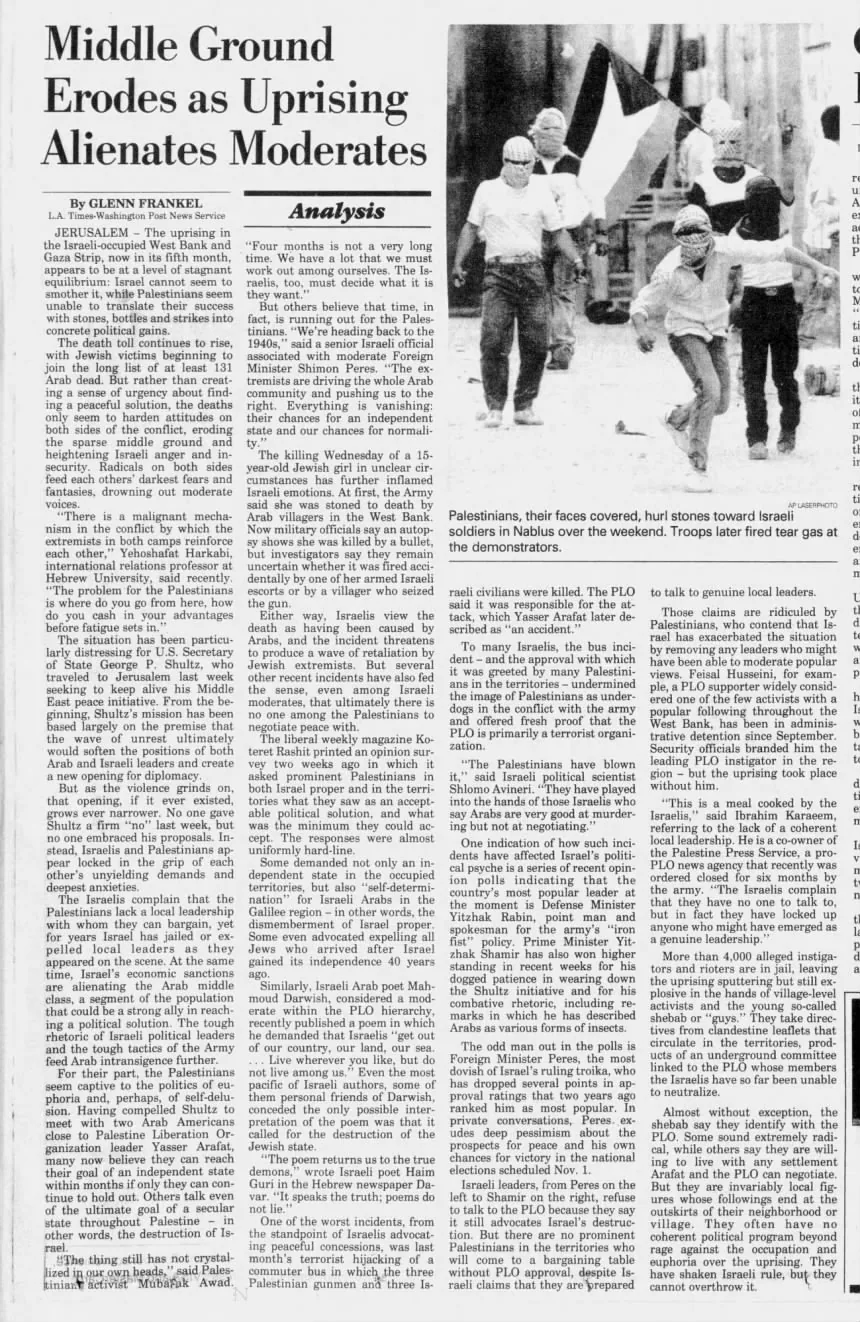
Transcribed from the clipping
JERUSALEM – The uprising in the Israeli-occupied West Bank and Gaza Strip, now in its fifth month, appears to be at a level of stagnant equilibrium: Israel cannot seem to smother it, while Palestinians seem unable to translate their success with stones, bottles and strikes into concrete political gains.
The death toll continues to rise, with Jewish victims beginning to join the long list of at least 131 Arab dead. But rather than creating a sense of urgency about finding a peaceful solution, the deaths only seem to harden attitudes on both sides of the conflict, eroding the sparse middle ground and heightening Israeli anger and insecurity.
Radicals on both sides feed each others’ darkest fears and fantasies, drowning out moderate voices. “There is a malignant mechanism in the conflict by which the extremists in both camps reinforce each other,” Yehoshafat Harkabi, international relations professor at Hebrew University, said recently.
“The problem for the Palestinians is where do you go from here, how do you cash in your advantages before fatigue sets in.” The situation has been particularly distressing for U.S. Secretary of State George P. Shultz, who traveled to Jerusalem last week seeking to keep alive his Middle East peace initiative.
From the beginning, Shultz’s mission has been based largely on the premise that the wave of unrest ultimately would soften the positions of both Arab and Israeli leaders and create a new opening for diplomacy. But as the violence grinds on, that opening, if it ever existed, grows ever narrower. No one gave Shultz a firm “no” last week, but no one embraced his proposals.
Instead, Israelis and Palestinians appear locked in the grip of each other’s unyielding demands and deepest anxieties. The Israelis complain that the Palestinians lack a local leadership with whom they can bargain, yet for years Israel has jailed or expelled local leaders as they appeared on the scene.
At the same time, Israel’s economic sanctions are alienating the Arab middle class, a segment of the population that could be a strong ally in reaching a political solution. The tough rhetoric of Israeli political leaders and the tough tactics of the Army feed Arab intransigence further.
For their part, the Palestinians seem captive to the politics of euphoria and, perhaps, of self-delusion. Having compelled Shultz to meet with two Arab Americans close to Palestine Liberation Organization leader Yasser Arafat, many now believe they can reach their goal of an independent state within months if only they can continue to hold out.
Others talk even of the ultimate goal of a secular state throughout Palestine – in other words, the destruction of Israel. “The thing still has not crystallized in our own heads,” said Palestinian activist Mubarak Awad. ...
Those claims are ridiculed by Palestinians, who contend that Israel has exacerbated the situation by removing any leaders who might have been able to moderate popular views. Feisal Husseini, for example, a PLO supporter widely considered one of the few activists with a popular following throughout the West Bank, has been in administrative detention since September.
Security officials branded him the leading PLO instigator in the region – but the uprising took place without him. “This is a meal cooked by the Israelis,” said Ibrahim Karaeem, referring to the lack of a coherent local leadership. He is a co-owner of the Palestine Press Service, a pro-PLO news agency that recently was ordered closed for six months by the army.
“The Israelis complain that they have no one to talk to, but in fact they have locked up anyone who might have emerged as a genuine leadership.” More than 4,000 alleged instigators and rioters are in jail, leaving the uprising sputtering but still explosive in the hands of village-level activists and the young so-called shebab or “guys.”
How this transcription was made
Masthead not readable on the scan. The label on the slide read: [no masthead on clipping] — Single scan of a broadsheet page; read in eight column crops at 7x–8x plus a separate crop of the photo caption and its AP LASERPHOTO credit. The excerpt gives column one in full, then skips to the lower right columns, marked with an ellipsis. Intervening material (the Shultz round-up, the Beita killing, the Koteret Rashit poll and the Darwish poem) is summarized in notable and quoted in quotes rather than run into the excerpt. — No masthead or date line survives on the cut. Internal evidence: the uprising is “now in its fifth month” (it began in December 1987); Shultz “traveled to Jerusalem last week”; the killing of the Israeli girl was “Wednesday”; the photograph is captioned “in Nablus over the weekend”; and the Israeli elections are “scheduled Nov. 1” (1 November 1988). A Monday paper in the week after Wednesday 6 April 1988 is Monday 11 April 1988. Consistent with Maria’s label but inferred, not read.
Cite this clipping
"Middle Ground Erodes as Uprising Alienates Moderates," (newspaper unidentified), 11 April 1988. Covering Palestine archive, CP-1988-124. https://coveringpalestine.org/archive/cp-1988-124
More from (newspaper unidentified)
- Kaiser Wilhelm's Trip to Palestine(newspaper unidentified) · 9 April 1898
- States the Arab Point of View Concerning Palestine(newspaper unidentified) · 1 January 1946
- Forcing Palestine to Become a World Problem(newspaper unidentified) · 1 January 1947
- Arab Terrorist Spokesman Killed As Auto Explodes(newspaper unidentified) · 8 July 1972
- Bomb in car kills Arab guerrilla chief(newspaper unidentified) · 8 July 1972
- Arab Who Claimed Massacre Credit Dies(newspaper unidentified) · 8 July 1972
- 57 more from this paper in the full text →
More from the 1980s
- Moderation Silenced by Israel RiotsThe Buffalo News · 3 January 1988
- Gaza Strip: the forgotten stepchildNorthwest Herald · 4 January 1988
- 'Iron Fist' Enslaves Gazans In Their LandThe Herald Sun · 6 January 1988
- Israel condemns U.N. vote on deportationsThe Birmingham News · 6 January 1988
- Israeli soldiers fire on protestersCarroll County Times · 6 January 1988
- Undaunted Palestinians resume violenceThe News & Observer · 6 January 1988
- All 527 clippings from the 1980s →
Last updated 2 November 2026
This record is part of Covering Palestine, an archive of American newspaper clippings about Palestinians, 1724 to 2023. Researched and assembled by Maria Robles.
The clipping belongs to the newspaper that printed it, or to the news agency that supplied the copy. It is reproduced here for research, criticism and commentary. A city here is where the newspaper was published, not where the story came from, and on most records it was taken from the masthead.
Something wrong here, or something you know about this clipping? The archive is still being built and corrections are wanted: maria@rozumstudio.com, quoting CP-1988-124.
Everything printed in 1988 · Printed on this day · See it in the archive reel · Full text of every clipping · Dataset