The Miami Herald · 12 April 1988
CP-1988-132
Israelis and Palestinians grapple toward the edge
JAMES McCARTNEY, WASHINGTON BUREAU (left column) / By CAL THOMAS (right column, Los Angeles Times Syndicate)
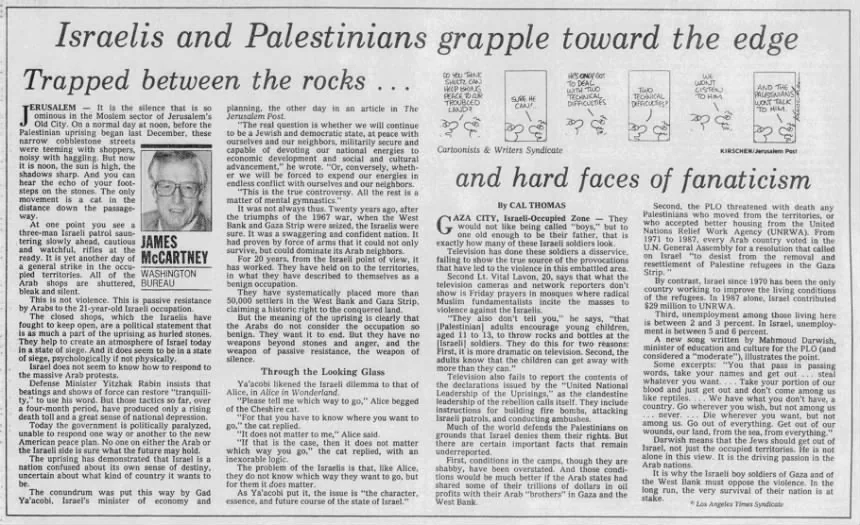
Transcribed from the clipping
[LEFT COLUMN — 'Trapped between the rocks ...' by James McCartney, Washington Bureau] JERUSALEM — It is the silence that is so ominous in the Moslem sector of Jerusalem's Old City. On a normal day at noon, before the Palestinian uprising began last December, these narrow cobblestone streets were teeming with shoppers, noisy with haggling.
But now it is noon, the sun is high, the shadows sharp. And you can hear the echo of your footsteps on the stones. The only movement is a cat in the distance down the passageway. At one point you see a three-man Israeli patrol sauntering slowly ahead, cautious and watchful, rifles at the ready. It is yet another day of a general strike in the occupied territories.
All of the Arab shops are shuttered, bleak and silent. This is not violence. This is passive resistance by Arabs to the 21-year-old Israeli occupation. The closed shops, which the Israelis have fought to keep open, are a political statement that is as much a part of the uprising as hurled stones. They help to create an atmosphere of Israel today in a state of siege.
And it does seem to be in a state of siege, psychologically if not physically. Israel does not seem to know how to respond to the massive Arab protests. Defense Minister Yitzhak Rabin insists that beatings and shows of force can restore “tranquility,” to use his word.
But those tactics so far, over a four-month period, have produced only a rising death toll and a great sense of national depression. Today the government is politically paralyzed, unable to respond one way or another to the new American peace plan. No one on either the Arab or the Israeli side is sure what the future may hold.
The uprising has demonstrated that Israel is a nation confused about its own sense of destiny, uncertain about what kind of country it wants to be. The conundrum was put this way by Gad Ya'acobi, Israel's minister of economy and planning, the other day in an article in The Jerusalem Post.
“The real question is whether we will continue to be a Jewish and democratic state, at peace with ourselves and our neighbors, militarily secure and capable of devoting our national energies to economic development and social and cultural advancement,” he wrote.
“Or, conversely, whether we will be forced to expend our energies in endless conflict with ourselves and our neighbors. “This is the true controversy. All the rest is a matter of mental gymnastics.” It was not always thus. Twenty years ago, after the triumphs of the 1967 war, when the West Bank and Gaza Strip were seized, the Israelis were sure.
It was a swaggering and confident nation. It had proven by force of arms that it could not only survive, but could dominate its Arab neighbors. For 20 years, from the Israeli point of view, it has worked. They have held on to the territories, in what they have described to themselves as a benign occupation.
They have systematically placed more than 50,000 settlers in the West Bank and Gaza Strip, claiming a historic right to the conquered land. But the meaning of the uprising is clearly that the Arabs do not consider the occupation so benign. They want it to end. But they have no weapons beyond stones and anger, and the weapon of passive resistance, the weapon of silence.
Through the Looking Glass Ya'acobi likened the Israeli dilemma to that of Alice, in Alice in Wonderland. “Please tell me which way to go,” Alice begged of the Cheshire cat. “For that you have to know where you want to go,” the cat replied. “It does not matter to me,” Alice said.
“If that is the case, then it does not matter which way you go,” the cat replied, with an inexorable logic. The problem of the Israelis is that, like Alice, they do not know which way they want to go, but for them it does matter.
As Ya'acobi put it, the issue is “the character, essence, and future course of the state of Israel.” [RIGHT COLUMN — 'and hard faces of fanaticism' by Cal Thomas] GAZA CITY, Israeli-Occupied Zone — They would not like being called “boys,” but to one old enough to be their father, that is exactly how many of these Israeli soldiers look.
Television has done these soldiers a disservice, failing to show the true source of the provocations that have led to the violence in this embattled area. Second Lt. Vital Lavon, 20, says that what the television cameras and network reporters don't show is Friday prayers in mosques where radical Muslim fundamentalists incite the masses to violence against the Israelis.
“They also don't tell you,” he says, “that [Palestinian] adults encourage young children, aged 11 to 13, to throw rocks and bottles at the [Israeli] soldiers. They do this for two reasons. First, it is more dramatic on television. Second, the adults know that the children can get away with more than they can.”
Television also fails to report the contents of the declarations issued by the “United National Leadership of the Uprisings,” as the clandestine leadership of the rebellion calls itself. They include instructions for building fire bombs, attacking Israeli patrols, and conducting ambushes.
Much of the world defends the Palestinians on grounds that Israel denies them their rights. But there are certain important facts that remain underreported. First, conditions in the camps, though they are shabby, have been overstated.
And those conditions would be much better if the Arab states had shared some of their trillions of dollars in oil profits with their Arab “brothers” in Gaza and the West Bank. Second, the PLO threatened with death any Palestinians who moved from the territories, or who accepted better housing from the United Nations Relief Work Agency (UNRWA).
From 1971 to 1987, every Arab country voted in the U.N. General Assembly for a resolution that called on Israel “to desist from the removal and resettlement of Palestine refugees in the Gaza Strip.” By contrast, Israel since 1970 has been the only country working to improve the living conditions of the refugees. In 1987 alone, Israel contributed $29 million to UNRWA.
Third, unemployment among those living here is between 2 and 3 percent. In Israel, unemployment is between 5 and 6 percent. A new song written by Mahmoud Darwish, minister of education and culture for the PLO (and considered a “moderate”), illustrates the point. Some excerpts: “You that pass in passing words, take your names and get out ... steal whatever you want. ...
Take your portion of our blood and just get out and don't come among us like reptiles. ... We have what you don't have, a country. Go wherever you wish, but not among us ... never. ... Die wherever you want, but not among us. Go out of everything. Get out of our wounds, our land, from the sea, from everything.”
Darwish means that the Jews should get out of Israel, not just the occupied territories. He is not alone in this view. It is the driving passion in the Arab nations. It is why the Israeli boy soldiers of Gaza and of the West Bank must oppose the violence. In the long run, the very survival of their nation is at stake.
How this transcription was made
No masthead on the cut. Attribution rests on Maria's label. The left column is bylined 'JAMES McCARTNEY / WASHINGTON BUREAU', which is consistent with a Knight-Ridder paper such as the Herald; the right column carries a Los Angeles Times Syndicate credit, so the two pieces come from different suppliers and neither names the host paper. — No printed date anywhere on the cut. Internal evidence puts it in April 1988: 'the Palestinian uprising began last December', 'the 21-year-old Israeli occupation', Rabin's tactics 'over a four-month period', 'the new American peace plan' (Shultz), and a Kirschen cartoon about Shultz. All consistent with Maria's April 12 1988 label; none of it fixes the day. — Both columns transcribed in full from magnified crops. The bracketed labels marking which column is which are mine, not the paper's. The square brackets inside Lt. Lavon's quote — '[Palestinian]' and '[Israeli]' — are printed on the page, Cal Thomas's own interpolations. The Darwish ellipses are set as printed. — This is one opinion package with two columns by two writers under one banner. The banner head is 'Israelis and Palestinians grapple toward the edge'. Below it the two pieces carry sub-heads that complete a single sentence across the spread: 'Trapped between the rocks ...' over the McCartney column on the left and 'and hard faces of fanaticism' over the Cal Thomas column on the right. Those are sub-heads to their own columns, not a deck to the banner, so dek is left empty. A six-panel Kirschen cartoon sits between them.
Cite this clipping
"Israelis and Palestinians grapple toward the edge," The Miami Herald, 12 April 1988. Covering Palestine archive, CP-1988-132. https://coveringpalestine.org/archive/cp-1988-132
More from The Miami Herald
- Irgun Takes Arab City In Night BattleThe Miami Herald · 5 May 1948
- Arabs Learn ABCs With the Hatred Left OutThe Miami Herald · 7 September 1967
- Debate Rages on Arab Refugee ProblemThe Miami Herald · 7 October 1967
- Downing Airliner Also TerrorismThe Miami Herald · 14 March 1973
- Buildings Burn and Corpses Rot In What Remains of Tal ZaatarThe Miami Herald · 14 August 1976
- The PalestiniansThe Miami Herald · 29 May 1977
- 18 more from this paper in the full text →
More from the 1980s
- Moderation Silenced by Israel RiotsThe Buffalo News · 3 January 1988
- Gaza Strip: the forgotten stepchildNorthwest Herald · 4 January 1988
- 'Iron Fist' Enslaves Gazans In Their LandThe Herald Sun · 6 January 1988
- Israel condemns U.N. vote on deportationsThe Birmingham News · 6 January 1988
- Israeli soldiers fire on protestersCarroll County Times · 6 January 1988
- Undaunted Palestinians resume violenceThe News & Observer · 6 January 1988
- All 527 clippings from the 1980s →
Last updated 2 November 2026
This record is part of Covering Palestine, an archive of American newspaper clippings about Palestinians, 1724 to 2023. Researched and assembled by Maria Robles.
The clipping belongs to the newspaper that printed it, or to the news agency that supplied the copy. It is reproduced here for research, criticism and commentary. A city here is where the newspaper was published, not where the story came from, and on most records it was taken from the masthead.
Something wrong here, or something you know about this clipping? The archive is still being built and corrections are wanted: maria@rozumstudio.com, quoting CP-1988-132.
Everything printed in 1988 · Printed on this day · See it in the archive reel · Full text of every clipping · Dataset