The New York Times · 26 October 1988
CP-1988-130
Israel Bars 3 Reporters Over 'Undercover' Articles
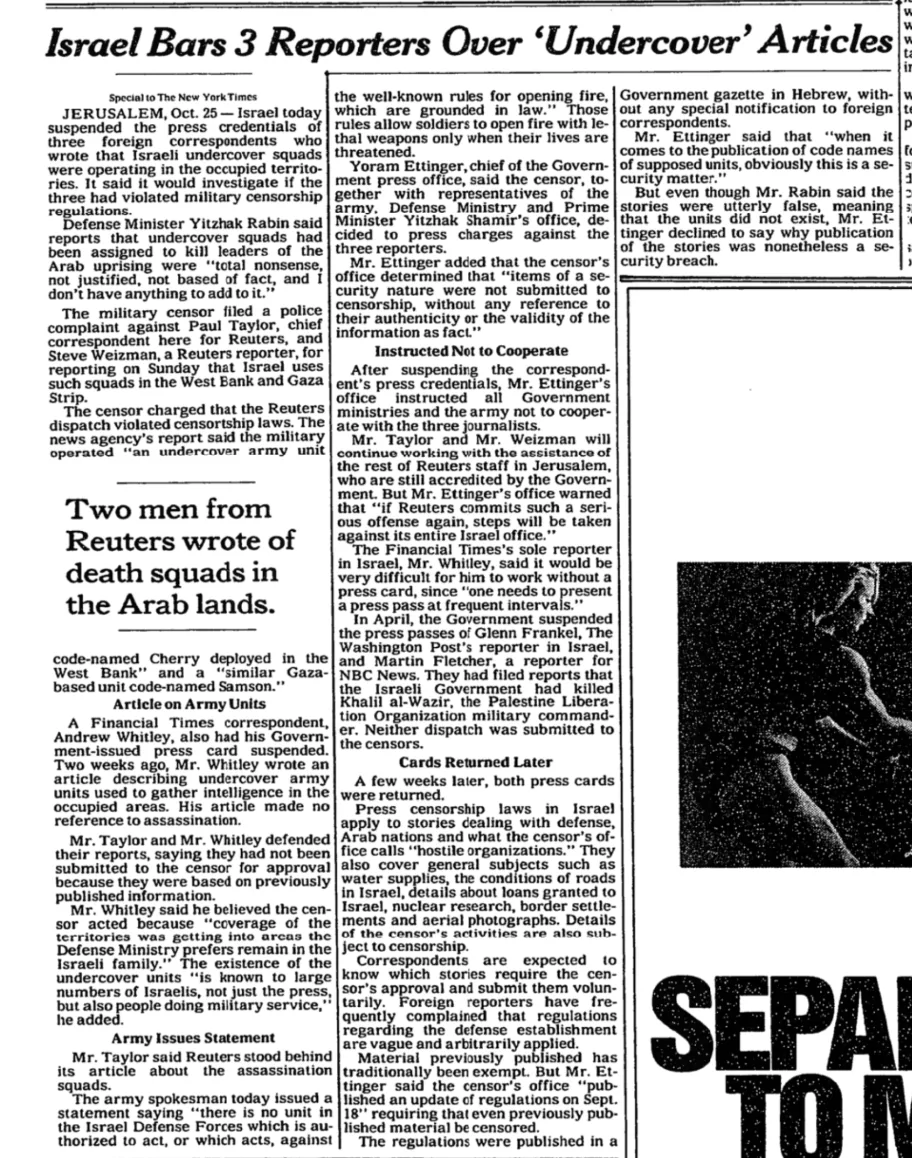
Transcribed from the clipping
JERUSALEM, Oct. 25 — Israel today suspended the press credentials of three foreign correspondents who wrote that Israeli undercover squads were operating in the occupied territories. It said it would investigate if the three had violated military censorship regulations.
Defense Minister Yitzhak Rabin said reports that undercover squads had been assigned to kill leaders of the Arab uprising were “total nonsense, not justified, not based of fact, and I don't have anything to add to it.”
The military censor filed a police complaint against Paul Taylor, chief correspondent here for Reuters, and Steve Weizman, a Reuters reporter, for reporting on Sunday that Israel uses such squads in the West Bank and Gaza Strip. The censor charged that the Reuters dispatch violated censortship laws.
The news agency's report said the military operated “an undercover army unit code-named Cherry deployed in the West Bank” and a “similar Gaza-based unit code-named Samson.” Article on Army Units A Financial Times correspondent, Andrew Whitley, also had his Government-issued press card suspended. Two weeks ago, Mr.
Whitley wrote an article describing undercover army units used to gather intelligence in the occupied areas. His article made no reference to assassination. Mr. Taylor and Mr. Whitley defended their reports, saying they had not been submitted to the censor for approval because they were based on previously published information. Mr.
Whitley said he believed the censor acted because “coverage of the territories was getting into areas the Defense Ministry prefers remain in the Israeli family.” The existence of the undercover units “is known to large numbers of Israelis, not just the press, but also people doing military service,” he added. Army Issues Statement Mr.
Taylor said Reuters stood behind its article about the assassination squads. The army spokesman today issued a statement saying “there is no unit in the Israel Defense Forces which is authorized to act, or which acts, against the well-known rules for opening fire, which are grounded in law.”
Those rules allow soldiers to open fire with lethal weapons only when their lives are threatened. Yoram Ettinger, chief of the Government press office, said the censor, together with representatives of the army, Defense Ministry and Prime Minister Yitzhak Shamir's office, decided to press charges against the three reporters. Mr.
Ettinger added that the censor's office determined that “items of a security nature were not submitted to censorship, without any reference to their authenticity or the validity of the information as fact.” Instructed Not to Cooperate After suspending the correspondent's press credentials, Mr.
Ettinger's office instructed all Government ministries and the army not to cooperate with the three journalists. Mr. Taylor and Mr. Weizman will continue working with the assistance of the rest of Reuters staff in Jerusalem, who are still accredited by the Government. But Mr.
Ettinger's office warned that “if Reuters commits such a serious offense again, steps will be taken against its entire Israel office.” The Financial Times's sole reporter in Israel, Mr. Whitley, said it would be very difficult for him to work without a press card, since “one needs to present a press pass at frequent intervals.”
In April, the Government suspended the press passes of Glenn Frankel, The Washington Post's reporter in Israel, and Martin Fletcher, a reporter for NBC News. They had filed reports that the Israeli Government had killed Khalil al-Wazir, the Palestine Liberation Organization military commander. Neither dispatch was submitted to the censors.
Cards Returned Later A few weeks later, both press cards were returned. Press censorship laws in Israel apply to stories dealing with defense, Arab nations and what the censor's office calls “hostile organizations.”
They also cover general subjects such as water supplies, the conditions of roads in Israel, details about loans granted to Israel, nuclear research, border settlements and aerial photographs. Details of the censor's activities are also subject to censorship. Correspondents are expected to know which stories require the censor's approval and submit them voluntarily.
Foreign reporters have frequently complained that regulations regarding the defense establishment are vague and arbitrarily applied. Material previously published has traditionally been exempt. But Mr. Ettinger said the censor's office “published an update of regulations on Sept. 18” requiring that even previously published material be censored.
The regulations were published in a Government gazette in Hebrew, without any special notification to foreign correspondents. Mr. Ettinger said that “when it comes to the publication of code names of supposed units, obviously this is a security matter.” But even though Mr. Rabin said the stories were utterly false, meaning that the units did not exist, Mr.
Ettinger declined to say why publication of the stories was nonetheless a security breach.
How this transcription was made
Credit line above the dateline reads "Special to The New York Times". Masthead itself not in frame. — No printed date. The dateline reads "JERUSALEM, Oct. 25" and the story says Israel acted "today", which puts publication on 26 October. The year is not printed; 1988 is supported by Rabin as defense minister, Shamir as prime minister, the first intifada as "the Arab uprising", and the reference to Khalil al-Wazir's killing "In April" (April 1988). LABEL ORDER DISAGREEMENT — see below. — Maria's labels for this slide read "New York Times Oct 26 1988 / New York Times Aug 11 1982", in that order, but the images are in the opposite order: s061_1 is the August 1982 Beirut story (dateline Aug. 10) and s061_2 is this October 1988 censorship story (dateline Oct. 25). Both dates in her label are right; they are paired to the wrong images. I have matched each record to the page it actually belongs to and left her dates unchanged. — Transcribed from magnified crops of all three columns. Two printed errors kept as set, both worth noting: Rabin is quoted saying the reports were "not based of fact" (for "not based on fact"), and the paper prints "violated censortship laws" — a typo in the word censorship, in a story about censorship. Also as printed: "the correspondent's press credentials" (singular possessive where three correspondents are meant). — Single quotation marks around 'Undercover' as set. — No deck. "Two men from Reuters wrote of death squads in the Arab lands." is a PULL QUOTE — set large, between two rules, inside the first column, not under the headline. Recorded here so it is not mistaken for a deck. "Article on Army Units", "Army Issues Statement", "Instructed Not to Cooperate" and "Cards Returned Later" are bold subheads.
Cite this clipping
"Israel Bars 3 Reporters Over 'Undercover' Articles," The New York Times, 26 October 1988. Covering Palestine archive, CP-1988-130. https://coveringpalestine.org/archive/cp-1988-130
More from The New York Times
- The Maine Colony in PalestineThe New York Times · 12 November 1866
- Jewish Colonization in PalestineThe New York Times · 9 December 1883
- Jewish State in Palestine OpposedThe New York Times · 9 July 1897
- ZIONIST CONGRESS IN BASELThe New York Times · 31 August 1897
- ROME FEARS THE ZIONISTSThe New York Times · 12 September 1897
- PROGRESS OF ZIONISMThe New York Times · 16 December 1901
- 852 more from this paper in the full text →
More from the 1980s
- Moderation Silenced by Israel RiotsThe Buffalo News · 3 January 1988
- Gaza Strip: the forgotten stepchildNorthwest Herald · 4 January 1988
- 'Iron Fist' Enslaves Gazans In Their LandThe Herald Sun · 6 January 1988
- Israel condemns U.N. vote on deportationsThe Birmingham News · 6 January 1988
- Israeli soldiers fire on protestersCarroll County Times · 6 January 1988
- Undaunted Palestinians resume violenceThe News & Observer · 6 January 1988
- All 527 clippings from the 1980s →
Last updated 2 November 2026
This record is part of Covering Palestine, an archive of American newspaper clippings about Palestinians, 1724 to 2023. Researched and assembled by Maria Robles.
The clipping belongs to the newspaper that printed it, or to the news agency that supplied the copy. It is reproduced here for research, criticism and commentary. A city here is where the newspaper was published, not where the story came from, and on most records it was taken from the masthead.
Something wrong here, or something you know about this clipping? The archive is still being built and corrections are wanted: maria@rozumstudio.com, quoting CP-1988-130.
Everything printed in 1988 · Printed on this day · See it in the archive reel · Full text of every clipping · Dataset