The New York Times · 21 December 1988
CP-1988-135
Ballots, Not Bullets, for the West Bank
By Shimon Peres
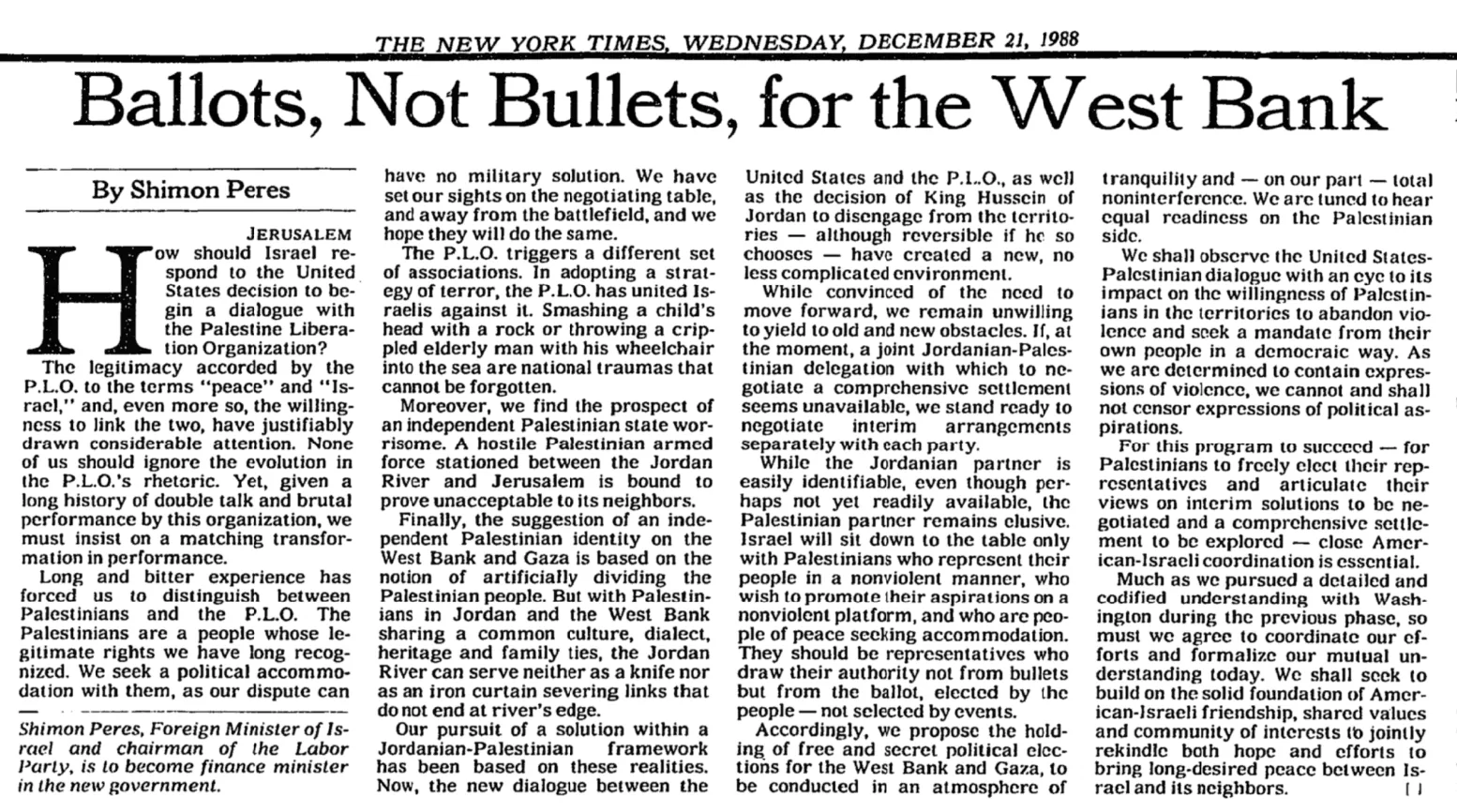
Transcribed from the clipping
JERUSALEM How should Israel respond to the United States decision to begin a dialogue with the Palestine Liberation Organization? The legitimacy accorded by the P.L.O. to the terms “peace” and “Israel,” and, even more so, the willingness to link the two, have justifiably drawn considerable attention. None of us should ignore the evolution in the P.L.O.'s rhetoric.
Yet, given a long history of double talk and brutal performance by this organization, we must insist on a matching transformation in performance. Long and bitter experience has forced us to distinguish between Palestinians and the P.L.O. The Palestinians are a people whose legitimate rights we have long recognized.
We seek a political accommodation with them, as our dispute can have no military solution. We have set our sights on the negotiating table, and away from the battlefield, and we hope they will do the same. The P.L.O. triggers a different set of associations. In adopting a strategy of terror, the P.L.O. has united Israelis against it.
Smashing a child's head with a rock or throwing a crippled elderly man with his wheelchair into the sea are national traumas that cannot be forgotten. Moreover, we find the prospect of an independent Palestinian state worrisome. A hostile Palestinian armed force stationed between the Jordan River and Jerusalem is bound to prove unacceptable to its neighbors.
Finally, the suggestion of an independent Palestinian identity on the West Bank and Gaza is based on the notion of artificially dividing the Palestinian people.
But with Palestinians in Jordan and the West Bank sharing a common culture, dialect, heritage and family ties, the Jordan River can serve neither as a knife nor as an iron curtain severing links that do not end at river's edge. Our pursuit of a solution within a Jordanian-Palestinian framework has been based on these realities.
Now, the new dialogue between the United States and the P.L.O., as well as the decision of King Hussein of Jordan to disengage from the territories — although reversible if he so chooses — have created a new, no less complicated environment. While convinced of the need to move forward, we remain unwilling to yield to old and new obstacles.
If, at the moment, a joint Jordanian-Palestinian delegation with which to negotiate a comprehensive settlement seems unavailable, we stand ready to negotiate interim arrangements separately with each party. While the Jordanian partner is easily identifiable, even though perhaps not yet readily available, the Palestinian partner remains elusive.
Israel will sit down to the table only with Palestinians who represent their people in a nonviolent manner, who wish to promote their aspirations on a nonviolent platform, and who are people of peace seeking accommodation. They should be representatives who draw their authority not from bullets but from the ballot, elected by the people — not selected by events.
Accordingly, we propose the holding of free and secret political elections for the West Bank and Gaza, to be conducted in an atmosphere of tranquility and — on our part — total noninterference. We are tuned to hear equal readiness on the Palestinian side.
We shall observe the United States-Palestinian dialogue with an eye to its impact on the willingness of Palestinians in the territories to abandon violence and seek a mandate from their own people in a democraic way. As we are determined to contain expressions of violence, we cannot and shall not censor expressions of political aspirations.
For this program to succeed — for Palestinians to freely elect their representatives and articulate their views on interim solutions to be negotiated and a comprehensive settlement to be explored — close American-Israeli coordination is essential.
Much as we pursued a detailed and codified understanding with Washington during the previous phase, so must we agree to coordinate our efforts and formalize our mutual understanding today.
We shall seek to build on the solid foundation of American-Israeli friendship, shared values and community of interests to jointly rekindle both hope and efforts to bring long-desired peace between Israel and its neighbors.
How this transcription was made
Single scan, four columns of an op-ed page. Transcribed from 5.5–10x crops of each column. — Running head reads “THE NEW YORK TIMES, WEDNESDAY, DECEMBER 21, 1988.” Verified at 10x. Agrees with Maria's label (hers has a typo, “New York TImes”, and again drops the definite article the masthead prints). — “seek a mandate from their own people in a democraic way” — the paper sets “democraic,” missing the t. Verified at 5.5x in column 4. Kept as set.
Cite this clipping
"Ballots, Not Bullets, for the West Bank," The New York Times, 21 December 1988. Covering Palestine archive, CP-1988-135. https://coveringpalestine.org/archive/cp-1988-135
More from The New York Times
- The Maine Colony in PalestineThe New York Times · 12 November 1866
- Jewish Colonization in PalestineThe New York Times · 9 December 1883
- Jewish State in Palestine OpposedThe New York Times · 9 July 1897
- ZIONIST CONGRESS IN BASELThe New York Times · 31 August 1897
- ROME FEARS THE ZIONISTSThe New York Times · 12 September 1897
- PROGRESS OF ZIONISMThe New York Times · 16 December 1901
- 852 more from this paper in the full text →
More from the 1980s
- Moderation Silenced by Israel RiotsThe Buffalo News · 3 January 1988
- Gaza Strip: the forgotten stepchildNorthwest Herald · 4 January 1988
- 'Iron Fist' Enslaves Gazans In Their LandThe Herald Sun · 6 January 1988
- Israel condemns U.N. vote on deportationsThe Birmingham News · 6 January 1988
- Israeli soldiers fire on protestersCarroll County Times · 6 January 1988
- Undaunted Palestinians resume violenceThe News & Observer · 6 January 1988
- All 527 clippings from the 1980s →
Last updated 2 November 2026
This record is part of Covering Palestine, an archive of American newspaper clippings about Palestinians, 1724 to 2023. Researched and assembled by Maria Robles.
The clipping belongs to the newspaper that printed it, or to the news agency that supplied the copy. It is reproduced here for research, criticism and commentary. A city here is where the newspaper was published, not where the story came from, and on most records it was taken from the masthead.
Something wrong here, or something you know about this clipping? The archive is still being built and corrections are wanted: maria@rozumstudio.com, quoting CP-1988-135.
Everything printed in 1988 · Printed on this day · See it in the archive reel · Full text of every clipping · Dataset