Daily News · 15 October 1989
CP-1989-036
Israel punishing rebels
By Siobhan Morrissey
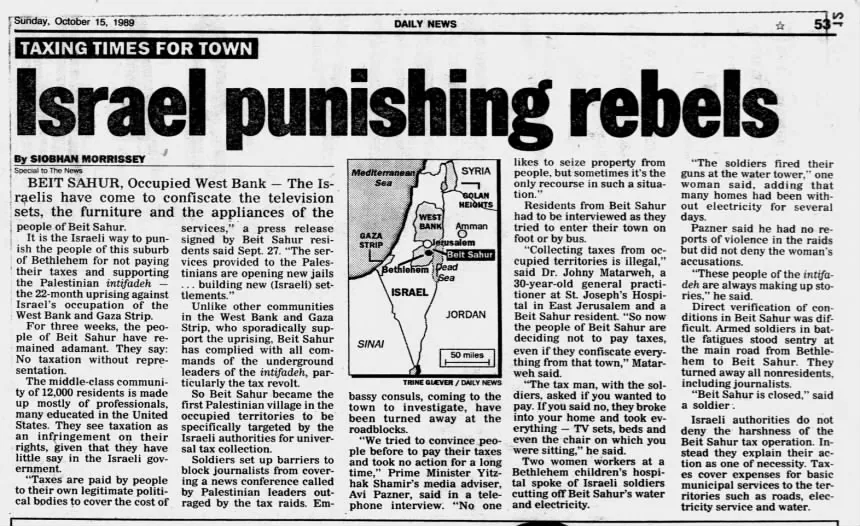
Transcribed from the clipping
BEIT SAHUR, Occupied West Bank — The Israelis have come to confiscate the television sets, the furniture and the appliances of the people of Beit Sahur.
It is the Israeli way to punish the people of this suburb of Bethlehem for not paying their taxes and supporting the Palestinian intifadeh, the 22-month uprising against Israel’s occupation of the West Bank and Gaza Strip. For three weeks, the people of Beit Sahur have remained adamant. They say: No taxation without representation.
The middle-class community of 12,000 residents is made up mostly of professionals, many educated in the United States. They see taxation as an infringement on their rights, given that they have little say in the Israeli government.
“Taxes are paid by people to their own legitimate political bodies to cover the cost of services,” a press release signed by Beit Sahur residents said Sept. 27. “The services provided to the Palestinians are opening new jails ... building new (Israeli) settlements.”
Unlike other communities in the West Bank and Gaza Strip, who sporadically support the uprising, Beit Sahur has complied with all commands of the underground leaders of the intifadeh, particularly the tax revolt.
So Beit Sahur became the first Palestinian village in the occupied territories to be specifically targeted by the Israeli authorities for universal tax collection. Soldiers set up barriers to block journalists from covering a news conference called by Palestinian leaders outraged by the tax raids.
Embassy consuls, coming to the town to investigate, have been turned away at the roadblocks. “We tried to convince people before to pay their taxes and took no action for a long time,” Prime Minister Yitzhak Shamir’s media adviser, Avi Pazner, said in a telephone interview.
“No one likes to seize property from people, but sometimes it’s the only recourse in such a situation.” Residents from Beit Sahur had to be interviewed as they tried to enter their town on foot or by bus. “Collecting taxes from occupied territories is illegal,” said Dr. Johny Matarweh, a 30-year-old general practitioner at St.
Joseph’s Hospital in East Jerusalem and a Beit Sahur resident. “So now the people of Beit Sahur are deciding not to pay taxes, even if they confiscate everything from that town,” Matarweh said. “The tax man, with the soldiers, asked if you wanted to pay.
If you said no, they broke into your home and took everything — TV sets, beds and even the chair on which you were sitting,” he said. Two women workers at a Bethlehem children’s hospital spoke of Israeli soldiers cutting off Beit Sahur’s water and electricity.
“The soldiers fired their guns at the water tower,” one woman said, adding that many homes had been without electricity for several days. Pazner said he had no reports of violence in the raids but did not deny the woman’s accusations. “These people of the intifadeh are always making up stories,” he said.
Direct verification of conditions in Beit Sahur was difficult. Armed soldiers in battle fatigues stood sentry at the main road from Bethlehem to Beit Sahur. They turned away all nonresidents, including journalists. “Beit Sahur is closed,” said a soldier. Israeli authorities do not deny the harshness of the Beit Sahur tax operation.
Instead they explain their action as one of necessity. Taxes cover expenses for basic municipal services to the territories such as roads, electricity service and water.
Cite this clipping
"Israel punishing rebels," Daily News, 15 October 1989, p. 53. Covering Palestine archive, CP-1989-036. https://coveringpalestine.org/archive/cp-1989-036
More from Daily News
- Only the Rich Can Share ’Em In a Harem, Arab Gals InsistDaily News · 18 January 1945
- King David Hotel, JerusalemDaily News · 24 July 1946
- 8 Die as Arabs, Jews Burn, Riot in PalestineDaily News · 3 December 1947
- Jews Dynamite HQ of Arabs’ High CommandDaily News · 5 January 1948
- Arabs Grab 41 Yankees Off ShipDaily News · 21 May 1948
- An Epic Ends as Tal Zaatar FallsDaily News · 13 August 1976
- 9 more from this paper in the full text →
More from the 1980s
- ArafatThe Times · 18 January 1989
- Israeli officials play down offer from Shamir to withdraw troopsThe Miami Herald · 3 February 1989
- Shamir offer not newWorcester Telegram · 3 February 1989
- Israelis Study Devices In Blasts in West BankThe New York Times · 16 February 1989
- Can't rule, absorb, bar or expel PalestiniansSt. Louis Jewish Light · 3 March 1989
- THE AMBIGUOUS YASIR ARAFATThe New York Times · 12 March 1989
- All 527 clippings from the 1980s →
Last updated 2 November 2026
This record is part of Covering Palestine, an archive of American newspaper clippings about Palestinians, 1724 to 2023. Researched and assembled by Maria Robles.
The clipping belongs to the newspaper that printed it, or to the news agency that supplied the copy. It is reproduced here for research, criticism and commentary. A city here is where the newspaper was published, not where the story came from, and on most records it was taken from the masthead.
Something wrong here, or something you know about this clipping? The archive is still being built and corrections are wanted: maria@rozumstudio.com, quoting CP-1989-036.
Everything printed in 1989 · Printed on this day · See it in the archive reel · Full text of every clipping · Dataset