The New York Times · 11 October 1989
CP-1989-035
In a Tax War, Even the Olivewood Dove Is Seized
By Alan Cowell
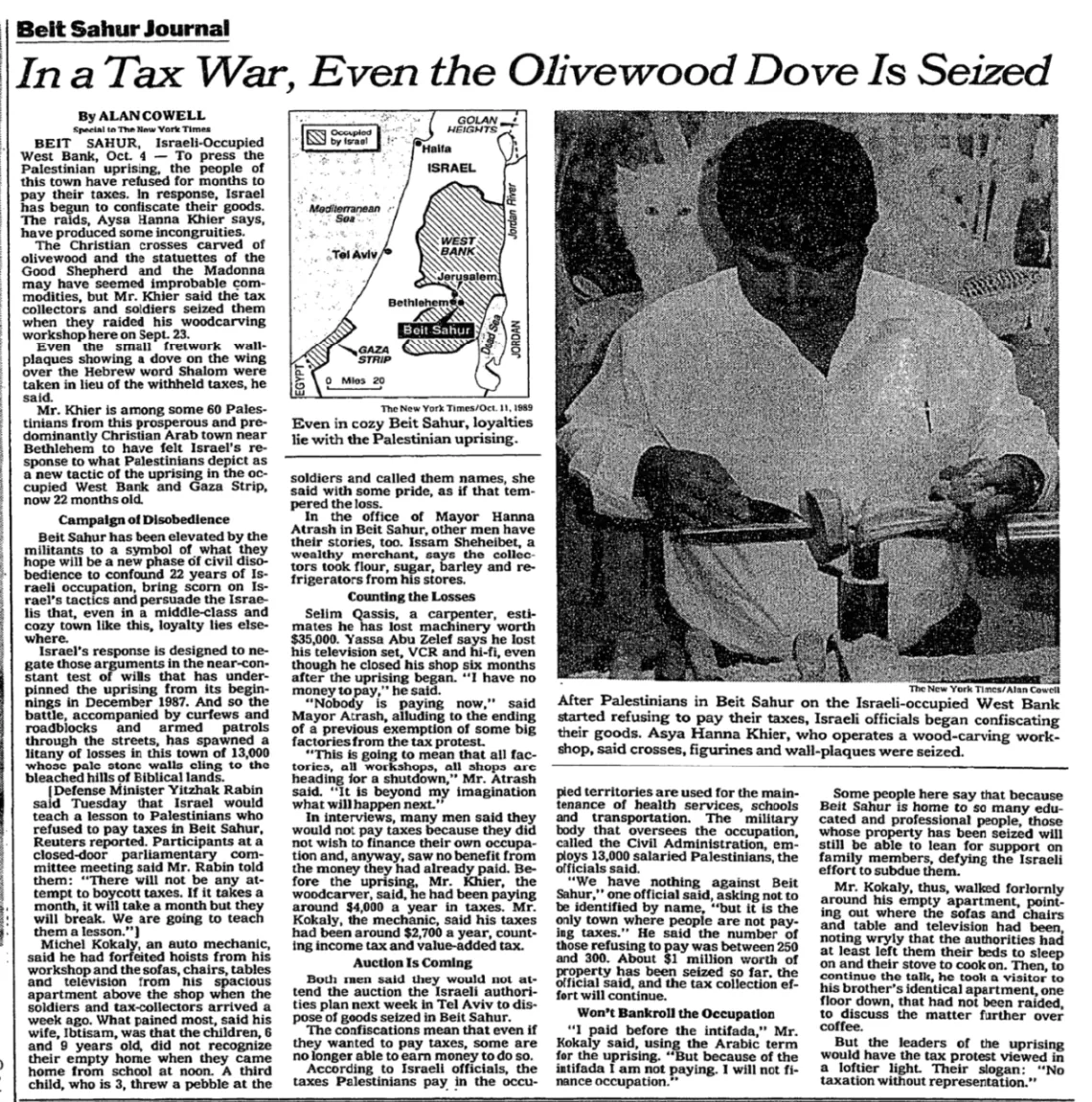
Transcribed from the clipping
BEIT SAHUR, Israeli-Occupied West Bank, Oct. 4 — To press the Palestinian uprising, the people of this town have refused for months to pay their taxes. In response, Israel has begun to confiscate their goods. The raids, Aysa Hanna Khier says, have produced some incongruities.
The Christian crosses carved of olivewood and the statuettes of the Good Shepherd and the Madonna may have seemed improbable commodities, but Mr. Khier said the tax collectors and soldiers seized them when they raided his woodcarving workshop here on Sept. 23.
Even the small fretwork wall-plaques showing a dove on the wing over the Hebrew word Shalom were taken in lieu of the withheld taxes, he said. Mr.
Khier is among some 60 Palestinians from this prosperous and predominantly Christian Arab town near Bethlehem to have felt Israel’s response to what Palestinians depict as a new tactic of the uprising in the occupied West Bank and Gaza Strip, now 22 months old.
Campaign of Disobedience Beit Sahur has been elevated by the militants to a symbol of what they hope will be a new phase of civil disobedience to confound 22 years of Israeli occupation, bring scorn on Israel’s tactics and persuade the Israelis that, even in a middle-class and cozy town like this, loyalty lies elsewhere.
Israel’s response is designed to negate those arguments in the near-constant test of wills that has underpinned the uprising from its beginnings in December 1987.
And so the battle, accompanied by curfews and roadblocks and armed patrols through the streets, has spawned a litany of losses in this town of 13,000 whose pale stone walls cling to the bleached hills of Biblical lands. [Defense Minister Yitzhak Rabin said Tuesday that Israel would teach a lesson to Palestinians who refused to pay taxes in Beit Sahur, Reuters reported.
Participants at a closed-door parliamentary committee meeting said Mr. Rabin told them: “There will not be any attempt to boycott taxes. If it takes a month, it will take a month but they will break.
We are going to teach them a lesson.”] Michel Kokaly, an auto mechanic, said he had forfeited hoists from his workshop and the sofas, chairs, tables and television from his spacious apartment above the shop when the soldiers and tax-collectors arrived a week ago.
What pained most, said his wife, Ibtisam, was that the children, 6 and 9 years old, did not recognize their empty home when they came home from school at noon. A third child, who is 3, threw a pebble at the soldiers and called them names, she said with some pride, as if that tempered the loss.
In the office of Mayor Hanna Atrash in Beit Sahur, other men have their stories, too. Issam Sheheibet, a wealthy merchant, says the collectors took flour, sugar, barley and refrigerators from his stores. Counting the Losses Selim Qassis, a carpenter, estimates he has lost machinery worth $35,000.
Yassa Abu Zelef says he lost his television set, VCR and hi-fi, even though he closed his shop six months after the uprising began. “I have no money to pay,” he said. “Nobody is paying now,” said Mayor Atrash, alluding to the ending of a previous exemption of some big factories from the tax protest.
“This is going to mean that all factories, all workshops, all shops are heading for a shutdown,” Mr. Atrash said. “It is beyond my imagination what will happen next.” In interviews, many men said they would not pay taxes because they did not wish to finance their own occupation and, anyway, saw no benefit from the money they had already paid.
Before the uprising, Mr. Khier, the woodcarver, said, he had been paying around $4,000 a year in taxes. Mr. Kokaly, the mechanic, said his taxes had been around $2,700 a year, counting income tax and value-added tax. Auction Is Coming Both men said they would not attend the auction the Israeli authorities plan next week in Tel Aviv to dispose of goods seized in Beit Sahur.
The confiscations mean that even if they wanted to pay taxes, some are no longer able to earn money to do so. According to Israeli officials, the taxes Palestinians pay in the occupied territories are used for the maintenance of health services, schools and transportation.
The military body that oversees the occupation, called the Civil Administration, employs 13,000 salaried Palestinians, the officials said. “We have nothing against Beit Sahur,” one official said, asking not to be identified by name, “but it is the only town where people are not paying taxes.”
He said the number of those refusing to pay was between 250 and 300. About $1 million worth of property has been seized so far. the official said, and the tax collection effort will continue. Won’t Bankroll the Occupation “I paid before the intifada,” Mr. Kokaly said, using the Arabic term for the uprising. “But because of the intifada I am not paying.
I will not finance occupation.”
Cite this clipping
"In a Tax War, Even the Olivewood Dove Is Seized," The New York Times, 11 October 1989. Covering Palestine archive, CP-1989-035. https://coveringpalestine.org/archive/cp-1989-035
More from The New York Times
- The Maine Colony in PalestineThe New York Times · 12 November 1866
- Jewish Colonization in PalestineThe New York Times · 9 December 1883
- Jewish State in Palestine OpposedThe New York Times · 9 July 1897
- ZIONIST CONGRESS IN BASELThe New York Times · 31 August 1897
- ROME FEARS THE ZIONISTSThe New York Times · 12 September 1897
- PROGRESS OF ZIONISMThe New York Times · 16 December 1901
- 852 more from this paper in the full text →
More from the 1980s
- ArafatThe Times · 18 January 1989
- Israeli officials play down offer from Shamir to withdraw troopsThe Miami Herald · 3 February 1989
- Shamir offer not newWorcester Telegram · 3 February 1989
- Israelis Study Devices In Blasts in West BankThe New York Times · 16 February 1989
- Can't rule, absorb, bar or expel PalestiniansSt. Louis Jewish Light · 3 March 1989
- THE AMBIGUOUS YASIR ARAFATThe New York Times · 12 March 1989
- All 527 clippings from the 1980s →
Last updated 2 November 2026
This record is part of Covering Palestine, an archive of American newspaper clippings about Palestinians, 1724 to 2023. Researched and assembled by Maria Robles.
The clipping belongs to the newspaper that printed it, or to the news agency that supplied the copy. It is reproduced here for research, criticism and commentary. A city here is where the newspaper was published, not where the story came from, and on most records it was taken from the masthead.
Something wrong here, or something you know about this clipping? The archive is still being built and corrections are wanted: maria@rozumstudio.com, quoting CP-1989-035.
Everything printed in 1989 · Printed on this day · See it in the archive reel · Full text of every clipping · Dataset