The New York Times · 29 October 1989
CP-1989-037
It Can Happen There

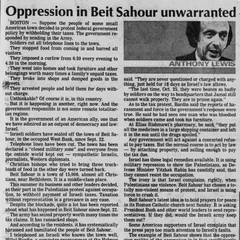
Shown from the top. The whole column — 7.6 times taller than it is wide — is in the enlargement.
Transcribed from the clipping
BOSTON — Suppose the people of some small American town decided to protest Federal Government policy by withholding their taxes. The Government responded by sending in the Army. Soldiers cut all telephone lines to the town. They stopped food from coming in and barred all visitors. They imposed a curfew from 6:30 every evening to 4:30 in the morning.
They went into homes and took furniture and other belongings worth many times a family’s unpaid taxes. They broke into shops and dumped goods in the streets. They arrested people and held them for days without charge. Unthinkable? Of course it is, in this country. But it is happening in another, right now.
And the Government responsible is not some remote totalitarian regime. It is the Government of an American ally, one that we have admired as an outpost of democracy and law: Israel. Israeli soldiers have sealed off the town of Beit Sahour, in the occupied West Bank, since Sept. 22. Telephone lines have been cut.
The town has been declared a “closed military zone” and everyone from the outside world kept out — sympathetic Israelis, journalists, Western diplomats. Christian bishops who tried to bring three truckloads of food in the other day were turned back. Beit Sahour is a town of 15,000, almost all Christians, near Bethlehem. It is a middle-class place.
This summer its business and other leaders decided, as their part in the Palestinian protest against occupation, to withhold payment of Israeli taxes. Taxation without representation is a grievance in any case. Despite the blockade, quite a lot has been reported about what has happened in Beit Sahour since Sept. 22. The army has seized property worth many times the tax claims.
It has ransacked shops. And according to the residents, it has systematically harassed and humiliated the people of Beit Sahour. I telephoned an Israeli who knows the town well, Hillel Bardin, a computer programmer at the Hebrew University in Jerusalem.
For the last 18 months he has been part of a group of Israelis carrying on a dialogue with a group from Beit Sahour, exchanging visits and talking about Israeli-Palestinian peace. Mr. Bardin began by saying that, apart from the tax protest, those in Beit Sahour who have spoken out for peace with Israel have been punished.
He mentioned two men in his dialogue group, Jamal Hilal and Ghassan Antoni. “Both have been arrested repeatedly since July,” he said. “They are never questioned or charged with anything, just held for 18 days as Israel’s law allows. “The last time, Oct.
25, they were beaten so badly by soldiers on the way to headquarters that Jamal still cannot walk properly. They are in prison again.” As to the tax protest, Mr. Bardin said the reports of harassment and force in the Government’s response were true. He said he had seen one man who was bloodied when soldiers came and took his furniture.
At Elias Rishmawi’s pharmacy, he said, “they put all the medicines in a large shipping container and left it in the sun until the drugs spoiled.”
Cite this clipping
"It Can Happen There," The New York Times, 29 October 1989. Covering Palestine archive, CP-1989-037. https://coveringpalestine.org/archive/cp-1989-037
More from The New York Times
- The Maine Colony in PalestineThe New York Times · 12 November 1866
- Jewish Colonization in PalestineThe New York Times · 9 December 1883
- Jewish State in Palestine OpposedThe New York Times · 9 July 1897
- ZIONIST CONGRESS IN BASELThe New York Times · 31 August 1897
- ROME FEARS THE ZIONISTSThe New York Times · 12 September 1897
- PROGRESS OF ZIONISMThe New York Times · 16 December 1901
- 852 more from this paper in the full text →
More from the 1980s
- ArafatThe Times · 18 January 1989
- Israeli officials play down offer from Shamir to withdraw troopsThe Miami Herald · 3 February 1989
- Shamir offer not newWorcester Telegram · 3 February 1989
- Israelis Study Devices In Blasts in West BankThe New York Times · 16 February 1989
- Can't rule, absorb, bar or expel PalestiniansSt. Louis Jewish Light · 3 March 1989
- THE AMBIGUOUS YASIR ARAFATThe New York Times · 12 March 1989
- All 527 clippings from the 1980s →
The same copy, in 1 other paper
Their text and this one are nearly identical. Found by comparing transcriptions, not by reading them side by side, so this establishes that the text overlaps and not that these papers ran the same dispatch. How this was done.
Last updated 2 November 2026
This record is part of Covering Palestine, an archive of American newspaper clippings about Palestinians, 1724 to 2023. Researched and assembled by Maria Robles.
The clipping belongs to the newspaper that printed it, or to the news agency that supplied the copy. It is reproduced here for research, criticism and commentary. A city here is where the newspaper was published, not where the story came from, and on most records it was taken from the masthead.
Something wrong here, or something you know about this clipping? The archive is still being built and corrections are wanted: maria@rozumstudio.com, quoting CP-1989-037.
Everything printed in 1989 · Printed on this day · See it in the archive reel · Full text of every clipping · Dataset