The New York Times · 29 October 1989
CP-1989-038
Costs of the Intifada
Even a Stalemate Forces Israel to Pay A Corrosive Price
Jack Rosenthal
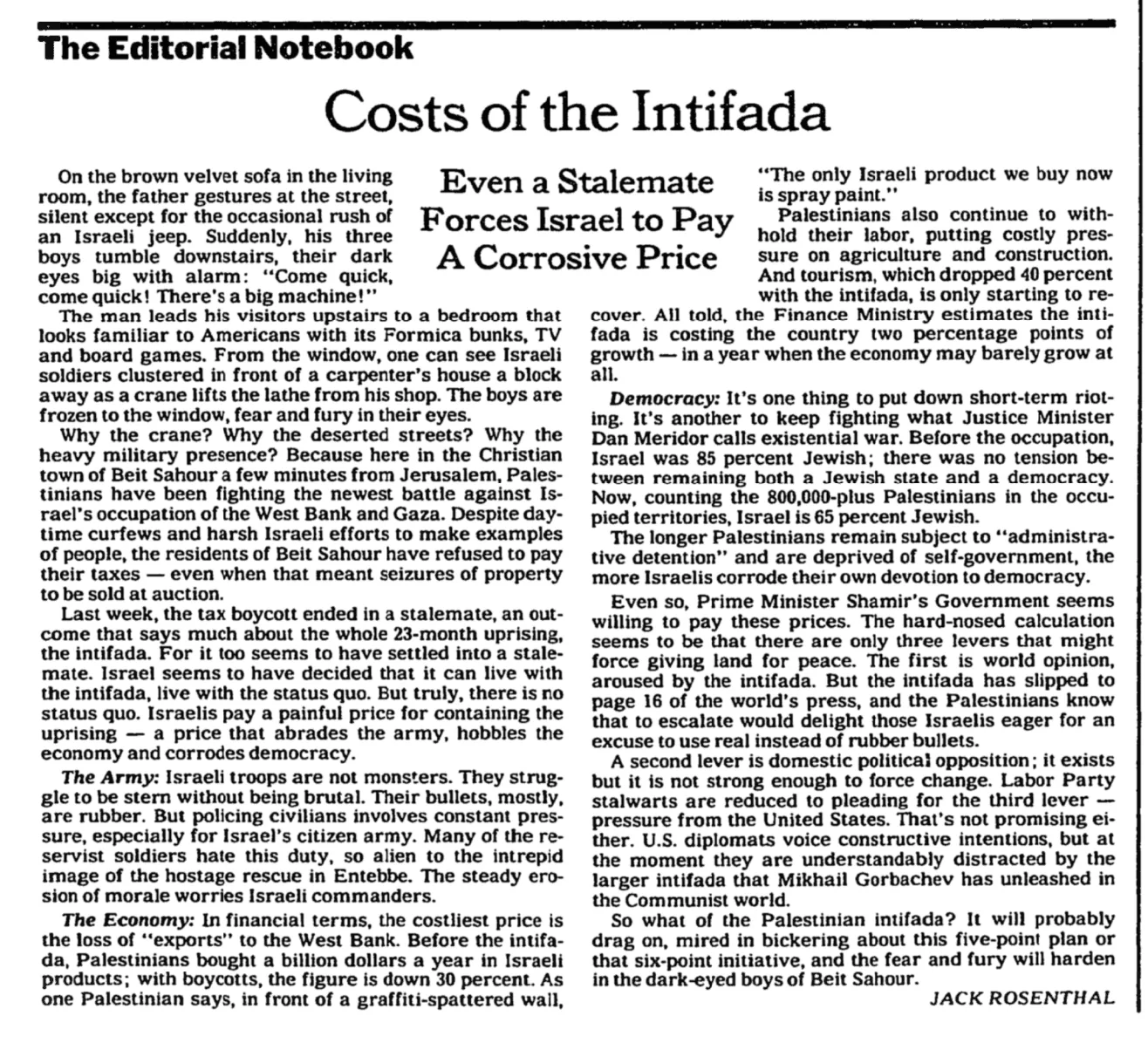
Transcribed from the clipping
On the brown velvet sofa in the living room, the father gestures at the street, silent except for the occasional rush of an Israeli jeep. Suddenly, his three boys tumble downstairs, their dark eyes big with alarm: “Come quick, come quick! There’s a big machine!”
The man leads his visitors upstairs to a bedroom that looks familiar to Americans with its Formica bunks, TV and board games. From the window, one can see Israeli soldiers clustered in front of a carpenter’s house a block away as a crane lifts the lathe from his shop. The boys are frozen to the window, fear and fury in their eyes. Why the crane? Why the deserted streets?
Why the heavy military presence? Because here in the Christian town of Beit Sahour a few minutes from Jerusalem, Palestinians have been fighting the newest battle against Israel’s occupation of the West Bank and Gaza.
Despite daytime curfews and harsh Israeli efforts to make examples of people, the residents of Beit Sahour have refused to pay their taxes — even when that meant seizures of property to be sold at auction. Last week, the tax boycott ended in a stalemate, an outcome that says much about the whole 23-month uprising, the intifada.
For it too seems to have settled into a stalemate. Israel seems to have decided that it can live with the intifada, live with the status quo. But truly, there is no status quo. Israelis pay a painful price for containing the uprising — a price that abrades the army, hobbles the economy and corrodes democracy. The Army: Israeli troops are not monsters.
They struggle to be stern without being brutal. Their bullets, mostly, are rubber. But policing civilians involves constant pressure, especially for Israel’s citizen army. Many of the reservist soldiers hate this duty, so alien to the intrepid image of the hostage rescue in Entebbe. The steady erosion of morale worries Israeli commanders.
The Economy: In financial terms, the costliest price is the loss of “exports” to the West Bank. Before the intifada, Palestinians bought a billion dollars a year in Israeli products; with boycotts, the figure is down 30 percent. As one Palestinian says, in front of a graffiti-spattered wall, “The only Israeli product we buy now is spray paint.”
Cite this clipping
"Costs of the Intifada," The New York Times, 29 October 1989. Covering Palestine archive, CP-1989-038. https://coveringpalestine.org/archive/cp-1989-038
More from The New York Times
- The Maine Colony in PalestineThe New York Times · 12 November 1866
- Jewish Colonization in PalestineThe New York Times · 9 December 1883
- Jewish State in Palestine OpposedThe New York Times · 9 July 1897
- ZIONIST CONGRESS IN BASELThe New York Times · 31 August 1897
- ROME FEARS THE ZIONISTSThe New York Times · 12 September 1897
- PROGRESS OF ZIONISMThe New York Times · 16 December 1901
- 852 more from this paper in the full text →
More from the 1980s
- ArafatThe Times · 18 January 1989
- Israeli officials play down offer from Shamir to withdraw troopsThe Miami Herald · 3 February 1989
- Shamir offer not newWorcester Telegram · 3 February 1989
- Israelis Study Devices In Blasts in West BankThe New York Times · 16 February 1989
- Can't rule, absorb, bar or expel PalestiniansSt. Louis Jewish Light · 3 March 1989
- THE AMBIGUOUS YASIR ARAFATThe New York Times · 12 March 1989
- All 527 clippings from the 1980s →
Last updated 2 November 2026
This record is part of Covering Palestine, an archive of American newspaper clippings about Palestinians, 1724 to 2023. Researched and assembled by Maria Robles.
The clipping belongs to the newspaper that printed it, or to the news agency that supplied the copy. It is reproduced here for research, criticism and commentary. A city here is where the newspaper was published, not where the story came from, and on most records it was taken from the masthead.
Something wrong here, or something you know about this clipping? The archive is still being built and corrections are wanted: maria@rozumstudio.com, quoting CP-1989-038.
Everything printed in 1989 · Printed on this day · See it in the archive reel · Full text of every clipping · Dataset