Sarasota Herald-Tribune · 1 November 1989
CP-1989-041
Army Ends West Bank Seizures; Both Sides Claim Victory
Associated Press
Transcribed from the clipping
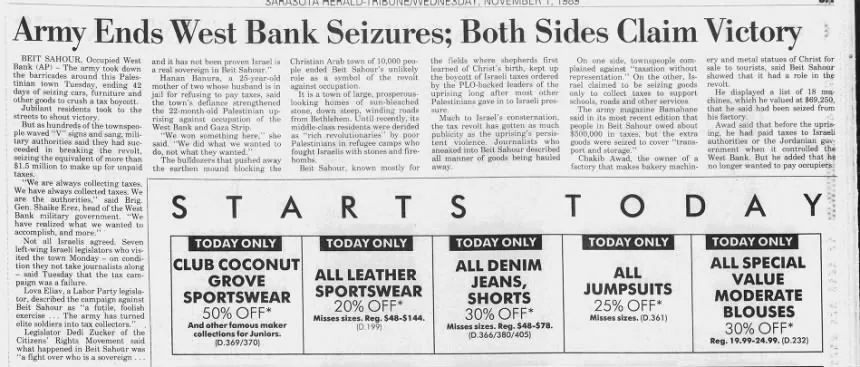
BEIT SAHOUR, Occupied West Bank (AP) — The army took down the barricades around this Palestinian town Tuesday, ending 42 days of seizing cars, furniture and other goods to crush a tax boycott. Jubilant residents took to the streets to shout victory.
But as hundreds of the townspeople waved “V” signs and sang, military authorities said they had succeeded in breaking the revolt, seizing the equivalent of more than $1.5 million to make up for unpaid taxes. “We are always collecting taxes. We have always collected taxes. We are the authorities,” said Brig. Gen.
Shaike Erez, head of the West Bank military government. “We have realized what we wanted to accomplish, and more.” Not all Israelis agreed. Seven left-wing Israeli legislators who visited the town Monday — on condition they not take journalists along — said Tuesday that the tax campaign was a failure.
Lova Eliav, a Labor Party legislator, described the campaign against Beit Sahour as “a futile, foolish exercise ... The army has turned elite soldiers into tax collectors.”
Legislator Dedi Zucker of the Citizens’ Rights Movement said what happened in Beit Sahour was “a fight over who is a sovereign ... and it has not been proven Israel is a real sovereign in Beit Sahour.”
Hanan Banura, a 25-year-old mother of two whose husband is in jail for refusing to pay taxes, said the town’s defiance strengthened the 22-month-old Palestinian uprising against occupation of the West Bank and Gaza Strip. “We won something here,” she said. “We did what we wanted to do, not what they wanted.”
The bulldozers that pushed away the earthen mound blocking the Christian Arab town of 10,000 people ended Beit Sahour’s unlikely role as a symbol of the revolt against occupation. It is a town of large, prosperous-looking homes of sun-bleached stone, down steep, winding roads from Bethlehem.
Until recently, its middle-class residents were derided as “rich revolutionaries” by poor Palestinians in refugee camps who fought Israelis with stones and firebombs.
Beit Sahour, known mostly for the fields where shepherds first learned of Christ’s birth, kept up the boycott of Israeli taxes ordered by the PLO-backed leaders of the uprising long after most other Palestinians gave in to Israeli pressure. Much to Israel’s consternation, the tax revolt has gotten as much publicity as the uprising’s persistent violence.
Journalists who sneaked into Beit Sahour described all manner of goods being hauled away. On one side, townspeople complained against “taxation without representation.” On the other, Israel claimed to be seizing goods only to collect taxes to support schools, roads and other services.
The army magazine Bamahane said in its most recent edition that people in Beit Sahour owed about $500,000 in taxes; but the extra goods were seized to cover “transport and storage.” Chakib Awad, the owner of a factory that makes bakery machinery and metal statues of Christ for sale to tourists, said Beit Sahour showed that it had a role in the revolt.
He displayed a list of 18 machines, which he valued at $69,250, that he said had been seized from his factory. Awad said that before the uprising, he had paid taxes to Israeli authorities or the Jordanian government when it controlled the West Bank. But he added that he no longer wanted to pay occupiers.
Cite this clipping
"Army Ends West Bank Seizures; Both Sides Claim Victory," Sarasota Herald-Tribune, 1 November 1989. Covering Palestine archive, CP-1989-041. https://coveringpalestine.org/archive/cp-1989-041
More from Sarasota Herald-Tribune
- ARABS RECOGNIZE ARABSSarasota Herald-Tribune · 14 October 1948
- Banning Of Some Arab Textbooks UrgedSarasota Herald-Tribune · 19 May 1969
- Israeli Expansion Could Prove Too CostlySarasota Herald-Tribune · 6 June 1977
- Terrorism . . . A Threat To Western WorldSarasota Herald-Tribune · 5 August 1979
- PLO Says It Repulsed Israeli TanksSarasota Herald-Tribune · 30 October 1979
- No Compromise At Kiryat ArbaSarasota Herald-Tribune · 12 February 1980
- 10 more from this paper in the full text →
More from the 1980s
- ArafatThe Times · 18 January 1989
- Israeli officials play down offer from Shamir to withdraw troopsThe Miami Herald · 3 February 1989
- Shamir offer not newWorcester Telegram · 3 February 1989
- Israelis Study Devices In Blasts in West BankThe New York Times · 16 February 1989
- Can't rule, absorb, bar or expel PalestiniansSt. Louis Jewish Light · 3 March 1989
- THE AMBIGUOUS YASIR ARAFATThe New York Times · 12 March 1989
- All 527 clippings from the 1980s →
The same copy, in 1 other paper
Most of the shorter text appears in the longer one. Found by comparing transcriptions, not by reading them side by side, so this establishes that the text overlaps and not that these papers ran the same dispatch. How this was done.
Last updated 2 November 2026
This record is part of Covering Palestine, an archive of American newspaper clippings about Palestinians, 1724 to 2023. Researched and assembled by Maria Robles.
The clipping belongs to the newspaper that printed it, or to the news agency that supplied the copy. It is reproduced here for research, criticism and commentary. A city here is where the newspaper was published, not where the story came from, and on most records it was taken from the masthead.
Something wrong here, or something you know about this clipping? The archive is still being built and corrections are wanted: maria@rozumstudio.com, quoting CP-1989-041.
Everything printed in 1989 · Printed on this day · See it in the archive reel · Full text of every clipping · Dataset