Sarasota Herald-Tribune · Sarasota, Florida · 5 August 1979
CP-1979-009
Terrorism . . . A Threat To Western World
By Suzanne Weaver, Wall Street Journal
Transcribed from the clipping
“Not long ago the city of Jerusalem, which has played host to a few international gatherings in its time, was the site of an international conference of politicians, journalists and intellectuals on the subject of terrorism. Despite the location, the conference didn’t turn out to be mainly a discussion of Mideast politics.
Instead it was a demonstration of how much terrorism has become part of the broader debate now going on about the proper foreign policy posture of Western nations. It wasn’t exactly a surprise that this was the message to emerge from the gathering.
The meeting was put on by an Israeli foundation named the Jonathan Institute, established in memory of Jonathan Netanyahu, the Israeli officer killed while leading the successful rescue mission to Entebbe in 1976.
In the words of Benjamin Netanyahu, brother of the slain soldier and organizer of the conference, the foundation aims to combat Israel’s ‘growing isolation’ on the international scene. Terrorism, the institute people think, is one of those issues dramatizing the fact that the forces threatening Israel are the same as those threatening the West in general.
So the delegates to the conference were, by and large, people who believe in the usefulness of making such connections. The conference attracted not only Israeli participants but an international cast of characters from the United States and Western Europe. There were speakers from Italy, Ireland, the Netherlands and France.
From West Germany there were terrorism specialist Hans Josef Horchem and journalist Gerhard Lowenthal. The British contingent included diplomat and writer Lord Chalfont, former Home Secretary Merlyn Rees and Brian Crozier, specialist in the subject of political violence.
Scholars And Writers The large American group included a range of scholars and writers like Harvard economist Thomas Schelling, Harvard Soviet specialist Richard Pipes, former CIA official Ray Cline and columnist George Will. A number of U.S. politicians also turned up: presidential candidate and former CIA director George Bush, Congressman Jack Kemp, Sen.
John Danforth and Sen. Henry Jackson. The speakers covered subjects like the scope of possible international cooperation on terrorism, the legal restraints on coping with terrorism and possible future forms of terrorism.
But since this was a conference mainly of public figures rather than technical specialists, the talk was less of the operational problems in fighting terrorism than it was of the political ones.
High on the speakers’ agenda was the issue of language: Too many reporters and analysts, many said, were legitimating terrorism by speaking of it as a natural response to flaws in Western society or a tactic in wars of national liberation, instead of calling it first and foremost an atrocity and a crime against humanity.
The most notable words on the topic came from conference speaker Paul Johnson, British author and former editor of the magazine ‘The New Statesman’. Terrorism, he argued, is a threat to Western civilization ‘in many respects more serious than the risk of nuclear war.’
In our recoverable history, major civilizations have fallen several times and Dark Ages have replaced them. And each of these falls occurred ‘when the spread of metals technology, and the availability of raw materials, enabled the forces of barbarism to equal or surpass the civilized powers in the quality and quantity of their weapons.’
Modern terrorism, he said, is a sign that just such a transfer of resources is going on. Many people hide this fact from themselves by viewing the terrorists as idealists whose worthy goals at least partly redeem their use of violence.
So, Johnson said, it is necessary to instruct people on why this is not so, and why the impact of terrorism on humanity is instead ‘intrinsically evil, necessarily evil and wholly evil.’
This impact comes from what Johnson called terrorism’s ‘seven deadly sins’: It is a deliberate ‘exaltation of violence over other forms of public activity.’ It requires a ‘deliberate suppression of the moral instincts in man.’ It is a ‘rejection of politics as the normal means by which communities resolve conflicts.’
Far from fighting repression, the terrorists’ activity ‘systematically and necessarily assists the spread of the totalitarian states’ which furnish the terrorists with their base.
Further, it favors totalitarian states over democratic ones, since ‘it can destroy a democracy, as it destroyed Lebanon, but it cannot destroy a totalitarian state’ which is willing to repress it ruthlessly.
Terrorism ‘exploits the apparatus of freedom in liberal societies and thereby endangers’ that freedom; and, finally, it ‘saps the will of a civilized society to defend itself.’
Necessary Step Many speakers during the conference echoed this theme: A necessary step in fighting terrorism is to educate democratic nations about how massive a moral and practical threat it is to their beliefs.
But one of Johnson’s points in particular dominated the proceedings: the assertion that terrorism is not just some random natural occurrence, but an instrument in the foreign policy of totalitarian nations — especially, nowadays, the Soviet Union.
Senator Jackson put the argument simply: Most terrorist groups, he said, use Soviet bloc weapons, get training in Warsaw Pact countries or Mideast nations like South Yemen or PLO-controlled Lebanon, and find sanctuary in the same places. In fact, he said, modern terrorism is a form of ‘warfare by remote control’ by these countries and groups.
Analyst Ray Cline elaborated. Western statesmen, he said, had to face up to ‘the widespread adoption of terrorism as a preferred instrument of policy by a finite, known number of modern states.’
More specifically, the current wave of world terrorism began after 1969, ‘when the Soviet KGB persuaded the Politburo of the Communist Party of the Soviet Union to accept the PLO as a major political instrument in the Mideast and to subsidize its terrorist policies by freely giving money, training, arms and coordinated communications.’
Many Soviet-related terrorist activities, he argued, ‘have been no more than largely unintended byproducts of Soviet dabbling in troubled international waters.’ Still, the supporting role played by the Soviets and surrogates like Cuba, North Korea and East Germany has ‘hardened into a system — an international troublemaking system.’
Cline gave specifics — KGB attempts to form terrorist cells in Saudi Arabia, KGB links with parts of the Irish Republican Army, Soviet influence on Latin American and African guerrilla groups through Cuba’s intelligence services.
But still more provocative accusations of Soviet involvement came from speaker Robert Moss, editor of the ‘Foreign Report’ put out by the British magazine ‘The Economist.’ Moss charged, for example, that the Soviets, plus Libya and the PLO, were heavily involved in the campaign to overthrow the Shah.
In Iran today a Soviet-trained PLO unit ‘functions as the nucleus of a secret police, a revolutionary SAVAK.’
In Nicaragua, to take another example, the Sandinist offensive against the Somoza regime was ‘planned and supervised, in meticulous detail, by Cuban staff officers’ and aided by ‘a miniature, international Communist brigade, including ‘volunteers’ from West Germany’s terrorist underground.’
The Sandinistas, in turn, are helping train terrorists from El Salvador and Guatemala. Other such proxies, Moss went on, are operating elsewhere in the world. For instance, it is probable that the Soviets, through Libya and the PLO, provided the Strela missiles that Rhodesian guerrilla Joshua Nkomo used to shoot down two civilian airliners.
The PLO has been a specially active surrogate, maintaining supportive contacts with guerrilla groups from Turkey to Argentina and many points in between.
Vision Of Detente Even more directly, Moss said, the Soviet Union maintains schools and camps to train foreigners in insurrection, including terror tactics. And what is most remarkable is that Western governments, hostage to their vision of detente, have refrained from publicly exposing all this Soviet involvement.
A considerable number in the press corps covering the conference were much annoyed by Moss’ charges and told him so. Where was he getting his information? Was he really asking people to believe he had respectable evidence of a Soviet-led conspiracy in these matters? The reporters demanded a special press conference from Moss the next day. He obliged.
Certainly he didn’t believe in a single-cause terrorist conspiracy, he explained to the reporters; but the connections he had alluded to were real and it was perfectly sound journalistic practice for him to refuse to reveal his sources.
The full extent of Soviet involvement, he argued, couldn’t be ascertained and publicized except by a government intelligence operation with more resources at its disposal than those of a journalist. But why weren’t Western governments making the effort? And why weren’t journalists pressing them to do so?
In Moss’ question lay the central issue that the conference attempted to place on the public agenda.
Most of the participants would have agreed that the first political task at hand on the issue of terrorism is to cut the idea of terrorism loose from the connection it now has in many Western liberal minds with notions of national liberation and social justice; only then can terror be viewed plainly as a crime and a threat.
But their second task is to establish another kind of connection, and to make people see terrorism not as just a random occurrence but as a tactic in the Soviet war against the West. If this attempt makes headway, the already-embattled idea of Western detente with the Soviets will be under even more intense challenge.
And political leaders who try to push detente-based policies, from trade agreements to SALT, will have even harder going ahead.”
Context added by this archive
The Jonathan Institute’s first conference, reported in a Florida Sunday paper. Benjamin Netanyahu is 29 and is named here as its organizer, five years before the earliest clipping this archive previously held of him.
What the page records is a conference setting itself a task in plain words: the first political task at hand on the issue of terrorism is to cut the idea of terrorism loose from the connection it now has in many Western liberal minds with notions of national liberation and social justice.
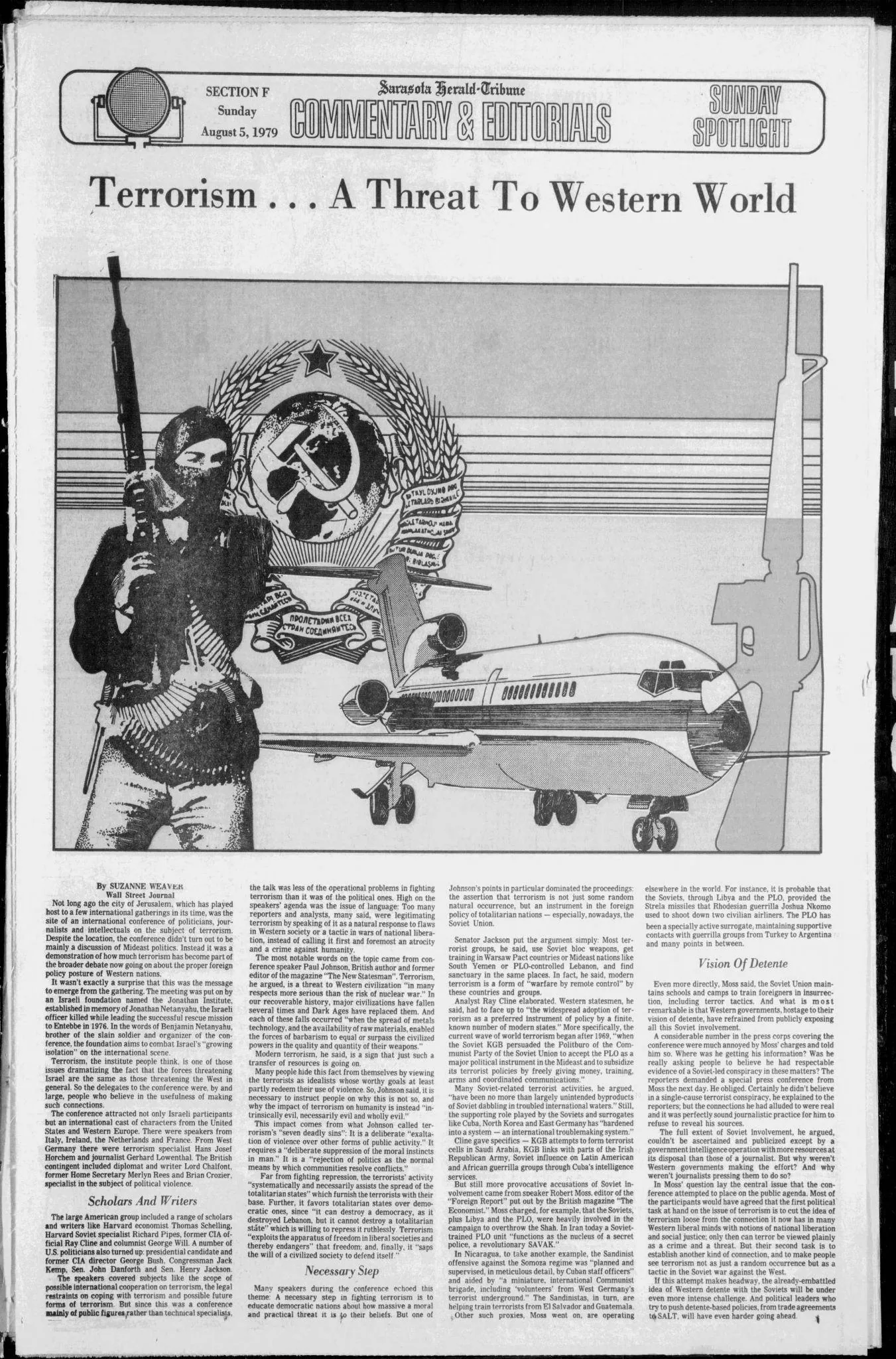
The PLO appears in the copy eight times, always as an instrument of the Soviet Union, and never in connection with Palestinians. No Palestinian is quoted, named or described anywhere on the page. The drawing above the text is a masked man with a rifle and a bandolier standing in front of the arms of the Soviet Union and a passenger airliner.
Cite this item
"Terrorism . . . A Threat To Western World," Sarasota Herald-Tribune, 5 August 1979. Covering Palestine archive, CP-1979-009. https://coveringpalestine.org/archive/cp-1979-009
More from Sarasota Herald-Tribune
- ARABS RECOGNIZE ARABSSarasota Herald-Tribune · 14 October 1948
- Israeli Expansion Could Prove Too CostlySarasota Herald-Tribune · 6 June 1977
- No Compromise At Kiryat ArbaSarasota Herald-Tribune · 12 February 1980
- Peres: Declaration of Palestinian state could start talksSarasota Herald-Tribune · 10 November 2001
- The port city of JaffaSarasota Herald-Tribune · 9 September 2018
More from the 1970s
- Are Israelis guilty of systematic torture? Perhaps, U.S. reports cautiously suggestHonolulu Advertiser · 7 February 1979
- WritersDes Moines Register · 11 March 1979
- ClosedAnn Arbor News · 24 May 1979
- The Closing of Bir Zeit University Ought To Be ReconsideredThe Baltimore Sun · 15 June 1979
- Radical Bir Zeit Unversity ‘Berkeley of the West Bank’The Daily Comet · 2 July 1979
- Israelis Decide To Reopen Bir Zeit, Palestinian SchoolCentre Daily Times · 2 July 1979
- All 103 clippings from the 1970s →
This record is part of Covering Palestine, an archive of American and Anglophone newspaper clippings about Palestinians, 1799 to 2023. Researched and assembled by Maria Robles.
The clipping belongs to the newspaper that printed it, or to the news agency that supplied the copy. It is reproduced here for research, criticism and commentary. The city is derived from the masthead, not read off the clipping.
Something wrong here, or something you know about this clipping? The archive is still being built and corrections are wanted: maria@rozumstudio.com, quoting CP-1979-009.
See it in the archive reel · Full text of every clipping · Dataset