The New York Times · New York, New York · 12 June 1997
CP-1997-022
Israel Says Arabs Born in Jerusalem Are Aliens
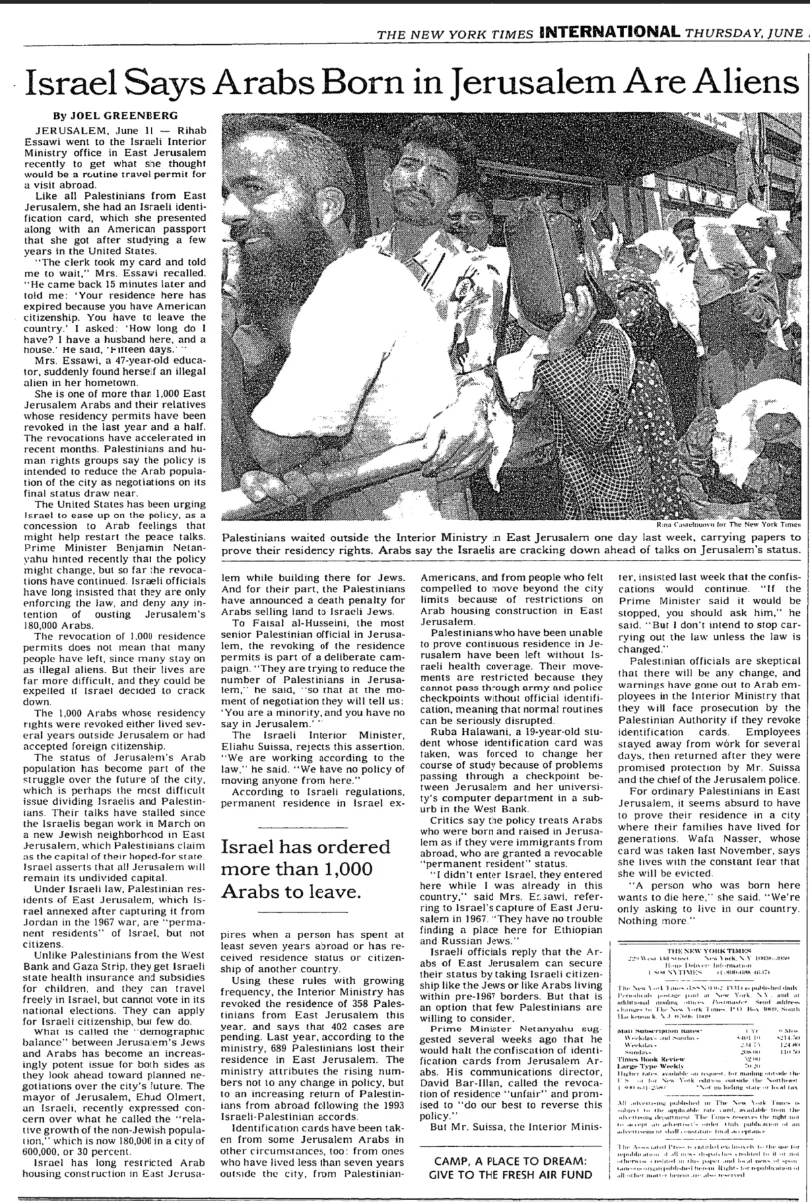
Transcribed from the clipping
JERUSALEM, June 11 — Rihab Essawi went to the Israeli Interior Ministry office in East Jerusalem recently to get what she thought would be a routine travel permit for a visit abroad.
Like all Palestinians from East Jerusalem, she had an Israeli identification card, which she presented along with an American passport that she got after studying a few years in the United States. “The clerk took my card and told me to wait,” Mrs. Essawi recalled.
“He came back 15 minutes later and told me: ‘Your residence here has expired because you have American citizenship. You have to leave the country.’ I asked: ‘How long do I have? I have a husband here, and a house.’ He said, ‘Fifteen days.’ ” Mrs.
Essawi, a 47-year-old educator, suddenly found herself an illegal alien in her hometown. She is one of more than 1,000 East Jerusalem Arabs and their relatives whose residency permits have been revoked in the last year and a half. The revocations have accelerated in recent months.
Palestinians and human rights groups say the policy is intended to reduce the Arab population of the city as negotiations on its final status draw near. The United States has been urging Israel to ease up on the policy, as a concession to Arab feelings that might help restart the peace talks.
Prime Minister Benjamin Netanyahu hinted recently that the policy might change, but so far the revocations have continued. Israeli officials have long insisted that they are only enforcing the law, and deny any intention of ousting Jerusalem’s 180,000 Arabs.
The revocation of 1,000 residence permits does not mean that many people have left, since many stay on as illegal aliens. But their lives are far more difficult, and they could be expelled if Israel decided to crack down. The 1,000 Arabs whose residency rights were revoked either lived several years outside Jerusalem or had accepted foreign citizenship.
The status of Jerusalem’s Arab population has become part of the struggle over the future of the city, which is perhaps the most difficult issue dividing Israelis and Palestinians. Their talks have stalled since the Israelis began work in March on a new Jewish neighborhood in East Jerusalem, which Palestinians claim as the capital of their hoped-for state.
Israel asserts that all Jerusalem will remain its undivided capital.
How this transcription was made
Read from the scan by a machine looking at the image of the page, not by optical character recognition and not by a person.
Context added by this archive
we gotta feature this somewhere…
Cite this clipping
"Israel Says Arabs Born in Jerusalem Are Aliens," The New York Times, 12 June 1997. Covering Palestine archive, CP-1997-022. https://coveringpalestine.org/archive/cp-1997-022
More from The New York Times
- The Maine Colony in PalestineThe New York Times · 12 November 1866
- Jewish Colonization in PalestineThe New York Times · 9 December 1883
- Jewish State in Palestine OpposedThe New York Times · 9 July 1897
- ZIONIST CONGRESS IN BASELThe New York Times · 31 August 1897
- ROME FEARS THE ZIONISTSThe New York Times · 12 September 1897
- PROGRESS OF ZIONISMThe New York Times · 16 December 1901
- 852 more from this paper in the full text →
More from the 1990s
- Israeli soldier shoots into a crowd in Hebron, injuring six PalestiniansThe Baltimore Sun · 2 January 1997
- Arabs celebrate Hebron self-ruleDaily News · 19 January 1997
- Israel to require students to take ArabicThe Boston Globe · 19 January 1997
- Palestinians celebrate in Hebron; settlers stay defiantConcord Monitor · 19 January 1997
- More than 200,000 at Al Aqsa Mosque for RamadanThe Winchester Sun · 1 February 1997
- Israel: Women to go freeSouth Florida Sun Sentinel · 8 February 1997
- All 374 clippings from the 1990s →
Last updated 2 November 2026
This record is part of Covering Palestine, an archive of American newspaper clippings about Palestinians, 1724 to 2023. Researched and assembled by Maria Robles.
The clipping belongs to the newspaper that printed it, or to the news agency that supplied the copy. It is reproduced here for research, criticism and commentary. A city here is where the newspaper was published, not where the story came from, and on most records it was taken from the masthead.
Something wrong here, or something you know about this clipping? The archive is still being built and corrections are wanted: maria@rozumstudio.com, quoting CP-1997-022.
Everything printed in 1997 · Printed on this day · See it in the archive reel · Full text of every clipping · Dataset