The Arizona Republic · Phoenix, Arizona · 6 July 1998
CP-1998-008
Palestinians remember ‘Nakba’
Show pictures life since Israel became a state
Lidia Romero, The Arizona Republic
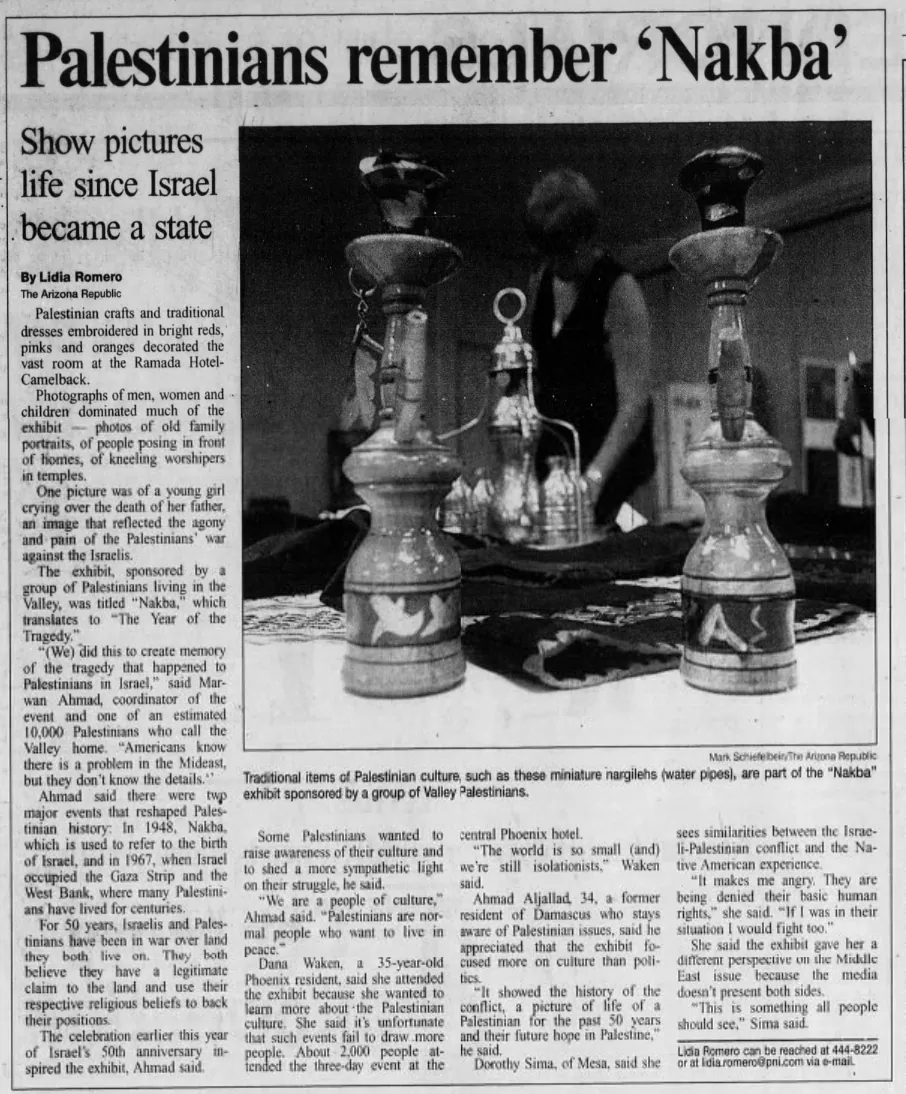
Transcribed from the clipping
“Palestinian crafts and traditional dresses embroidered in bright reds, pinks and oranges decorated the vast room at the Ramada Hotel-Camelback. Photographs of men, women and children dominated much of the exhibit — photos of old family portraits, of people posing in front of homes, of kneeling worshipers in temples.
One picture was of a young girl crying over the death of her father, an image that reflected the agony and pain of the Palestinians’ war against the Israelis. The exhibit, sponsored by a group of Palestinians living in the Valley, was titled ‘Nakba,’ which translates to ‘The Year of the Tragedy.’
‘(We) did this to create memory of the tragedy that happened to Palestinians in Israel,’ said Marwan Ahmad, coordinator of the event and one of an estimated 10,000 Palestinians who call the Valley home. ‘Americans know there is a problem in the Mideast, but they don’t know the details.’
Ahmad said there were two major events that reshaped Palestinian history: In 1948, Nakba, which is used to refer to the birth of Israel, and in 1967, when Israel occupied the Gaza Strip and the West Bank, where many Palestinians have lived for centuries. For 50 years, Israelis and Palestinians have been in war over land they both live on.
They both believe they have a legitimate claim to the land and use their respective religious beliefs to back their positions. The celebration earlier this year of Israel’s 50th anniversary inspired the exhibit, Ahmad said. Some Palestinians wanted to raise awareness of their culture and to shed a more sympathetic light on their struggle, he said.
‘We are a people of culture,’ Ahmad said. ‘Palestinians are normal people who want to live in peace.’ Dana Waken, a 35-year-old Phoenix resident, said she attended the exhibit because she wanted to learn more about the Palestinian culture. She said it’s unfortunate that such events fail to draw more people.
About 2,000 people attended the three-day event at the central Phoenix hotel. ‘The world is so small (and) we’re still isolationists,’ Waken said. Ahmad Aljallad, 34, a former resident of Damascus who stays aware of Palestinian issues, said he appreciated that the exhibit focused more on culture than politics.
‘It showed the history of the conflict, a picture of life of a Palestinian for the past 50 years and their future hope in Palestine,’ he said. Dorothy Sima, of Mesa, said she sees similarities between the Israeli-Palestinian conflict and the Native American experience. ‘It makes me angry. They are being denied their basic human rights,’ she said.
‘If I was in their situation I would fight too.’ She said the exhibit gave her a different perspective on the Middle East issue because the media doesn’t present both sides. ‘This is something all people should see,’ Sima said.”
Context added by this archive
Ten thousand Palestinians in the Phoenix valley, putting on an exhibition about 1948 for the fiftieth anniversary, and a local paper covering it as a community story.
Cite this clipping
"Palestinians remember ‘Nakba’," The Arizona Republic, 6 July 1998, p. 1. Covering Palestine archive, CP-1998-008. https://coveringpalestine.org/archive/cp-1998-008
More from The Arizona Republic
- Suspicion Befogs Plan To Divide PalestineThe Arizona Republic · 29 February 1948
- Jews Accused Of Reducing Arab PopulaceThe Arizona Republic · 21 October 1949
- 8 Israeli Police Found Guilty In Arab MassacreThe Arizona Republic · 13 October 1958
- Arabs Call Unity Meeting For Israel OppositionThe Arizona Republic · 2 January 1967
- The Arabs' View of the conflict's history (Toynbee)The Arizona Republic · 18 June 1967
- 'U.S. Has Made Arabs Pay for Germany's Crime Against Jews'The Arizona Republic · 18 June 1967
- 9 more from this paper in the full text →
More from the 1990s
- Israeli Arabs Living Inside a Jewish Neighborhood Know FearLos Angeles Times · 5 February 1998
- Arab citizens of Israel despair they’ll never be acceptedThe St. Augustine Record · 6 February 1998
- Palestinian protesters voice support for IraqisChicago Tribune · 10 February 1998
- Netanyahu Snubs BritishTulsa World · 18 March 1998
- Israeli Arabs March Home, To a Place They Can’t Live InThe New York Times · 29 March 1998
- Palestinians confront past, betrayals on path to statehoodKalamazoo Gazette · 5 April 1998
- All 374 clippings from the 1990s →
In these collections
Last updated 2 November 2026
This record is part of Covering Palestine, an archive of American newspaper clippings about Palestinians, 1724 to 2023. Researched and assembled by Maria Robles.
The clipping belongs to the newspaper that printed it, or to the news agency that supplied the copy. It is reproduced here for research, criticism and commentary. A city here is where the newspaper was published, not where the story came from, and on most records it was taken from the masthead.
Something wrong here, or something you know about this clipping? The archive is still being built and corrections are wanted: maria@rozumstudio.com, quoting CP-1998-008.
Everything printed in 1998 · Printed on this day · See it in the archive reel · Full text of every clipping · Dataset