The New York Times · New York, New York · 15 August 1998
CP-1998-023
Water Divides Haves From Have-Nots in West Bank
By DOUGLAS JEHL
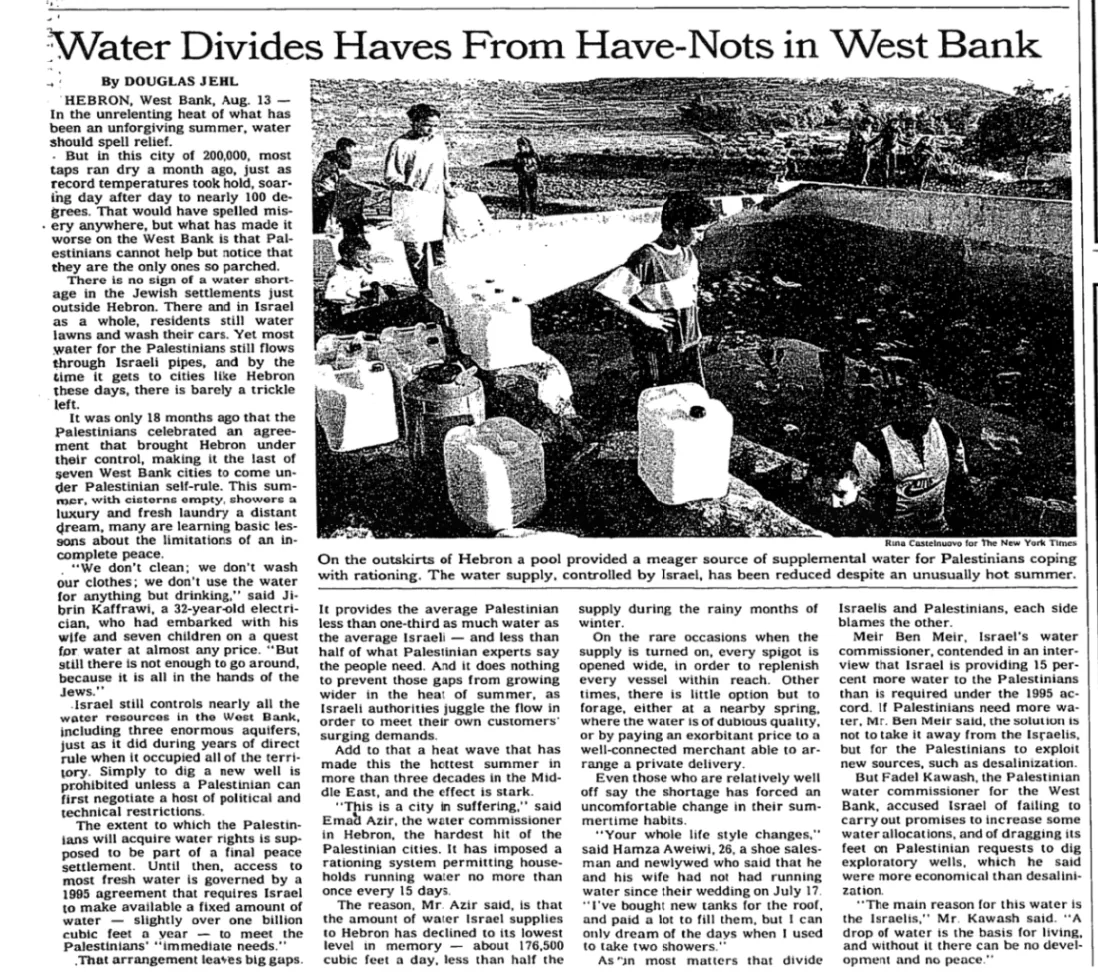
Transcribed from the clipping
HEBRON, West Bank, Aug. 13 — In the unrelenting heat of what has been an unforgiving summer, water should spell relief. But in this city of 200,000, most taps ran dry a month ago, just as record temperatures took hold, soaring day after day to nearly 100 degrees.
That would have spelled misery anywhere, but what has made it worse on the West Bank is that Palestinians cannot help but notice that they are the only ones so parched. There is no sign of a water shortage in the Jewish settlements just outside Hebron. There and in Israel as a whole, residents still water lawns and wash their cars.
Yet most water for the Palestinians still flows through Israeli pipes, and by the time it gets to cities like Hebron these days, there is barely a trickle left. It was only 18 months ago that the Palestinians celebrated an agreement that brought Hebron under their control, making it the last of seven West Bank cities to come under Palestinian self-rule.
This summer, with cisterns empty, showers a luxury and fresh laundry a distant dream, many are learning basic lessons about the limitations of an incomplete peace.
“We don’t clean; we don’t wash our clothes; we don’t use the water for anything but drinking,” said Jibrin Kaffrawi, a 32-year-old electrician, who had embarked with his wife and seven children on a quest for water at almost any price. “But still there is not enough to go around, because it is all in the hands of the Jews.”
Israel still controls nearly all the water resources in the West Bank, including three enormous aquifers, just as it did during years of direct rule when it occupied all of the territory. Simply to dig a new well is prohibited unless a Palestinian can first negotiate a host of political and technical restrictions.
The extent to which the Palestinians will acquire water rights is supposed to be part of a final peace settlement. Until then, access to most fresh water is governed by a 1995 agreement that requires Israel to make available a fixed amount of water — slightly over one billion cubic feet a year — to meet the Palestinians’ “immediate needs.”
That arrangement leaves big gaps.
How this transcription was made
Read from the scan by a machine looking at the image of the page, not by optical character recognition and not by a person. The clipping carries no masthead or date line, so its date and newspaper rest on the record it arrived with, not on anything visible in the scan.
Context added by this archive
Date check: No masthead or dateline rule is visible in the clipping — it begins at the headline. The story’s own dateline reads “HEBRON, West Bank, Aug. 13”, which is consistent with publication on Aug. 15, 1998. The photo credit reads “Rina Castelnuovo for The New York Times”, which confirms the paper.
Cite this clipping
"Water Divides Haves From Have-Nots in West Bank," The New York Times, 15 August 1998. Covering Palestine archive, CP-1998-023. https://coveringpalestine.org/archive/cp-1998-023
More from The New York Times
- The Maine Colony in PalestineThe New York Times · 12 November 1866
- Jewish Colonization in PalestineThe New York Times · 9 December 1883
- Jewish State in Palestine OpposedThe New York Times · 9 July 1897
- ZIONIST CONGRESS IN BASELThe New York Times · 31 August 1897
- ROME FEARS THE ZIONISTSThe New York Times · 12 September 1897
- PROGRESS OF ZIONISMThe New York Times · 16 December 1901
- 852 more from this paper in the full text →
More from the 1990s
- Israeli Arabs Living Inside a Jewish Neighborhood Know FearLos Angeles Times · 5 February 1998
- Arab citizens of Israel despair they’ll never be acceptedThe St. Augustine Record · 6 February 1998
- Palestinian protesters voice support for IraqisChicago Tribune · 10 February 1998
- Netanyahu Snubs BritishTulsa World · 18 March 1998
- Israeli Arabs March Home, To a Place They Can’t Live InThe New York Times · 29 March 1998
- Palestinians confront past, betrayals on path to statehoodKalamazoo Gazette · 5 April 1998
- All 374 clippings from the 1990s →
Last updated 2 November 2026
This record is part of Covering Palestine, an archive of American newspaper clippings about Palestinians, 1724 to 2023. Researched and assembled by Maria Robles.
The clipping belongs to the newspaper that printed it, or to the news agency that supplied the copy. It is reproduced here for research, criticism and commentary. A city here is where the newspaper was published, not where the story came from, and on most records it was taken from the masthead.
Something wrong here, or something you know about this clipping? The archive is still being built and corrections are wanted: maria@rozumstudio.com, quoting CP-1998-023.
Everything printed in 1998 · Printed on this day · See it in the archive reel · Full text of every clipping · Dataset