The New York Times · New York, New York · 23 April 1998
CP-1998-012
Living With the Palestinian ‘Catastrophe’
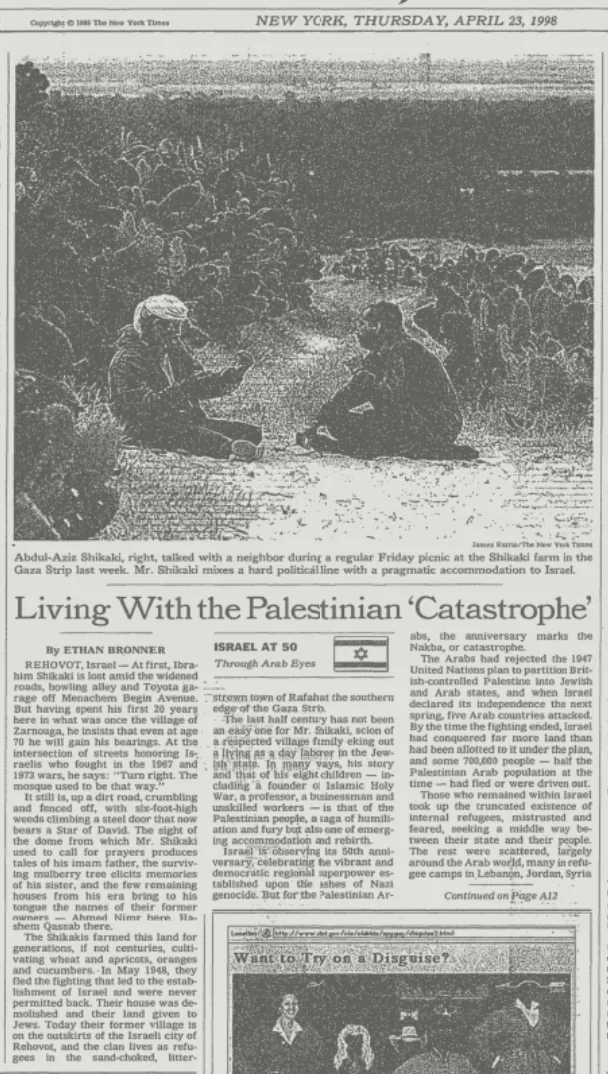
Transcribed from the clipping
REHOVOT, Israel — At first, Ibrahim Shikaki is lost amid the widened roads, bowling alley and Toyota garage off Menachem Begin Avenue. But having spent his first 20 years here in what was once the village of Zarnouga, he insists that even at age 70 he will gain his bearings.
At the intersection of streets honoring Israelis who fought in the 1967 and 1973 wars, he says: “Turn right. The mosque used to be that way.” It still is, up a dirt road, crumbling and fenced off, with six-foot-high weeds climbing a steel door that now bears a Star of David. The sight of the dome from which Mr.
Shikaki used to call for prayers produces tales of his imam father, the surviving mulberry tree elicits memories of his sister, and the few remaining houses from his era bring to his tongue the names of their former owners — Ahmed Nimr here, Hashem Qassab there.
The Shikakis farmed this land for generations, if not centuries, cultivating wheat and apricots, oranges and cucumbers. In May 1948, they fled the fighting that led to the establishment of Israel and were never permitted back. Their house was demolished and their land given to Jews.
Today their former village is on the outskirts of the Israeli city of Rehovot, and the clan lives as refugees in the sand-choked, litter-strewn town of Rafah at the southern edge of the Gaza Strip. The last half century has not been an easy one for Mr. Shikaki, scion of a respected village family eking out a living as a day laborer in the Jewish state.
In many ways, his story and that of his eight children — including a founder of Islamic Holy War, a professor, a businessman and unskilled workers — is that of the Palestinian people, a saga of humiliation and fury but also one of emerging accommodation and rebirth.
Israel is observing its 50th anniversary, celebrating the vibrant and democratic regional superpower established upon the ashes of Nazi genocide. But for the Palestinian Arabs, the anniversary marks the Nakba, or catastrophe.
The Arabs had rejected the 1947 United Nations plan to partition British-controlled Palestine into Jewish and Arab states, and when Israel declared its independence the next spring, five Arab countries attacked.
By the time the fighting ended, Israel had conquered far more land than had been allotted to it under the plan, and some 700,000 people — half the Palestinian Arab population at the time — had fled or were driven out.
How this transcription was made
Read from the scan by a machine looking at the image of the page, not by optical character recognition and not by a person. The clipping carries no masthead or date line, so its date and newspaper rest on the record it arrived with, not on anything visible in the scan.
Context added by this archive
The page date line reads NEW YORK, THURSDAY, APRIL 23, 1998. The article continues on page A12, which this archive does not hold, so the text here stops at the foot of the front-page column.
Cite this clipping
"Living With the Palestinian ‘Catastrophe’," The New York Times, 23 April 1998. Covering Palestine archive, CP-1998-012. https://coveringpalestine.org/archive/cp-1998-012
More from The New York Times
- The Maine Colony in PalestineThe New York Times · 12 November 1866
- Jewish Colonization in PalestineThe New York Times · 9 December 1883
- Jewish State in Palestine OpposedThe New York Times · 9 July 1897
- ZIONIST CONGRESS IN BASELThe New York Times · 31 August 1897
- ROME FEARS THE ZIONISTSThe New York Times · 12 September 1897
- PROGRESS OF ZIONISMThe New York Times · 16 December 1901
- 852 more from this paper in the full text →
More from the 1990s
- Israeli Arabs Living Inside a Jewish Neighborhood Know FearLos Angeles Times · 5 February 1998
- Arab citizens of Israel despair they’ll never be acceptedThe St. Augustine Record · 6 February 1998
- Palestinian protesters voice support for IraqisChicago Tribune · 10 February 1998
- Netanyahu Snubs BritishTulsa World · 18 March 1998
- Israeli Arabs March Home, To a Place They Can’t Live InThe New York Times · 29 March 1998
- Netanyahu says Palestinians not doing their partChicago Tribune · 1 April 1998
- All 383 clippings from the 1990s →
Last updated 17 November 2026
This record is part of Covering Palestine, an archive of American newspaper clippings about Palestinians, 1724 to 2023. Researched and assembled by Maria Robles.
The clipping belongs to the newspaper that printed it, or to the news agency that supplied the copy. It is reproduced here for research, criticism and commentary. A city here is where the newspaper was published, not where the story came from, and on most records it was taken from the masthead.
Something wrong here, or something you know about this clipping? The archive is still being built and corrections are wanted: maria@rozumstudio.com, quoting CP-1998-012.
Everything printed in 1998 · Printed on this day · See it in the archive reel · Full text of every clipping · Dataset