Spokesman Review · 6 October 2000
CP-2000-024
takes on new meaning
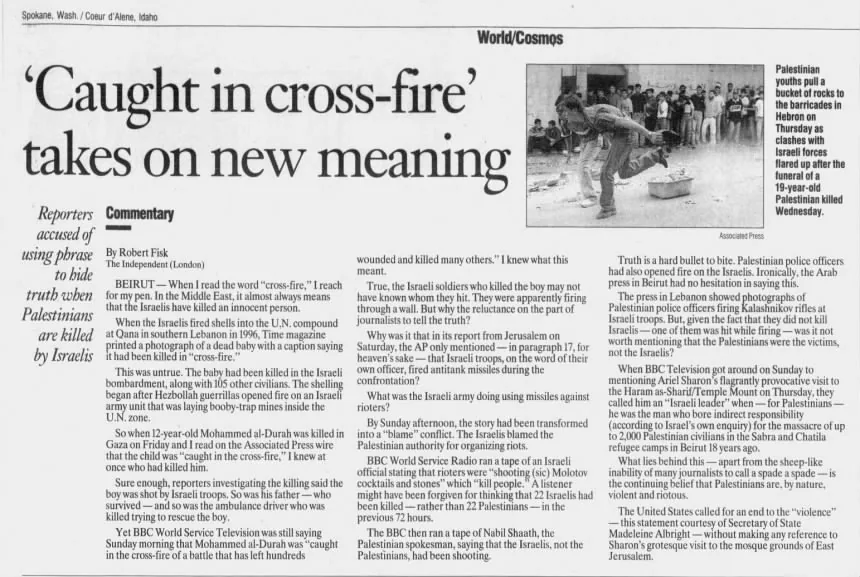
Transcribed from the clipping
Spokane, Wash. / Coeur d'Alene, Idaho World/Cosmos 'Caught in cross-fire' takes on new meaning Reporters accused of using phrase to hide truth when Palestinians are killed by Israelis Commentary By Robert Fisk The Independent (London) BEIRUT - When I read the word "cross-fire," 1 reach for my pen.
In the Middle East, it almost always means that the Israelis have killed an innocent person. When the Israelis fired shells into the U,N. compound at Oana in southern Lebanon in 1996, Time magazine printed a photograph of a dead baby with a caption saying it had been killed in "cross-fire." This was untrue.
The baby had been killed in the Isracli bombardment, along with 105 other civilians. The shelling began after Hezbollah guerrillas opened fire on an Israeli army unit that was laying booby-trap mines inside the U.N. zone.
So when 12-year-old Mohammed al-Durah was killed in Gaza on Friday and I read on the Associated Press wire that the child was "caught in the cross-fire," I knew at once who had killed him. Sure cnough, reporters investigating the killing said the boy was shot by Israeli troops.
So was his father - who survived - and so was the ambulance driver who was killed trying to rescue the boy. Yet BBC World Service Television was still saying Sunday morning that Mohammed al-Durah was "caught in the cross-fire of a battle that has left hundreds wounded and killed many others." I knew what this meant.
True, the Israeli soldiers who killed the boy may not have known whom they hit. They were apparently firing through a wall. But why the reluctance on the part of journalists to tell the truth?
Why was it that in its report from Jerusalem on Saturday, the AP only mentioned — in paragraph 17, for heaven's sake — that Isracli troops, on the word of their own officer, fired antitank missiles during the confrontation? What was the Israeli army doing using missiles against rioters? By Sunday afternoon, the story had been transformed into a "blame" conflict.
The Israelis blamed the Palestinian authority for organizing riots. BBC World Service Radio ran a tape of an Isracli official stating that roters were "shooting (sic) Molotov cocktails and stones" which "kill people. A listener might have been forgiven for thinking that 22 Israelis had been killed - rather than 22 Palestinians - in the previous 72 hours.
The BBC then ran a tape of Nabil Shaath, the Palestinian spokesman, saying that the Israclis, not the Palestinians, had been shooting. Palestinian youths pull a bucket of rocks to the barricades in Hebron on Thursday as clashes with Israeli forces lared up after the funeral of a 19-year-old Palestinian killed Wednesday. Truth is a hard bullet to bite.
Palestinian police officers had also opened fire on the Israclis. Ironically, the Arab press in Beirut had no hesitation in saying this. The press in Lebanon showed photographs of Palestinian police officers firing Kalashnikov rifles at Isracli troops.
But, given the fact that they did not kill Israclis — one of them was hit while firing — - was it not worth mentioning that the Palestinians were the victims, not the Israclis?
When BBC Television got around on Sunday to mentioning Ariel Sharon's flagrantly provocative visit to the Haram as-Sharif/Temple Mount on Thursday, they called him an "Isracli leader" when — for Palestinians - he was the man who bore indirect responsibility (according to Israel's own enquiry) for the massacre of up to 2,000 Palestinian civilians in the Sabra and Chatila refugee camps in Beirut 18 years ago.
What lies behind this — apart from the sheep-like inability of many journalists to call a spade a spade — is the continuing belief that Palestinians are. by nature, violent and riotous.
The United States called for an end to the "violence" - this statement courtesy of Secretary of State Madeleine Albright - without making any reference to Sharon's grotesque visit to the mosque grounds of East Jerusalem.
Cite this item
"takes on new meaning," Spokesman Review, 6 October 2000. Covering Palestine archive, CP-2000-024. https://coveringpalestine.org/archive/cp-2000-024
This clipping is read closely in the section below
More from the 2000s
- The poetry of Arab pain: Are Israeli students ready?The Bulletin · 7 March 2000
- Israelis argue over teaching Palestinian’s verseThe Oregonian · 7 March 2000
- An uproar over introduction of poet into curriculumThe News Virginian · 7 March 2000
- Poet’s work inflames cultural divideTampa Bay Times · 11 March 2000
- Arafat rejected $30 billion for refugee relocation, aide saysIndianapolis Star · 11 August 2000
- Contested holy sitesThe Columbian · 8 September 2000
- All 193 clippings from the 2000s →
This record is part of Covering Palestine, an archive of American and Anglophone newspaper clippings about Palestinians, 1799 to 2023. Researched and assembled by Maria Robles.
The clipping belongs to the newspaper that printed it, or to the news agency that supplied the copy. It is reproduced here for research, criticism and commentary. The city is derived from the masthead, not read off the clipping.
Something wrong here, or something you know about this clipping? The archive is still being built and corrections are wanted: maria@rozumstudio.com, quoting CP-2000-024.
See it in the archive reel · Full text of every clipping · Dataset