The Palm Beach Post · West Palm Beach, Florida · 5 October 2000
CP-2000-030
Nothing random about hatred
Transcribed from the clipping
The killing of Mohammed Jamal Aldura at age 12 on a Gaza road last weekend cannot be dismissed as a random accident or a senseless tragedy.
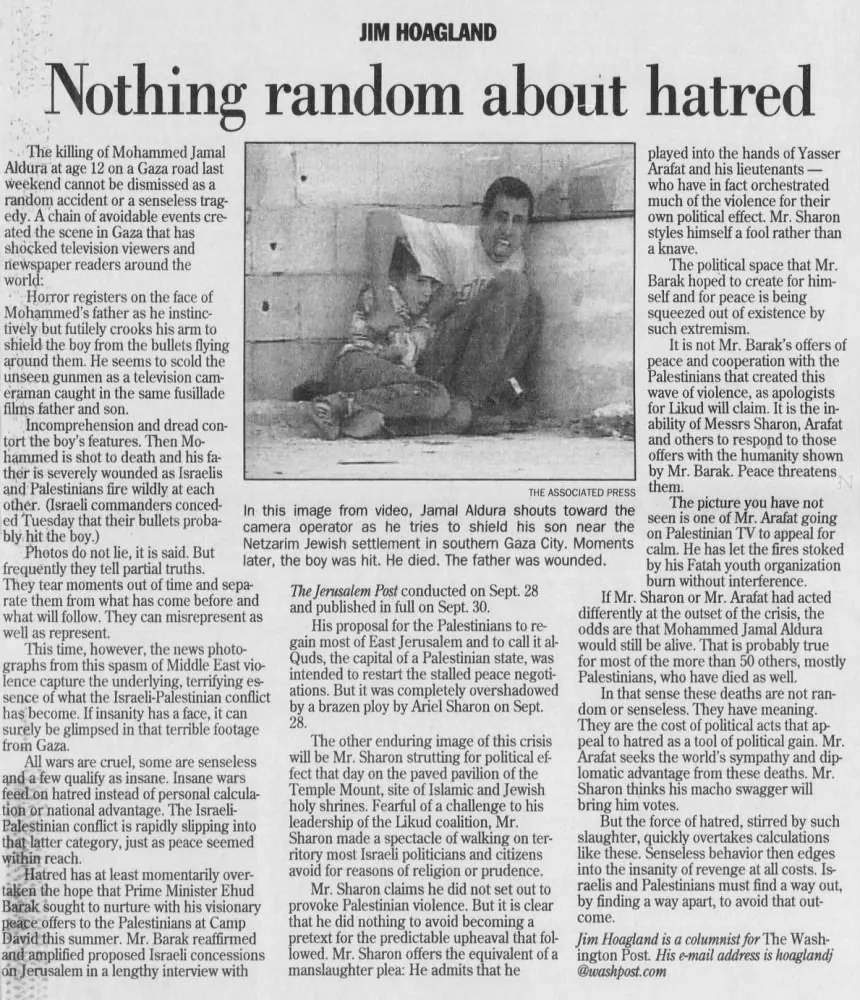
A chain of avoidable events created the scene in Gaza that has shocked television viewers and newspaper readers around the world: Horror registers on the face of Mohammed’s father as he instinctively but futilely crooks his arm to shield the boy from the bullets flying around them.
He seems to scold the unseen gunmen as a television cameraman caught in the same fusillade films father and son. Incomprehension and dread contort the boy’s features. Then Mohammed is shot to death and his father is severely wounded as Israelis and Palestinians fire wildly at each other. (Israeli commanders conceded Tuesday that their bullets probably hit the boy.)
Photos do not lie, it is said. But frequently they tell partial truths. They tear moments out of time and separate them from what has come before and what will follow. They can misrepresent as well as represent.
This time, however, the news photographs from this spasm of Middle East violence capture the underlying, terrifying essence of what the Israeli-Palestinian conflict has become. If insanity has a face, it can surely be glimpsed in that terrible footage from Gaza. All wars are cruel, some are senseless and a few qualify as insane.
Insane wars feed on hatred instead of personal calculation or national advantage. The Israeli-Palestinian conflict is rapidly slipping into that latter category, just as peace seemed within reach. Hatred has at least momentarily overtaken the hope that Prime Minister Ehud Barak sought to nurture with his visionary peace offers to the Palestinians at Camp David this summer. Mr.
Barak reaffirmed and amplified proposed Israeli concessions on Jerusalem in a lengthy interview with The Jerusalem Post conducted on Sept. 28 and published in full on Sept. 30. His proposal for the Palestinians to regain most of East Jerusalem and to call it al-Quds, the capital of a Palestinian state, was intended to restart the stalled peace negotiations.
But it was completely overshadowed by a brazen ploy by Ariel Sharon on Sept. 28. The other enduring image of this crisis will be Mr. Sharon strutting for political effect that day on the paved pavilion of the Temple Mount, site of Islamic and Jewish holy shrines. Fearful of a challenge to his leadership of the Likud coalition, Mr.
Sharon made a spectacle of walking on territory most Israeli politicians and citizens avoid for reasons of religion or prudence. Mr. Sharon claims he did not set out to provoke Palestinian violence. But it is clear that he did nothing to avoid becoming a pretext for the predictable upheaval that followed. Mr.
Sharon offers the equivalent of a manslaughter plea: He admits that he played into the hands of Yasser Arafat and his lieutenants — who have in fact orchestrated much of the violence for their own political effect. Mr. Sharon styles himself a fool rather than a knave. The political space that Mr.
Barak hoped to create for himself and for peace is being squeezed out of existence by such extremism. It is not Mr. Barak’s offers of peace and cooperation with the Palestinians that created this wave of violence, as apologists for Likud will claim. It is the inability of Messrs Sharon, Arafat and others to respond to those offers with the humanity shown by Mr. Barak.
Peace threatens them. The picture you have not seen is one of Mr. Arafat going on Palestinian TV to appeal for calm. He has let the fires stoked by his Fatah youth organization burn without interference. If Mr. Sharon or Mr. Arafat had acted differently at the outset of the crisis, the odds are that Mohammed Jamal Aldura would still be alive.
That is probably true for most of the more than 50 others, mostly Palestinians, who have died as well. In that sense these deaths are not random or senseless. They have meaning. They are the cost of political acts that appeal to hatred as a tool of political gain. Mr. Arafat seeks the world’s sympathy and diplomatic advantage from these deaths. Mr.
Sharon thinks his macho swagger will bring him votes. But the force of hatred, stirred by such slaughter, quickly overtakes calculations like these. Senseless behavior then edges into the insanity of revenge at all costs. Israelis and Palestinians must find a way out, by finding a way apart, to avoid that outcome. Jim Hoagland is a columnist for The Washington Post.
His e-mail address is hoaglandj@washpost.com
How this transcription was made
Read from the scan by a machine looking at the image of the page, not by optical character recognition and not by a person. The clipping carries no masthead or date line, so its date and newspaper rest on the record it arrived with, not on anything visible in the scan.
Cite this clipping
"Nothing random about hatred," The Palm Beach Post, 5 October 2000. Covering Palestine archive, CP-2000-030. https://coveringpalestine.org/archive/cp-2000-030
This clipping is read closely in the section below
More from The Palm Beach Post
- Israeli Court Convicts Eight In ’56 MassacreThe Palm Beach Post · 17 October 1958
- Israeli TortureThe Palm Beach Post · 18 December 1972
- Denied an identity, Gazans losing hope in land of despairThe Palm Beach Post · 8 October 1986
- Islamic zealots threaten PLO’s ‘unified leadership’The Palm Beach Post · 18 September 1988
- U.S.-PLO talks encouraging terrorism, Israeli saysThe Palm Beach Post · 30 December 1988
- Palestinians fear loss of homes as evictions loomThe Palm Beach Post · 11 May 2021
- 1 more from this paper in the full text →
More from the 2000s
- Are refugee camps still temporary?Pittsburgh Post-Gazette · 27 February 2000
- Building, like West Bank peace, still under constructionLansing State Journal · 29 February 2000
- No progress in peace missionLaredo Morning Times · 29 February 2000
- Some Palestinians fed up with ArafatLexington Herald-Leader · 29 February 2000
- Symbols, semantics key to Jerusalem peaceStaten Island Advance · 29 February 2000
- The poetry of Arab pain: Are Israeli students ready?The Bulletin · 7 March 2000
- All 527 clippings from the 2000s →
Last updated 17 November 2026
This record is part of Covering Palestine, an archive of American newspaper clippings about Palestinians, 1724 to 2023. Researched and assembled by Maria Robles.
The clipping belongs to the newspaper that printed it, or to the news agency that supplied the copy. It is reproduced here for research, criticism and commentary. A city here is where the newspaper was published, not where the story came from, and on most records it was taken from the masthead.
Something wrong here, or something you know about this clipping? The archive is still being built and corrections are wanted: maria@rozumstudio.com, quoting CP-2000-030.
Read in: A boy was killed, and nine papers called it crossfire
Everything printed in 2000 · Printed on this day · See it in the archive reel · Full text of every clipping · Dataset