The New York Times · 3 April 2002
CP-2002-102
Gazans Await Israeli Attack Despite Lack Of a Buildup
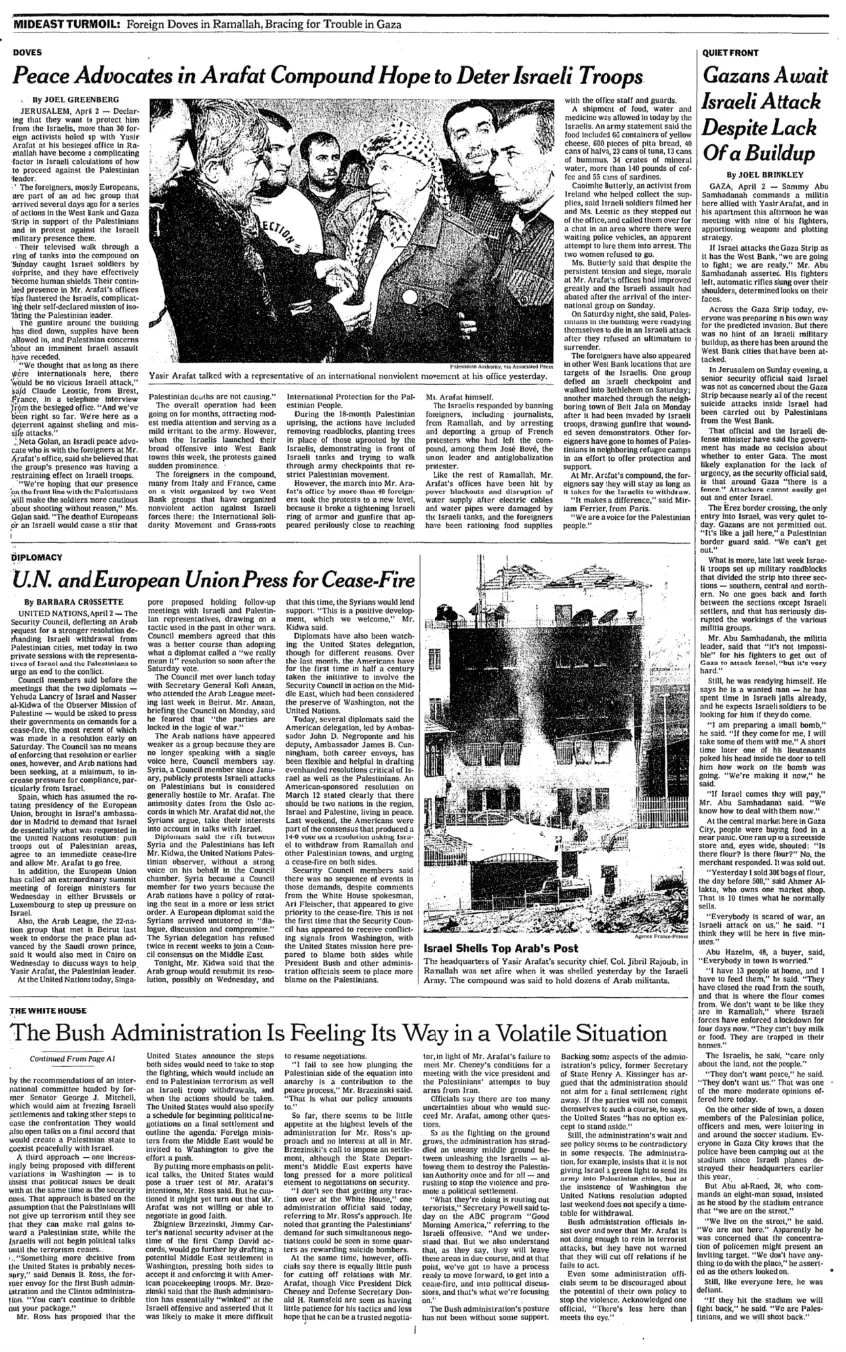
Transcribed from the clipping
GAZA, April 2 — Sammy Abu Samhadanah commands a militia here allied with Yasir Arafat, and in his apartment this afternoon he was meeting with nine of his fighters, apportioning weapons and plotting strategy. If Israel attacks the Gaza Strip as it has the West Bank, “we are going to fight; we are ready,” Mr. Abu Samhadanah asserted.
His fighters left, automatic rifles slung over their shoulders, determined looks on their faces. Across the Gaza Strip today, everyone was preparing in his own way for the predicted invasion. But there was no hint of an Israeli military buildup, as there has been around the West Bank cities that have been attacked.
In Jerusalem on Sunday evening, a senior security official said Israel was not as concerned about the Gaza Strip because nearly all of the recent suicide attacks inside Israel had been carried out by Palestinians from the West Bank. That official and the Israeli defense minister have said the government has made no decision about whether to enter Gaza.
The most likely explanation for the lack of urgency, as the security official said, is that around Gaza “there is a fence.” Attackers cannot easily get out and enter Israel. The Erez border crossing, the only entry into Israel, was very quiet today. Gazans are not permitted out. “It’s like a jail here,” a Palestinian border guard said.
“We can’t get out.” What is more, late last week Israeli troops set up military roadblocks that divided the strip into three sections — southern, central and northern. No one goes back and forth between the sections except Israeli settlers, and that has seriously disrupted the workings of the various militia groups. Mr.
Abu Samhadanah, the militia leader, said that “it’s not impossible” for his fighters to get out of Gaza to attack Israel, “but it’s very hard.” Still, he was readying himself. He says he is a wanted man — he has spent time in Israeli jails already, and he expects Israeli soldiers to be looking for him if they do come.
“I am preparing a small bomb,” he said. “If they come for me, I will take some of them with me.” A short time later one of his lieutenants poked his head inside the door to tell him how work on the bomb was going. “We’re making it now,” he said. “If Israel comes they will pay,” Mr. Abu Samhadanah said.
“We know how to deal with them now.” At the central market here in Gaza City, people were buying food in a near panic. One ran up to a streetside store and, eyes wide, shouted: “Is there flour? Is there flour?” No, the merchant responded. It was sold out.
“Yesterday I sold 300 bags of flour, the day before 500,” said Ahmer Al-lakta, who owns one market shop. That is 10 times what he normally sells. “Everybody is scared of war, an Israeli attack on us,” he said. “I think they will be here in five minutes.” Abu Hazeim, 48, a buyer, said, “Everybody in town is worried.”
“I have 13 people at home, and I have to feed them,” he said. “They have closed the road from the south, and that is where the flour comes from. We don’t want to be like they are in Ramallah,” where Israeli forces have enforced a lockdown for four days now. “They can’t buy milk or food. They are trapped in their homes.”
The Israelis, he said, “care only about the land, not the people.” “They don’t want peace,” he said. “They don’t want us.” That was one of the more moderate opinions offered here today. On the other side of town, a dozen members of the Palestinian police, officers and men, were loitering in and around the soccer stadium.
Everyone in Gaza City knows that the police have been camping out at the stadium since Israeli planes destroyed their headquarters earlier this year. But Abu al-Raed, 30, who commands an eight-man squad, insisted as he stood by the stadium entrance that “we are on the street.” “We live on the street,” he said. “We are not here.”
Apparently he was concerned that the concentration of policemen might present an inviting target. “We don’t have anything to do with the place,” he asserted as the others looked on. Still, like everyone here, he was defiant. “If they hit the stadium we will fight back,” he said. “We are Palestinians, and we will shoot back.”
How this transcription was made
Transcribed from the slide scan by a reader working off magnified crops, not by optical character recognition. The clipping carries no masthead and no folio, and the newspaper is not printed on it — the two photographs are credited “Palestinian Authority, via Associated Press” and “Agence France-Presse” — so the attribution rests on the hand-typed slide label and on a match to the archive’s other page of the same date. The date is derived from the printed dateline, “GAZA, April 2”, and the companion columns’ datelines of the same day. THE SCAN IS A WHOLE PAGE CARRYING FOUR ARTICLES under the banner “MIDEAST TURMOIL: Foreign Doves in Ramallah, Bracing for Trouble in Gaza”. Only the one transcribed here carries ordinary Palestinians. The other three are “Peace Advocates in Arafat Compound Hope to Deter Israeli Troops” by Joel Greenberg, “U.N. and European Union Press for Cease-Fire” by Barbara Crossette, and “The Bush Administration Is Feeling Its Way in a Volatile Situation”, a jump from page A1. This is a different page from the archive’s existing 3 April 2002 record, which is bannered “MIDEAST TURMOIL: Rejecting Exile, Burying the Dead” and shares no text with it. One reading is uncertain: the market shopkeeper’s surname breaks across a line as “Al-” / “lakta”, so the page does not show whether the hyphen is the paper’s or only an end-of-line break.
Cite this clipping
"Gazans Await Israeli Attack Despite Lack Of a Buildup," The New York Times, 3 April 2002. Covering Palestine archive, CP-2002-102. https://coveringpalestine.org/archive/cp-2002-102
More from The New York Times
- The Maine Colony in PalestineThe New York Times · 12 November 1866
- Jewish Colonization in PalestineThe New York Times · 9 December 1883
- Jewish State in Palestine OpposedThe New York Times · 9 July 1897
- ZIONIST CONGRESS IN BASELThe New York Times · 31 August 1897
- ROME FEARS THE ZIONISTSThe New York Times · 12 September 1897
- PROGRESS OF ZIONISMThe New York Times · 16 December 1901
- 852 more from this paper in the full text →
More from the 2000s
- Don’t forget it’s an Israeli occupationThe Daily Press · 1 January 2002
- Soothing Israel’s FearsThe New York Times · 7 January 2002
- Israel, in Reprisal for Killings, Razes Gaza Refugee HomesThe New York Times · 11 January 2002
- Refugees and Reparations in the MideastThe New York Times · 13 January 2002
- Israeli missiles strike naval baseThe Greenville News · 13 January 2002
- Friendship of Palestinian, architect defies oddsThe Bismarck Tribune · 17 January 2002
- All 516 clippings from the 2000s →
Last updated 2 November 2026
This record is part of Covering Palestine, an archive of American newspaper clippings about Palestinians, 1724 to 2023. Researched and assembled by Maria Robles.
The clipping belongs to the newspaper that printed it, or to the news agency that supplied the copy. It is reproduced here for research, criticism and commentary. A city here is where the newspaper was published, not where the story came from, and on most records it was taken from the masthead.
Something wrong here, or something you know about this clipping? The archive is still being built and corrections are wanted: maria@rozumstudio.com, quoting CP-2002-102.
Everything printed in 2002 · Printed on this day · See it in the archive reel · Full text of every clipping · Dataset