The New York Times · 4 April 2002
CP-2002-103
Arabs’ Grief in Bethlehem, Bombers’ Gloating in Gaza
By JAMES BENNET and By JOEL BRINKLEY
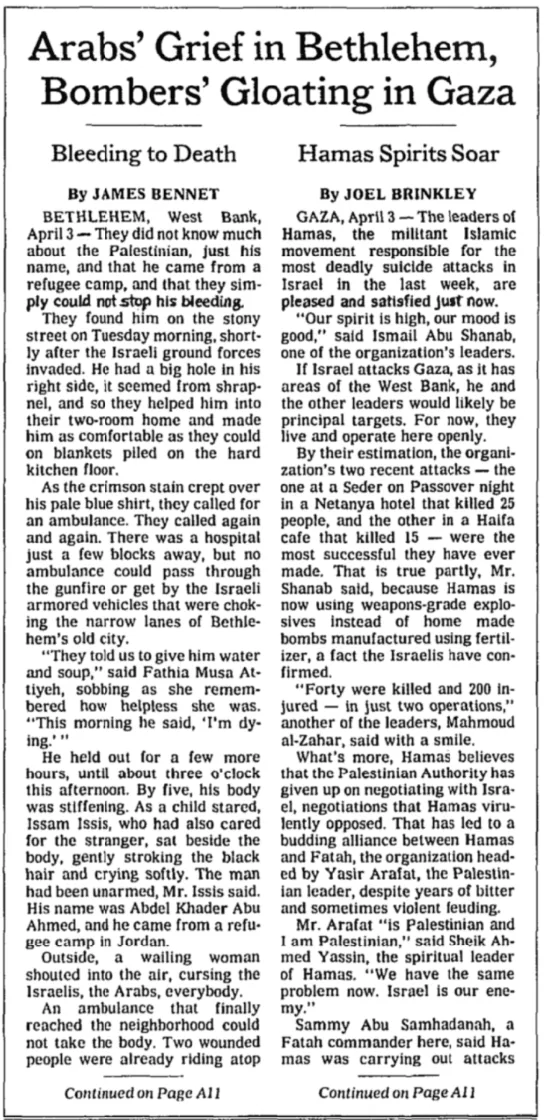
Transcribed from the clipping
Bleeding to Death By JAMES BENNET BETHLEHEM, West Bank, April 3 — They did not know much about the Palestinian, just his name, and that he came from a refugee camp, and that they simply could not stop his bleeding. They found him on the stony street on Tuesday morning, shortly after the Israeli ground forces invaded.
He had a big hole in his right side, it seemed from shrapnel, and so they helped him into their two-room home and made him as comfortable as they could on blankets piled on the hard kitchen floor. As the crimson stain crept over his pale blue shirt, they called for an ambulance. They called again and again.
There was a hospital just a few blocks away, but no ambulance could pass through the gunfire or get by the Israeli armored vehicles that were choking the narrow lanes of Bethlehem’s old city. “They told us to give him water and soup,” said Fathia Musa Attiyeh, sobbing as she remembered how helpless she was.
“This morning he said, ‘I’m dying.’” He held out for a few more hours, until about three o’clock this afternoon. By five, his body was stiffening. As a child stared, Issam Issis, who had also cared for the stranger, sat beside the body, gently stroking the black hair and crying softly. The man had been unarmed, Mr. Issis said.
His name was Abdel Khader Abu Ahmed, and he came from a refugee camp in Jordan. Outside, a wailing woman shouted into the air, cursing the Israelis, the Arabs, everybody. An ambulance that finally reached the neighborhood could not take the body.
Two wounded people were already riding atop Hamas Spirits Soar By JOEL BRINKLEY GAZA, April 3 — The leaders of Hamas, the militant Islamic movement responsible for the most deadly suicide attacks in Israel in the last week, are pleased and satisfied just now.
“Our spirit is high, our mood is good,” said Ismail Abu Shanab, one of the organization’s leaders. If Israel attacks Gaza, as it has areas of the West Bank, he and the other leaders would likely be principal targets. For now, they live and operate here openly.
By their estimation, the organization’s two recent attacks — the one at a Seder on Passover night in a Netanya hotel that killed 25 people, and the other in a Haifa cafe that killed 15 — were the most successful they have ever made. That is true partly, Mr.
Shanab said, because Hamas is now using weapons-grade explosives instead of home made bombs manufactured using fertilizer, a fact the Israelis have confirmed. “Forty were killed and 200 injured — in just two operations,” another of the leaders, Mahmoud al-Zahar, said with a smile.
What’s more, Hamas believes that the Palestinian Authority has given up on negotiating with Israel, negotiations that Hamas virulently opposed. That has led to a budding alliance between Hamas and Fatah, the organization headed by Yasir Arafat, the Palestinian leader, despite years of bitter and sometimes violent feuding. Mr.
Arafat “is Palestinian and I am Palestinian,” said Sheik Ahmed Yassin, the spiritual leader of Hamas. “We have the same problem now. Israel is our enemy.”
How this transcription was made
Transcribed from the slide scan by a reader working off magnified crops, not by optical character recognition. The clipping carries no masthead and no folio, and the newspaper is not printed on it anywhere; that attribution rests on the hand-typed slide label and on house typography. The date is derived from the two printed datelines, “BETHLEHEM, West Bank, April 3” and “GAZA, April 3”, with the year fixed by the article’s references to the Passover bombing in Netanya and the Haifa cafe. ONE CLIPPING, TWO BYLINED ARTICLES: the head “Arabs’ Grief in Bethlehem, Bombers’ Gloating in Gaza” runs across both columns and each column below it has its own sub-head and byline, “Bleeding to Death” by James Bennet and “Hamas Spirits Soar” by Joel Brinkley. Both are transcribed, with the sub-heads marked inside the text, because the package is what the page printed.
Cite this clipping
"Arabs’ Grief in Bethlehem, Bombers’ Gloating in Gaza," The New York Times, 4 April 2002. Covering Palestine archive, CP-2002-103. https://coveringpalestine.org/archive/cp-2002-103
More from The New York Times
- The Maine Colony in PalestineThe New York Times · 12 November 1866
- Jewish Colonization in PalestineThe New York Times · 9 December 1883
- Jewish State in Palestine OpposedThe New York Times · 9 July 1897
- ZIONIST CONGRESS IN BASELThe New York Times · 31 August 1897
- ROME FEARS THE ZIONISTSThe New York Times · 12 September 1897
- PROGRESS OF ZIONISMThe New York Times · 16 December 1901
- 852 more from this paper in the full text →
More from the 2000s
- Don’t forget it’s an Israeli occupationThe Daily Press · 1 January 2002
- Soothing Israel’s FearsThe New York Times · 7 January 2002
- Israel, in Reprisal for Killings, Razes Gaza Refugee HomesThe New York Times · 11 January 2002
- Refugees and Reparations in the MideastThe New York Times · 13 January 2002
- Israeli missiles strike naval baseThe Greenville News · 13 January 2002
- Friendship of Palestinian, architect defies oddsThe Bismarck Tribune · 17 January 2002
- All 516 clippings from the 2000s →
Last updated 2 November 2026
This record is part of Covering Palestine, an archive of American newspaper clippings about Palestinians, 1724 to 2023. Researched and assembled by Maria Robles.
The clipping belongs to the newspaper that printed it, or to the news agency that supplied the copy. It is reproduced here for research, criticism and commentary. A city here is where the newspaper was published, not where the story came from, and on most records it was taken from the masthead.
Something wrong here, or something you know about this clipping? The archive is still being built and corrections are wanted: maria@rozumstudio.com, quoting CP-2002-103.
Everything printed in 2002 · Printed on this day · See it in the archive reel · Full text of every clipping · Dataset