The New York Times · 11 September 2002
CP-2002-110
‘Moonlight’ and Mendelssohn in the West Bank
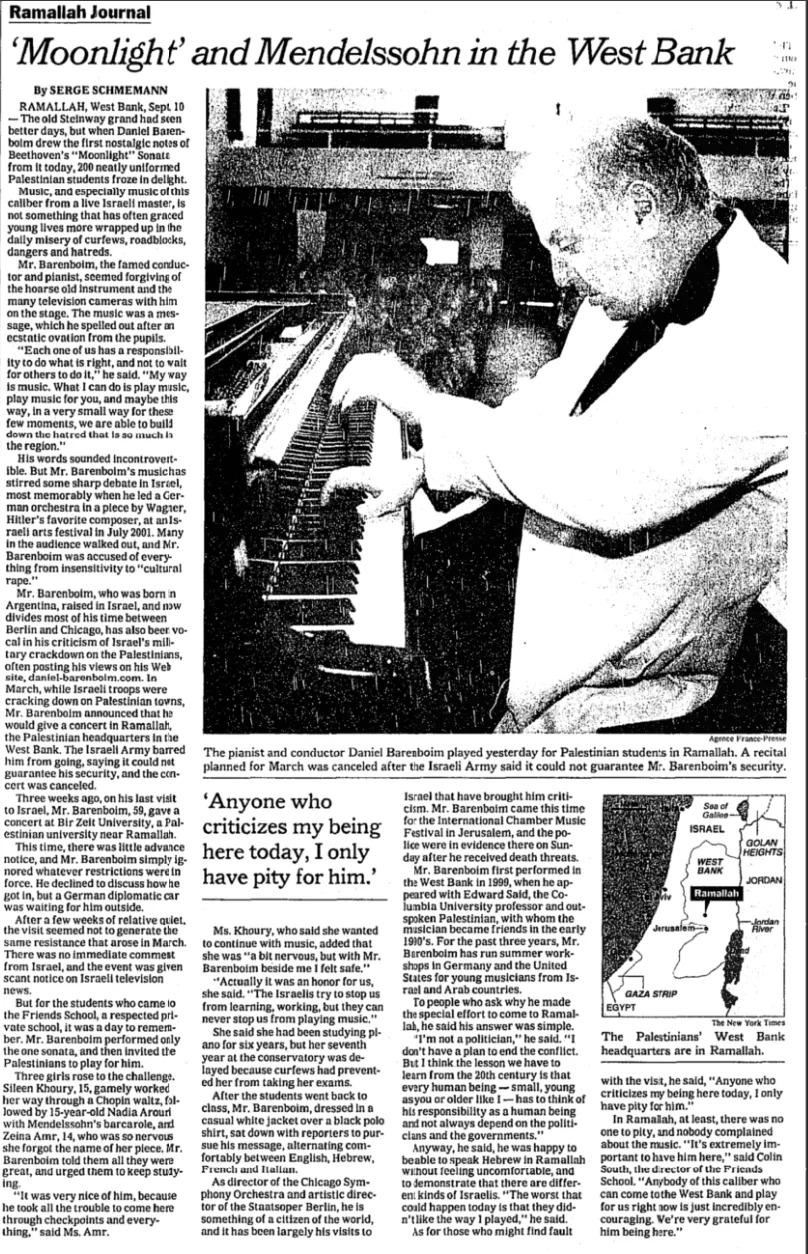
Transcribed from the clipping
RAMALLAH, West Bank, Sept. 10 — The old Steinway grand had seen better days, but when Daniel Barenboim drew the first nostalgic notes of Beethoven’s “Moonlight” Sonata from it today, 200 neatly uniformed Palestinian students froze in delight.
Music, and especially music of this caliber from a live Israeli master, is not something that has often graced young lives more wrapped up in the daily misery of curfews, roadblocks, dangers and hatreds. Mr. Barenboim, the famed conductor and pianist, seemed forgiving of the hoarse old instrument and the many television cameras with him on the stage.
The music was a message, which he spelled out after an ecstatic ovation from the pupils. “Each one of us has a responsibility to do what is right, and not to wait for others to do it,” he said. “My way is music.
What I can do is play music, play music for you, and maybe this way, in a very small way for these few moments, we are able to build down the hatred that is so much in the region.” His words sounded incontrovertible. But Mr.
Barenboim’s music has stirred some sharp debate in Israel, most memorably when he led a German orchestra in a piece by Wagner, Hitler’s favorite composer, at an Israeli arts festival in July 2001. Many in the audience walked out, and Mr. Barenboim was accused of everything from insensitivity to “cultural rape.” Mr.
Barenboim, who was born in Argentina, raised in Israel, and now divides most of his time between Berlin and Chicago, has also been vocal in his criticism of Israel’s military crackdown on the Palestinians, often posting his views on his Web site, daniel-barenboim.com. In March, while Israeli troops were cracking down on Palestinian towns, Mr.
Barenboim announced that he would give a concert in Ramallah, the Palestinian headquarters in the West Bank. The Israeli Army barred him from going, saying it could not guarantee his security, and the concert was canceled. Three weeks ago, on his last visit to Israel, Mr. Barenboim, 59, gave a concert at Bir Zeit University, a Palestinian university near Ramallah.
This time, there was little advance notice, and Mr. Barenboim simply ignored whatever restrictions were in force. He declined to discuss how he got in, but a German diplomatic car was waiting for him outside. After a few weeks of relative quiet, the visit seemed not to generate the same resistance that arose in March.
There was no immediate comment from Israel, and the event was given scant notice on Israeli television news. But for the students who came to the Friends School, a respected private school, it was a day to remember. Mr. Barenboim performed only the one sonata, and then invited the Palestinians to play for him. Three girls rose to the challenge.
Sileen Khoury, 15, gamely worked her way through a Chopin waltz, followed by 15-year-old Nadia Arouri with Mendelssohn’s barcarole, and Zeina Amr, 14, who was so nervous she forgot the name of her piece. Mr. Barenboim told them all they were great, and urged them to keep studying.
“It was very nice of him, because he took all the trouble to come here through checkpoints and everything,” said Ms. Amr. Ms. Khoury, who said she wanted to continue with music, added that she was “a bit nervous, but with Mr. Barenboim beside me I felt safe.” “Actually it was an honor for us, she said.
“The Israelis try to stop us from learning, working, but they can never stop us from playing music.” She said she had been studying piano for six years, but her seventh year at the conservatory was delayed because curfews had prevented her from taking her exams.
How this transcription was made
Transcribed from the slide scan by a reader working off magnified crops, not by optical character recognition. The clipping carries no masthead and no folio, only the standing head “Ramallah Journal”. The date is derived from the printed dateline, “RAMALLAH, West Bank, Sept. 10”, together with the photo caption’s statement that Daniel Barenboim played “yesterday”; the year is fixed by the article’s own references, the Wagner row at an Israeli arts festival in July 2001 and Barenboim’s age given as 59. The newspaper is identified from the credit printed at the foot of the locator map, “The New York Times”. Two readings are flagged: the paper sets “we are able to build down the hatred”, which is kept as printed, and the surname of one of the three schoolgirls, transcribed here as Nadia Arouri, falls against the column rule and its final letter is compressed; Arouri is the best reading at 14x and should not be treated as certain.
Cite this clipping
"‘Moonlight’ and Mendelssohn in the West Bank," The New York Times, 11 September 2002. Covering Palestine archive, CP-2002-110. https://coveringpalestine.org/archive/cp-2002-110
More from The New York Times
- The Maine Colony in PalestineThe New York Times · 12 November 1866
- Jewish Colonization in PalestineThe New York Times · 9 December 1883
- Jewish State in Palestine OpposedThe New York Times · 9 July 1897
- ZIONIST CONGRESS IN BASELThe New York Times · 31 August 1897
- ROME FEARS THE ZIONISTSThe New York Times · 12 September 1897
- PROGRESS OF ZIONISMThe New York Times · 16 December 1901
- 852 more from this paper in the full text →
More from the 2000s
- Don’t forget it’s an Israeli occupationThe Daily Press · 1 January 2002
- Soothing Israel’s FearsThe New York Times · 7 January 2002
- Israel, in Reprisal for Killings, Razes Gaza Refugee HomesThe New York Times · 11 January 2002
- Refugees and Reparations in the MideastThe New York Times · 13 January 2002
- Israeli missiles strike naval baseThe Greenville News · 13 January 2002
- Friendship of Palestinian, architect defies oddsThe Bismarck Tribune · 17 January 2002
- All 516 clippings from the 2000s →
Last updated 2 November 2026
This record is part of Covering Palestine, an archive of American newspaper clippings about Palestinians, 1724 to 2023. Researched and assembled by Maria Robles.
The clipping belongs to the newspaper that printed it, or to the news agency that supplied the copy. It is reproduced here for research, criticism and commentary. A city here is where the newspaper was published, not where the story came from, and on most records it was taken from the masthead.
Something wrong here, or something you know about this clipping? The archive is still being built and corrections are wanted: maria@rozumstudio.com, quoting CP-2002-110.
Everything printed in 2002 · Printed on this day · See it in the archive reel · Full text of every clipping · Dataset