South Bend Tribune · 22 January 2002
CP-2002-125
'Separate but equal' Israeli education leaves Arab children at disadvantage
Neve Gordon
Transcribed from the clipping
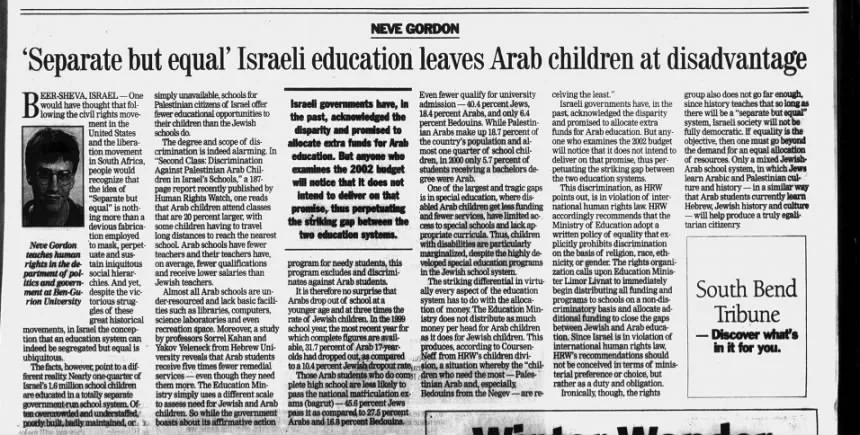
BEER-SHEVA, ISRAEL — One would have thought that following the civil rights movement in the United States and the liberation movement in South Africa, people would recognize that the idea of “Separate but equal” is nothing more than a devious fabrication employed to mask, perpetuate and sustain iniquitous social hierarchies.
And yet, despite the victorious struggles of these great historical movements, in Israel the conception that an education system can indeed be segregated but equal is ubiquitous. The facts, however, point to a different reality: Nearly one-quarter of Israel's 1.6 million school children are educated in a totally separate government-run school system.
Often overcrowded and understaffed, poorly built, badly maintained, or simply unavailable, schools for Palestinian citizens of Israel offer fewer educational opportunities to their children than the Jewish schools do. The degree and scope of discrimination is indeed alarming.
In “Second Class: Discrimination Against Palestinian Arab Children in Israel's Schools,” a 187-page report recently published by Human Rights Watch, one reads that Arab children attend classes that are 20 percent larger, with some children having to travel long distances to reach the nearest school.
Arab schools have fewer teachers and their teachers have, on average, fewer qualifications and receive lower salaries than Jewish teachers.
How this transcription was made
Date and publication rest on the collector's slide label; no masthead, folio or printed dateline appears on this clipping. Filed under the archive’s spelling; the page prints “The South Bend Tribune”. Legibility fair; any passage that could not be read is omitted rather than reconstructed.
Context added by this archive
Op-ed by Neve Gordon, who 'teaches human rights in the department of politics and government at Ben-Gurion University' (italic bio set beside his mugshot). This is the earliest item in the batch to use the term 'Palestinian citizens of Israel' in body text, and it does so twice - the same phrase the 2018 op-eds will use.
The comparison to Jim Crow and to apartheid South Africa is made in the first sentence, in 2002.
Cite this clipping
"'Separate but equal' Israeli education leaves Arab children at disadvantage," South Bend Tribune, 22 January 2002. Covering Palestine archive, CP-2002-125. https://coveringpalestine.org/archive/cp-2002-125
More from South Bend Tribune
- Soldiers disperse PalestiniansSouth Bend Tribune · 2 November 1984
- One Palestinian's story shows tragic situationSouth Bend Tribune · 3 March 1992
- Arafat leaves chaos behindSouth Bend Tribune · 12 November 2004
- Israel’s actsSouth Bend Tribune · 1 August 2010
More from the 2000s
- Don’t forget it’s an Israeli occupationThe Daily Press · 1 January 2002
- Soothing Israel’s FearsThe New York Times · 7 January 2002
- Israel, in Reprisal for Killings, Razes Gaza Refugee HomesThe New York Times · 11 January 2002
- Refugees and Reparations in the MideastThe New York Times · 13 January 2002
- Israeli missiles strike naval baseThe Greenville News · 13 January 2002
- Friendship of Palestinian, architect defies oddsThe Bismarck Tribune · 17 January 2002
- All 516 clippings from the 2000s →
Last updated 2 November 2026
This record is part of Covering Palestine, an archive of American newspaper clippings about Palestinians, 1724 to 2023. Researched and assembled by Maria Robles.
The clipping belongs to the newspaper that printed it, or to the news agency that supplied the copy. It is reproduced here for research, criticism and commentary. A city here is where the newspaper was published, not where the story came from, and on most records it was taken from the masthead.
Something wrong here, or something you know about this clipping? The archive is still being built and corrections are wanted: maria@rozumstudio.com, quoting CP-2002-125.
Everything printed in 2002 · Printed on this day · See it in the archive reel · Full text of every clipping · Dataset