The Buffalo News · Buffalo, New York · 27 January 2002
CP-2002-035
Palestinian, Israeli women team up for peace
By RANIA AWWAD, Special to The News
Transcribed from the clipping
The term “intifada” comes from an Arabic word signifying a “shaking up” or “shaking off.” And true enough, the Palestinian intifada has lived up to this meaning in several ways, involving both the attempt to shake off the Israeli occupation as well as the shaking up of the societies affected by that occupation.
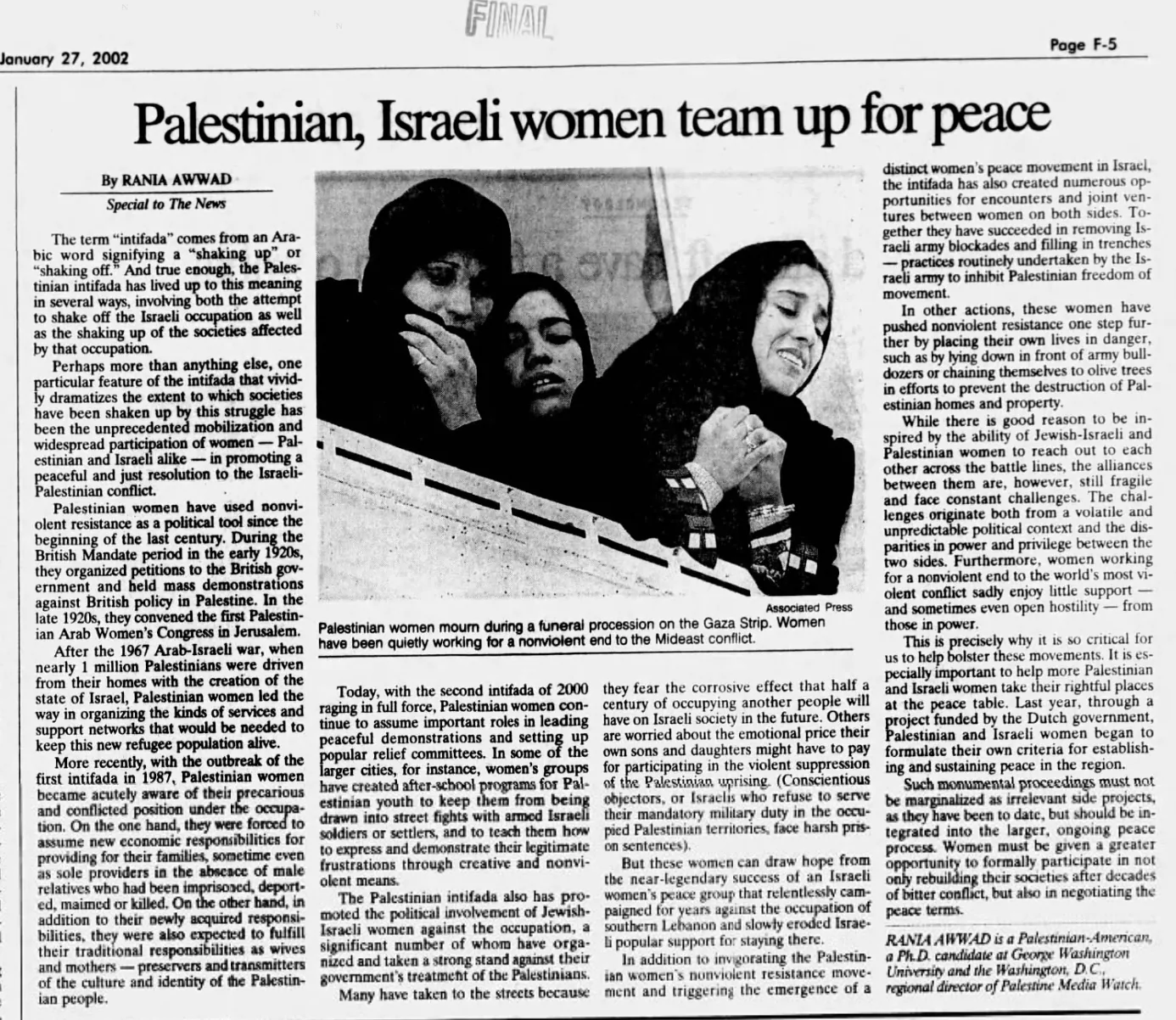
Perhaps more than anything else, one particular feature of the intifada that vividly dramatizes the extent to which societies have been shaken up by this struggle has been the unprecedented mobilization and widespread participation of women — Palestinian and Israeli alike — in promoting a peaceful and just resolution to the Israeli-Palestinian conflict.
Palestinian women have used nonviolent resistance as a political tool since the beginning of the last century. During the British Mandate period in the early 1920s, they organized petitions to the British government and held mass demonstrations against British policy in Palestine. In the late 1920s, they convened the first Palestinian Arab Women's Congress in Jerusalem.
After the 1967 Arab-Israeli war, when nearly 1 million Palestinians were driven from their homes with the creation of the state of Israel, Palestinian women led the way in organizing the kinds of services and support networks that would be needed to keep this new refugee population alive.
More recently, with the outbreak of the first intifada in 1987, Palestinian women became acutely aware of their precarious and conflicted position under the occupation.
On the one hand, they were forced to assume new economic responsibilities for providing for their families, sometime even as sole providers in the absence of male relatives who had been imprisoned, deported, maimed or killed.
On the other hand, in addition to their newly acquired responsibilities, they were also expected to fulfill their traditional responsibilities as wives and mothers — preservers and transmitters of the culture and identity of the Palestinian people.
Today, with the second intifada of 2000 raging in full force, Palestinian women continue to assume important roles in leading peaceful demonstrations and setting up popular relief committees.
In some of the larger cities, for instance, women's groups have created after-school programs for Palestinian youth to keep them from being drawn into street fights with armed Israeli soldiers or settlers, and to teach them how to express and demonstrate their legitimate frustrations through creative and nonviolent means.
The Palestinian intifada also has promoted the political involvement of Jewish-Israeli women against the occupation, a significant number of whom have organized and taken a strong stand against their government's treatment of the Palestinians.
Many have taken to the streets because they fear the corrosive effect that half a century of occupying another people will have on Israeli society in the future. Others are worried about the emotional price their own sons and daughters might have to pay for participating in the violent suppression of the Palestinian uprising.
(Conscientious objectors, or Israelis who refuse to serve their mandatory military duty in the occupied Palestinian territories, face harsh prison sentences).
But these women can draw hope from the near-legendary success of an Israeli women's peace group that relentlessly campaigned for years against the occupation of southern Lebanon and slowly eroded Israeli popular support for staying there.
In addition to invigorating the Palestinian women's nonviolent resistance movement and triggering the emergence of a distinct women's peace movement in Israel, the intifada has also created numerous opportunities for encounters and joint ventures between women on both sides.
Together they have succeeded in removing Israeli army blockades and filling in trenches — practices routinely undertaken by the Israeli army to inhibit Palestinian freedom of movement.
In other actions, these women have pushed nonviolent resistance one step further by placing their own lives in danger, such as by lying down in front of army bulldozers or chaining themselves to olive trees in efforts to prevent the destruction of Palestinian homes and property.
While there is good reason to be inspired by the ability of Jewish-Israeli and Palestinian women to reach out to each other across the battle lines, the alliances between them are, however, still fragile and face constant challenges.
The challenges originate both from a volatile and unpredictable political context and the disparities in power and privilege between the two sides. Furthermore, women working for a nonviolent end to the world's most violent conflict sadly enjoy little support — and sometimes even open hostility — from those in power.
This is precisely why it is so critical for us to help bolster these movements. It is especially important to help more Palestinian and Israeli women take their rightful places at the peace table. Last year, through a project funded by the Dutch government, Palestinian and Israeli women began to formulate their own criteria for establishing and sustaining peace in the region.
Such monumental proceedings must not be marginalized as irrelevant side projects, as they have been to date, but should be integrated into the larger, ongoing peace process. Women must be given a greater opportunity to formally participate in not only rebuilding their societies after decades of bitter conflict, but also in negotiating the peace terms.
Context added by this archive
Signed guest column in the FINAL edition. The tagline reads: RANIA AWWAD is a Palestinian-American, a Ph.D. candidate at George Washington University and the Washington, D.C., regional director of Palestine Media Watch. Photograph credited Associated Press.
Cite this item
"Palestinian, Israeli women team up for peace," The Buffalo News, 27 January 2002. Covering Palestine archive, CP-2002-035. https://coveringpalestine.org/archive/cp-2002-035
More from The Buffalo News
- Arabs in Holy Land Fear Jews; Say Zionism MenaceThe Buffalo News · 19 March 1919
- PALESTINE FACES NEW BLOODSHEDThe Buffalo News · 29 July 1938
- 3 Palestinians Killed In Accidental BlastThe Buffalo News · 11 July 1980
- 1,000 March Peacefully to Protest Killing of Three Arabs by IsraelisThe Buffalo News · 10 December 1986
- Angry Palestinians demonstrate in Amman, Jordan to protest the killing of 19 Palestinians by Israeli police during unrest Monday in JerusalemThe Buffalo News · 9 October 1990
- Palestinians demonstrate at the Damascus GateThe Buffalo News · 8 December 2017
- 2 more from this paper in the full text →
More from the 2000s
- Don’t forget it’s an Israeli occupationThe Daily Press · 1 January 2002
- Friendship of Palestinian, architect defies oddsThe Bismarck Tribune · 17 January 2002
- Israeli siege explodes hopes in RamallahTampa Bay Times · 14 March 2002
- Israeli troops round up PalestiniansThe Advocate-Messenger · 31 March 2002
- Israel broadens Palestinian offensiveConcord Monitor · 1 April 2002
- Palestine an invention of Arab propagandaThe Blade · 17 April 2002
- All 175 clippings from the 2000s →
This record is part of Covering Palestine, an archive of American and Anglophone newspaper clippings about Palestinians, 1799 to 2023. Researched and assembled by Maria Robles.
The clipping belongs to the newspaper that printed it, or to the news agency that supplied the copy. It is reproduced here for research, criticism and commentary. The city is derived from the masthead, not read off the clipping.
Something wrong here, or something you know about this clipping? The archive is still being built and corrections are wanted: maria@rozumstudio.com, quoting CP-2002-035.
See it in the archive reel · Full text of every clipping · Dataset