The Journal News · White Plains, New York · 27 October 2005
CP-2005-003
The making of a human bomb
‘Paradise’ paints a compelling portrait of two ordinary guys turned mass killers
Kevin Canfield, The Journal News
Transcribed from the clipping
“Said and Khaled are best friends. Boyish young men in their 20s, they live at home with their parents and share meals with siblings and friends. They work together at an automobile repair shop, but you get the sense that like lots of others their age they haven’t quite decided what to do with their lives. In short, they’re very much like you or someone you know. Except for this: They’re Palestinian suicide bombers in waiting. The protagonists of the brilliant new film ‘Paradise Now,’ Said (Kais Nashef) and Khaled (Ali Suliman) are ordinary men in an extraordinary situation and their sheer averageness makes director Hany Abu-Assad’s film a compelling portrait. The carnage these men are about to set in motion, like the branch of zero-sum militancy they subscribe to, is loathsome. But as humans they are not loathsome, and that disconnect, that raising-of-questions, is the stuff of great art.… (Hamas, the Palestinian organization responsible for many such suicide bombings is never mentioned by name, but the implication is clear.)… In one of the film’s many emotionally resonant scenes, Said silently watches his mother chop vegetables. He wants to speak but can’t. Khaled, whose father was badly injured by Israeli soldiers, is certain he’s doing the right thing — ‘Now it’s our turn,’ he says gleefully — but Said is clearly spooked, equally afraid of dying and murdering innocents. Later that night he will sneak out for a final, chaste visit with the woman he seems to be in love with. Her late father was also a bomber, complicating his feelings all the more… Abu-Assad knows exactly what he’s doing. By portraying Khaled and Said as unimpeachably normal, even likable, young men, he argues that moments in history make men — that any of us, or at least many of us, would act irrationally were we raised in similar straits. This is a terribly unsophisticated argument, one that seems to suggest a given person’s makeup is all nurture and no nature. Coexistence, of course, isn’t merely a matter of seeing one another as human. But maybe that’s a start? Rating PG-13 (mature thematic material and brief strong language). Running time 90 minutes. Bottomline A-.”
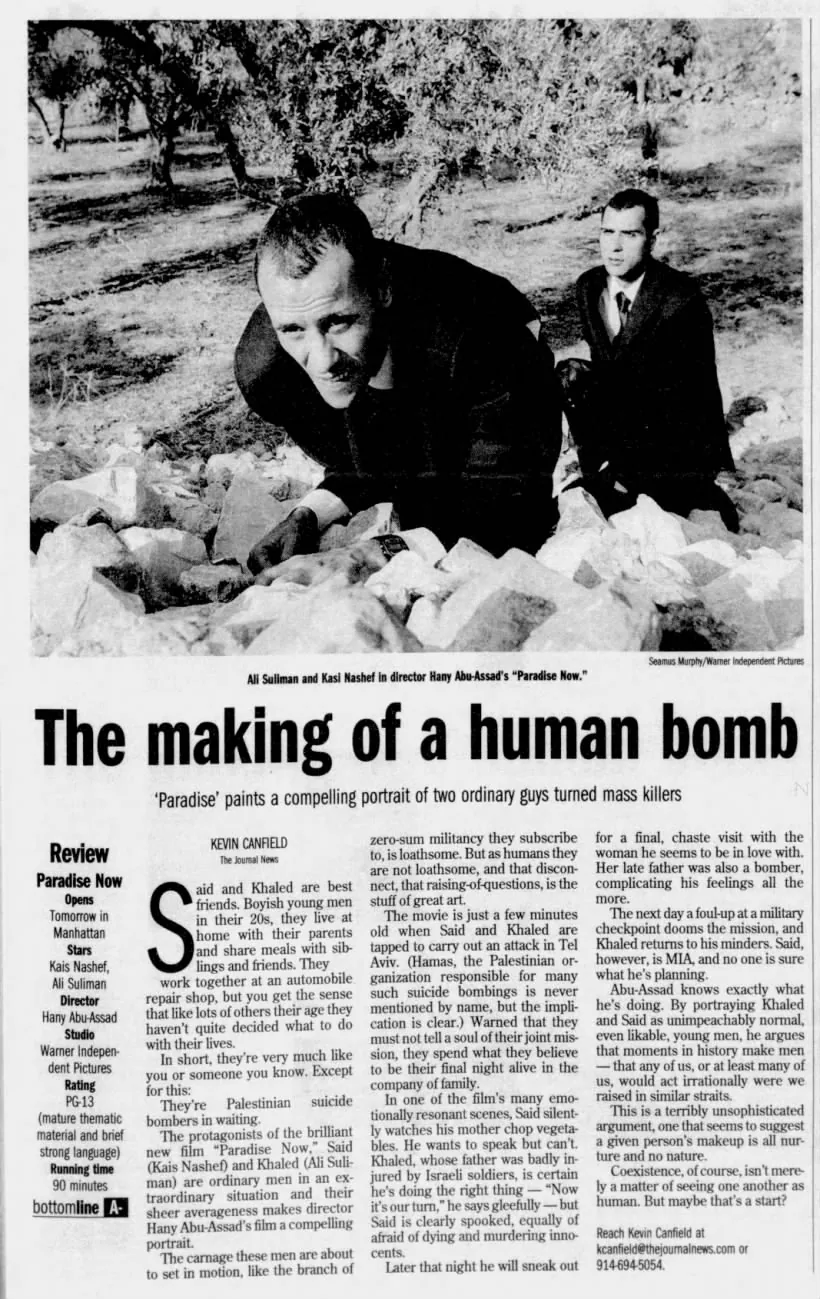
Photograph caption
“Ali Suliman and Kais Nashef in director Hany Abu-Assad’s ‘Paradise Now.’” · Seamus Murphy / Warner Independent Pictures
Context added by this archive
An A-minus review that calls the film brilliant and then objects to the thing it does. Showing two Palestinians as unimpeachably normal is, the reviewer writes, a terribly unsophisticated argument. The scene he singles out as most affecting is a young man watching his mother chop vegetables. Nine years later this archive holds the same director in the Los Angeles Times insisting his next film is not about the conflict, and an American paper filing a Palestinian screenwriter under the slug CONFLICT seven months after that.
Cite this item
"The making of a human bomb," The Journal News, 27 October 2005. Covering Palestine archive, CP-2005-003. https://coveringpalestine.org/archive/cp-2005-003
Elsewhere in the archive
- Increased criticism of Israel justifiedThe Journal News · 20 April 2002 · the same newspaper
- Thousands at D.C. rally denounce Israeli, U.S. policiesThe Journal News · 21 April 2002 · the same newspaper
- Israeli raid kills 10 PalestiniansThe Journal News · 23 February 2023 · the same newspaper
- A solemn anniversary for someDetroit Free Press · 16 May 2005 · the same year
- A Mideast ‘Paradise’ apocalypseNewsday · 28 October 2005 · the same year
- ‘Paradise’ examines terroristsThe Selma Times-Journal · 14 November 2005 · the same year
This record is part of Covering Palestine, an archive of American and Anglophone newspaper clippings about Palestinians, 1812 to 2022. Researched and assembled by Maria Robles.
The clipping belongs to the newspaper that printed it, or to the wire service that supplied the copy. It is reproduced here for research, criticism and commentary. The city is derived from the masthead, not read off the clipping.
Something wrong here, or something you know about this clipping? The archive is still being built and corrections are wanted: maria@rozumstudio.com, quoting CP-2005-003.
See it in the archive reel · Full text of every clipping · Dataset