The Journal News · White Plains, New York · 16 November 1988
CP-1988-079
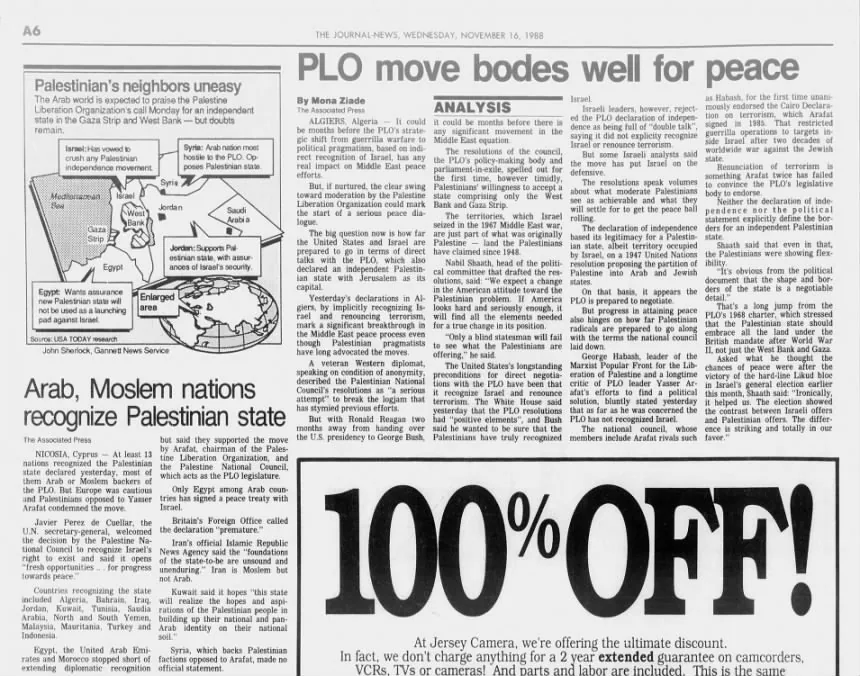
PLO move bodes well for peace
Transcribed from the clipping
ALGIERS, Algeria — It could be months before the PLO’s strategic shift from guerrilla warfare to political pragmatism, based on indirect recognition of Israel, has any real impact on Middle East peace efforts. But, if nurtured, the clear swing toward moderation by the Palestine Liberation Organization could mark the start of a serious peace dialogue.
The big question now is how far the United States and Israel are prepared to go in terms of direct talks with the PLO, which also declared an independent Palestinian state with Jerusalem as its capital.
Yesterday’s declarations in Algiers, by implicitly recognizing Israel and renouncing terrorism, mark a significant breakthrough in the Middle East peace process even though Palestinian pragmatists have long advocated the moves.
A veteran Western diplomat, speaking on condition of anonymity, described the Palestinian National Council’s resolutions as “a serious attempt” to break the logjam that has stymied previous efforts.
But with Ronald Reagan two months away from handing over the U.S. presidency to George Bush, it could be months before there is any significant movement in the Middle East equation.
The resolutions of the council, the PLO’s policy-making body and parliament-in-exile, spelled out for the first time, however timidly, Palestinians’ willingness to accept a state comprising only the West Bank and Gaza Strip.
The territories, which Israel seized in the 1967 Middle East war, are just part of what was originally Palestine — land the Palestinians have claimed since 1948. Nabil Shaath, head of the political committee that drafted the resolutions, said: “We expect a change in the American attitude toward the Palestinian problem.
If America looks hard and seriously enough, it will find all the elements needed for a true change in its position. “Only a blind statesman will fail to see what the Palestinians are offering,” he said. The United States’s longstanding preconditions for direct negotiations with the PLO have been that it recognize Israel and renounce terrorism.
The White House said yesterday that the PLO resolutions had “positive elements”, and Bush said he wanted to be sure that the Palestinians have truly recognized Israel. Israeli leaders, however, rejected the PLO declaration of independence as being full of “double talk”, saying it did not explicity recognize Israel or renounce terrorism.
But some Israeli analysts said the move has put Israel on the defensive. The resolutions speak volumes about what moderate Palestinians see as achievable and what they will settle for to get the peace ball rolling.
The declaration of independence based its legitimacy for a Palestinian state, albeit territory occupied by Israel, on a 1947 United Nations resolution proposing the partition of Palestine into Arab and Jewish states. On that basis, it appears the PLO is prepared to negotiate.
But progress in attaining peace also hinges on how far Palestinian radicals are prepared to go along with the terms the national council laid down.
George Habash, leader of the Marxist Popular Front for the Liberation of Palestine and a longtime critic of PLO leader Yasser Arafat’s efforts to find a political solution, bluntly stated yesterday that as far as he was concerned the PLO has not recognized Israel.
The national council, whose members include Arafat rivals such as Habash, for the first time unanimously endorsed the Cairo Declaration on terrorism, which Arafat signed in 1985. That restricted guerrilla operations to targets inside Israel after two decades of worldwide war against the Jewish state.
Renunciation of terrorism is something Arafat twice has failed to convince the PLO’s legislative body to endorse. Neither the declaration of independence nor the political statement explicitly define the borders for an independent Palestinian state. Shaath said that even in that, the Palestinians were showing flexibility.
“It’s obvious from the political document that the shape and borders of the state is a negotiable detail.” That’s a long jump from the PLO’s 1968 charter, which stressed that the Palestinian state should embrace all the land under the British mandate after World War II, not just the West Bank and Gaza.
Asked what he thought the chances of peace were after the victory of the hard-line Likud bloc in Israel’s general election earlier this month, Shaath said: “Ironically, it helped us. The election showed the contrast between Israeli offers and Palestinian offers. The difference is striking and totally in our favor.”
How this transcription was made
Transcribed by optical character recognition and read back against the scan by hand.
Cite this clipping
"PLO move bodes well for peace," The Journal News, 16 November 1988. Covering Palestine archive, CP-1988-079. https://coveringpalestine.org/archive/cp-1988-079
More from The Journal News
- Journalist wounded by gunfire in Gaza StripThe Journal News · 16 December 1990
- Increased criticism of Israel justifiedThe Journal News · 20 April 2002
- Thousands at D.C. rally denounce Israeli, U.S. policiesThe Journal News · 21 April 2002
- The making of a human bombThe Journal News · 27 October 2005
- Palestinian women argue with security officers in RamallahThe Journal News · 8 March 2006
- Densely populated area targetedThe Journal News · 12 January 2009
- 3 more from this paper in the full text →
More from the 1980s
- Moderation Silenced by Israel RiotsThe Buffalo News · 3 January 1988
- Gaza Strip: the forgotten stepchildNorthwest Herald · 4 January 1988
- 'Iron Fist' Enslaves Gazans In Their LandThe Herald Sun · 6 January 1988
- Israel condemns U.N. vote on deportationsThe Birmingham News · 6 January 1988
- Israeli soldiers fire on protestersCarroll County Times · 6 January 1988
- Undaunted Palestinians resume violenceThe News & Observer · 6 January 1988
- All 571 clippings from the 1980s →
The same copy, in 1 other paper
Their text and this one are nearly identical. Found by comparing transcriptions, not by reading them side by side, so this establishes that the text overlaps and not that these papers ran the same dispatch. How this was done.
Last updated 17 November 2026
This record is part of Covering Palestine, an archive of American newspaper clippings about Palestinians, 1724 to 2023. Researched and assembled by Maria Robles.
The clipping belongs to the newspaper that printed it, or to the news agency that supplied the copy. It is reproduced here for research, criticism and commentary. A city here is where the newspaper was published, not where the story came from, and on most records it was taken from the masthead.
Something wrong here, or something you know about this clipping? The archive is still being built and corrections are wanted: maria@rozumstudio.com, quoting CP-1988-079.
Everything printed in 1988 · Printed on this day · See it in the archive reel · Full text of every clipping · Dataset