The Grand Rapids Press · Grand Rapids, Michigan · 20 June 2013
CP-2013-008
Caught in the conflict
Holy Land archaeological treasure hurt by politics
Daniela Berretta, The Associated Press, Sebastia
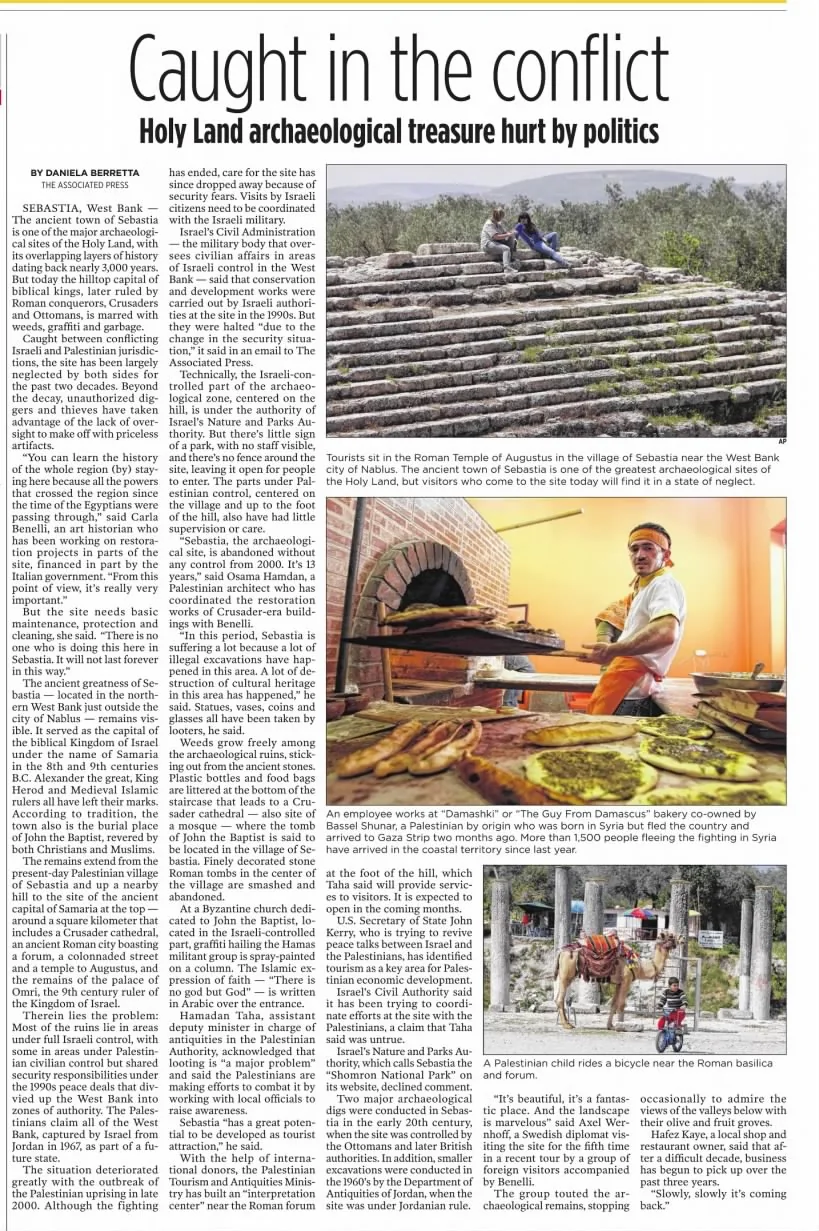
Transcribed from the clipping
“SEBASTIA, West Bank — The ancient town of Sebastia is one of the major archaeological sites of the Holy Land, with its overlapping layers of history dating back nearly 3,000 years. But today the hilltop capital of biblical kings, later ruled by Roman conquerors, Crusaders and Ottomans, is marred with weeds, graffiti and garbage. Caught between conflicting Israeli and Palestinian jurisdictions, the site has been largely neglected for the past two decades. Beyond the decay, unauthorized diggers and thieves have taken advantage of the lack of oversight to make off with priceless artifacts. ‘You can learn the history of the whole region (by) staying here because all the powers that crossed the region since the time of the Egyptians were passing through,’ said Carla Benelli, an art historian who has been working on restoration projects in parts of the site, financed in part by the Italian government. ‘From this point of view, it’s really important.’ But the site needs basic maintenance, protection and cleaning, she said. ‘There is no one who is doing this here in Sebastia. It will not last forever in this way.’… ‘Sebastia, the archaeological site, is abandoned without any control from 2000. It’s 13 years,’ said Osama Hamdan, a Palestinian architect who has coordinated the restoration works of Crusader-era buildings with Benelli. ‘In this period, Sebastia is suffering a lot because a lot of illegal excavations have happened in this area. A lot of destruction of cultural heritage in this area has happened,’ he said. Statues, vases, coins and glasses all have been taken by looters, he said… With the help of international donors, the Palestinian Tourism and Antiquities Ministry has built an ‘interpretation center’ near the Roman forum at the foot of the hill, which Taha said will provide services to visitors. It is expected to open in the coming months… Hafez Kaye, a local shop and restaurant owner, said that after a difficult decade, business has begun to pick up over the past three years. ‘Slowly, slowly it’s coming back.’”
Context added by this archive
An archaeology story headlined “Caught in the conflict.” A shopkeeper’s cautious hope is the last line of it. A second photograph on the page shows a bakery called Damashki, The Guy From Damascus, co-owned by a Palestinian born in Syria who fled and arrived in Gaza two months before.
Cite this item
"Caught in the conflict," The Grand Rapids Press, 20 June 2013. Covering Palestine archive, CP-2013-008. https://coveringpalestine.org/archive/cp-2013-008
Elsewhere in the archive
- Palestinian opens fire at West Bank gas stationThe Grand Rapids Press · 21 June 2023 · the same newspaper
- Israel Snatching Pieces of Lebanese BorderThe Grand Rapids Press · 27 November 1980 · the same newspaper
- Palestinians evacuated, Netanyahu affirms plansThe Philadelphia Inquirer · 14 January 2013 · the same year
- Bus service for Palestinians raises charges of racismSanta Barbara News-Press · 5 March 2013 · the same year
- Economic development is seen as a key aspect of Palestinian state buildingSanta Barbara News-Press · 23 May 2013 · the same year
This record is part of Covering Palestine, an archive of American and Anglophone newspaper clippings about Palestinians, 1812 to 2022. Researched and assembled by Maria Robles.
The clipping belongs to the newspaper that printed it, or to the wire service that supplied the copy. It is reproduced here for research, criticism and commentary. The city is derived from the masthead, not read off the clipping.
Something wrong here, or something you know about this clipping? The archive is still being built and corrections are wanted: maria@rozumstudio.com, quoting CP-2013-008.
See it in the archive reel · Full text of every clipping · Dataset