Los Angeles Times · 29 April 2014
CP-2014-074
The victim barrier
To achieve peace, Israelis and Palestinians will both have to put aside the past.
By Christopher J. Fettweis
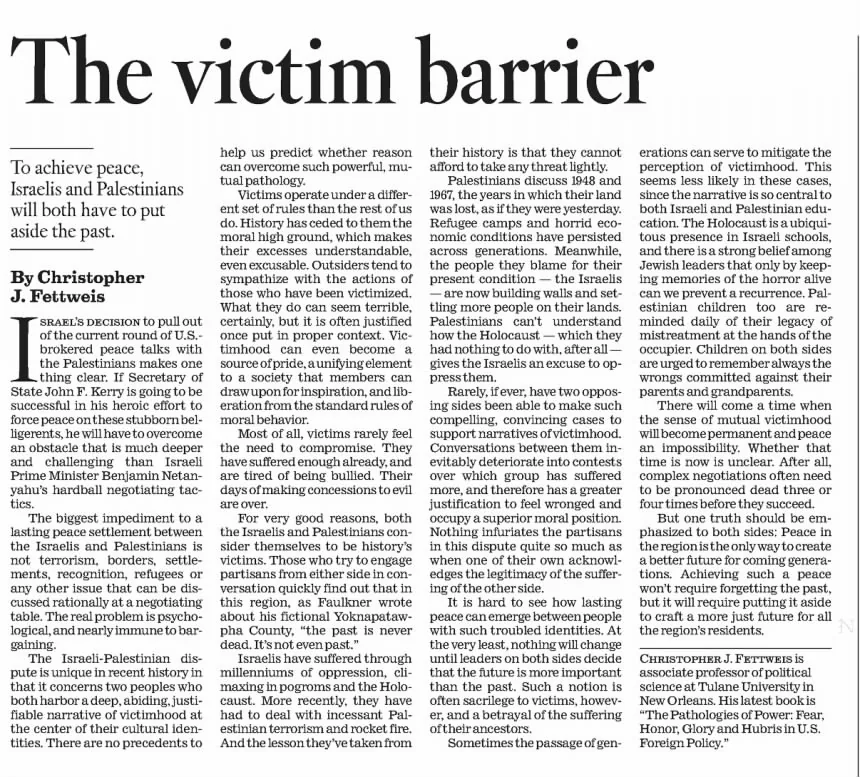
Transcribed from the clipping
Israel’s decision to pull out of the current round of U.S.-brokered peace talks with the Palestinians makes one thing clear. If Secretary of State John F.
Kerry is going to be successful in his heroic effort to force peace on these stubborn belligerents, he will have to overcome an obstacle that is much deeper and challenging than Israeli Prime Minister Benjamin Netanyahu’s hardball negotiating tactics.
The biggest impediment to a lasting peace settlement between the Israelis and Palestinians is not terrorism, borders, settlements, recognition, refugees or any other issue that can be discussed rationally at a negotiating table. The real problem is psychological, and nearly immune to bargaining.
The Israeli-Palestinian dispute is unique in recent history in that it concerns two peoples who both harbor a deep, abiding, justifiable narrative of victimhood at the center of their cultural identities. There are no precedents to help us predict whether reason can overcome such powerful, mutual pathology. Victims operate under a different set of rules than the rest of us do.
History has ceded to them the moral high ground, which makes their excesses understandable, even excusable. Outsiders tend to sympathize with the actions of those who have been victimized. What they do can seem terrible, certainly, but it is often justified once put in proper context.
Victimhood can even become a source of pride, a unifying element to a society that members can draw upon for inspiration, and liberation from the standard rules of moral behavior. Most of all, victims rarely feel the need to compromise. They have suffered enough already, and are tired of being bullied. Their days of making concessions to evil are over.
How this transcription was made
Read from the scan Maria supplied on 17 November 2026, at magnification, band by band. No masthead, no page date line and no page number are on this clipping — it is a tight crop of an op-ed page, headline to tagline, with nothing above the headline. The label date 2014-04-29 cannot be confirmed or contradicted from the page itself. Nothing on the page names the paper either. No masthead and no date line survive on this crop, so neither the date nor the publication can be checked against the page. The only internal dating evidence is the text: it refers to Israel pulling out of the current round of U.S.-brokered talks led by Secretary of State John F. Kerry, which is consistent with spring 2014 but does not pin a day. The paper set ‘an obstacle that is much deeper and challenging than’ — the missing ‘more’ is the paper’s, not mine, and I have left it. The opening words are set as a drop-cap I followed by small capitals (ISRAEL’S DECISION); I have transcribed them in ordinary case. Nothing in this clipping concerns a campus, a student government, a divestment vote or Los Angeles. The author is placed at Tulane University in New Orleans. Headline is set in a single line of large roman type with no kicker and no section flag above it. The italic block above the byline (‘To achieve peace...’) is a rule-boxed deck, so I have taken it as the dek.
Cite this clipping
"The victim barrier," Los Angeles Times, 29 April 2014. Covering Palestine archive, CP-2014-074. https://coveringpalestine.org/archive/cp-2014-074
More from Los Angeles Times
- The Palestinians’ EvolutionLos Angeles Times · 21 March 1969
- Bomb Victim Had Expected DeathLos Angeles Times · 10 July 1972
- Mrs. Meir's Safety StudiedLos Angeles Times · 11 January 1973
- Show of Artists from PalestineLos Angeles Times · 24 June 1977
- UCLA Jewish Groups Ask Palestinian BanLos Angeles Times · 21 October 1984
- UCLA Renews Rival Groups' StatusLos Angeles Times · 1 November 1984
- 60 more from this paper in the full text →
More from the 2010s
- Roger Waters rips Scarlett Johansson, Neil Young over Israel; SodaStream stock dipsSt. Louis Jewish Light · 5 February 2014
- Palestinian women make strides in high-tech jobsThe Sentinel · 12 February 2014
- Stories in and out of timeStar Tribune · 16 February 2014
- Conflict, paranoia, but little propaganda in ‘Omar’The Oregonian · 21 February 2014
- The front-runnersLos Angeles Times · 23 February 2014
- Masterful ‘Omar’ dives deep into notion of conflictHonolulu Star-Advertiser · 28 February 2014
- All 343 clippings from the 2010s →
Last updated 17 November 2026
This record is part of Covering Palestine, an archive of American newspaper clippings about Palestinians, 1724 to 2023. Researched and assembled by Maria Robles.
The clipping belongs to the newspaper that printed it, or to the news agency that supplied the copy. It is reproduced here for research, criticism and commentary. A city here is where the newspaper was published, not where the story came from, and on most records it was taken from the masthead.
Something wrong here, or something you know about this clipping? The archive is still being built and corrections are wanted: maria@rozumstudio.com, quoting CP-2014-074.
Everything printed in 2014 · Printed on this day · See it in the archive reel · Full text of every clipping · Dataset