Miami News · Miami, Florida · 1 December 1969
CP-1969-018
The Gaza Strip: A prison for 270,000
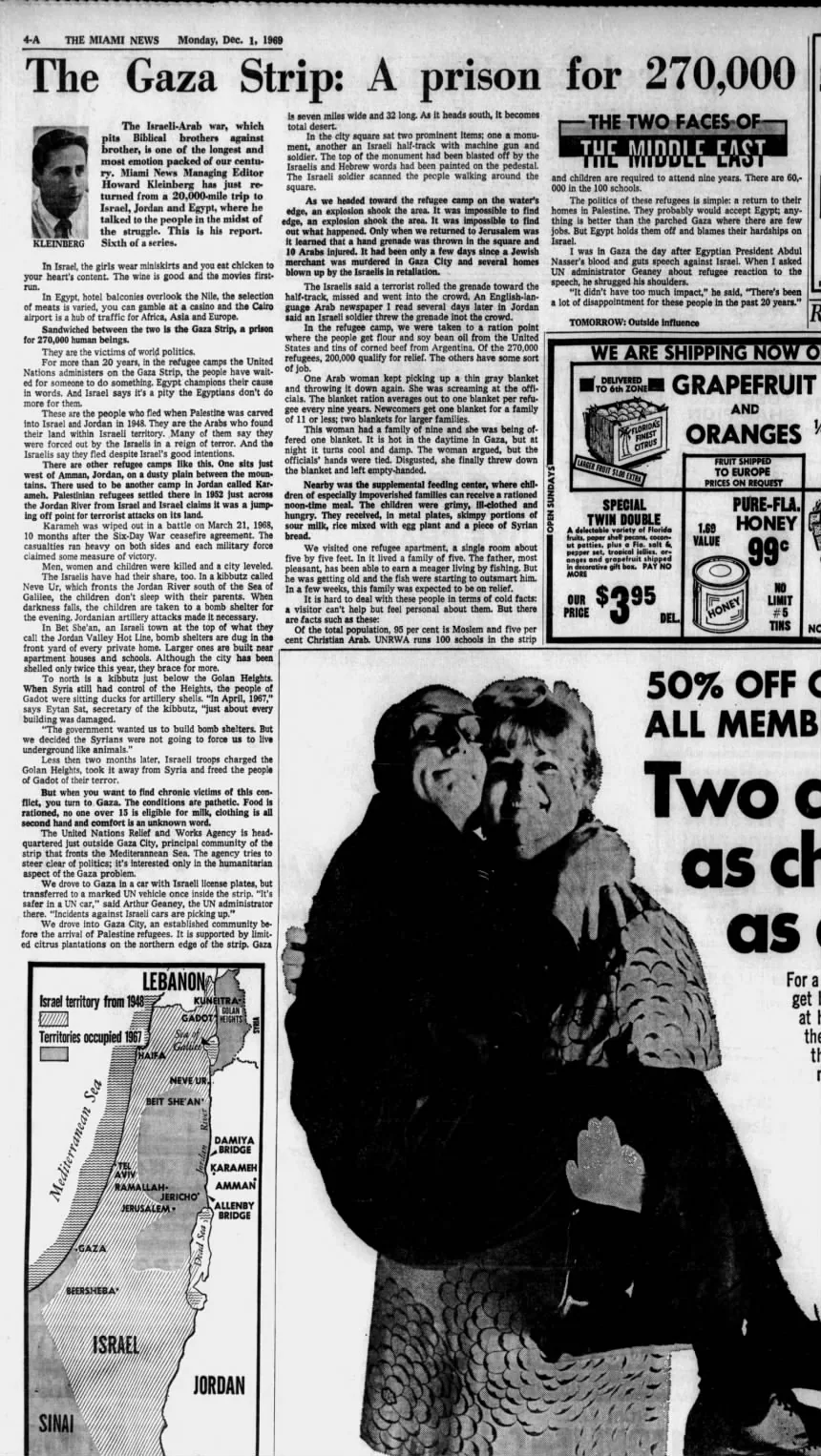
Transcribed from the clipping
In Israel, the girls wear miniskirts and you eat chicken to your heart’s content. The wine is good and the movies first-run. In Egypt, hotel balconies overlook the Nile, the selection of meats is varied, you can gamble at a casino and the Cairo airport is a hub of traffic for Africa, Asia and Europe.
Sandwiched between the two is the Gaza Strip, a prison for 270,000 human beings. They are the victims of world politics. For more than 20 years, in the refugee camps the United Nations administers on the Gaza Strip, the people have waited for someone to do something. Egypt champions their cause in words. And Israel says it’s a pity the Egyptians don’t do more for them.
These are the people who fled when Palestine was carved into Israel and Jordan in 1948. They are the Arabs who found their land within Israeli territory. Many of them say they were forced out by the Israelis in a reign of terror. And the Israelis say they fled despite Israel’s good intentions. There are other refugee camps like this.
One sits just west of Amman, Jordan, on a dusty plain between the mountains. There used to be another camp in Jordan called Karameh. Palestinian refugees settled there in 1952 just across the Jordan River from Israel and Israel claims it was a jumping off point for terrorist attacks on its land.
Karameh was wiped out in a battle on March 21, 1968, 10 months after the Six-Day War ceasefire agreement. The casualties ran heavy on both sides and each military force claimed some measure of victory. Men, women and children were killed and a city leveled. The Israelis have had their share, too.
In a kibbutz called Neve Ur, which fronts the Jordan River south of the Sea of Galilee, the children don’t sleep with their parents. When darkness falls, the children are taken to a bomb shelter for the evening. Jordanian artillery attacks made it necessary.
In Bet She’an, an Israeli town at the top of what they call the Jordan Valley Hot Line, bomb shelters are dug in the front yard of every private home. Larger ones are built near apartment houses and schools. Although the city has been shelled only twice this year, they brace for more. To north is a kibbutz just below the Golan Heights.
When Syria still had control of the Heights, the people of Gadot were sitting ducks for artillery shells. “In April, 1967,” says Eytan Sat, secretary of the kibbutz, “just about every building was damaged. “The government wanted us to build bomb shelters. But we decided the Syrians were not going to force us to live underground like animals.”
How this transcription was made
Read from the scan by a machine looking at the image of the page, not by optical character recognition and not by a person.
Cite this clipping
"The Gaza Strip: A prison for 270,000," Miami News, 1 December 1969, p. 4-A. Covering Palestine archive, CP-1969-018. https://coveringpalestine.org/archive/cp-1969-018
More from Miami News
- ‘Arabs Have Rights’Miami News · 20 July 1968
- UN papers on Zionism challenge Israel itselfMiami News · 29 January 1980
- Bus raiders warn of attacks on ArabsMiami News · 29 October 1984
- Israel stifles Palestinians' human rightsMiami News · 30 June 1987
More from the 1960s
- Israel Integrating Druze AreasThe Plain Dealer · 1969
- Arabs Create 'Schools of Hate' for YoungSan Francisco Examiner · 12 January 1969
- Arab textbooks carry message of hatredAlbany Democrat-Herald · 22 January 1969
- Dayan Tours Four Towns in West-Bank RegionThe New York Times · 12 February 1969
- Israelis Slaughter Palestine ArabsFlorida Today · 13 February 1969
- Another View On Justice, TruthWorcester Telegram · 19 February 1969
- All 227 clippings from the 1960s →
Last updated 2 November 2026
This record is part of Covering Palestine, an archive of American newspaper clippings about Palestinians, 1724 to 2023. Researched and assembled by Maria Robles.
The clipping belongs to the newspaper that printed it, or to the news agency that supplied the copy. It is reproduced here for research, criticism and commentary. A city here is where the newspaper was published, not where the story came from, and on most records it was taken from the masthead.
Something wrong here, or something you know about this clipping? The archive is still being built and corrections are wanted: maria@rozumstudio.com, quoting CP-1969-018.
Everything printed in 1969 · Printed on this day · See it in the archive reel · Full text of every clipping · Dataset