The New York Times · 22 October 1972
CP-1972-040
A New Policy Of First Strike
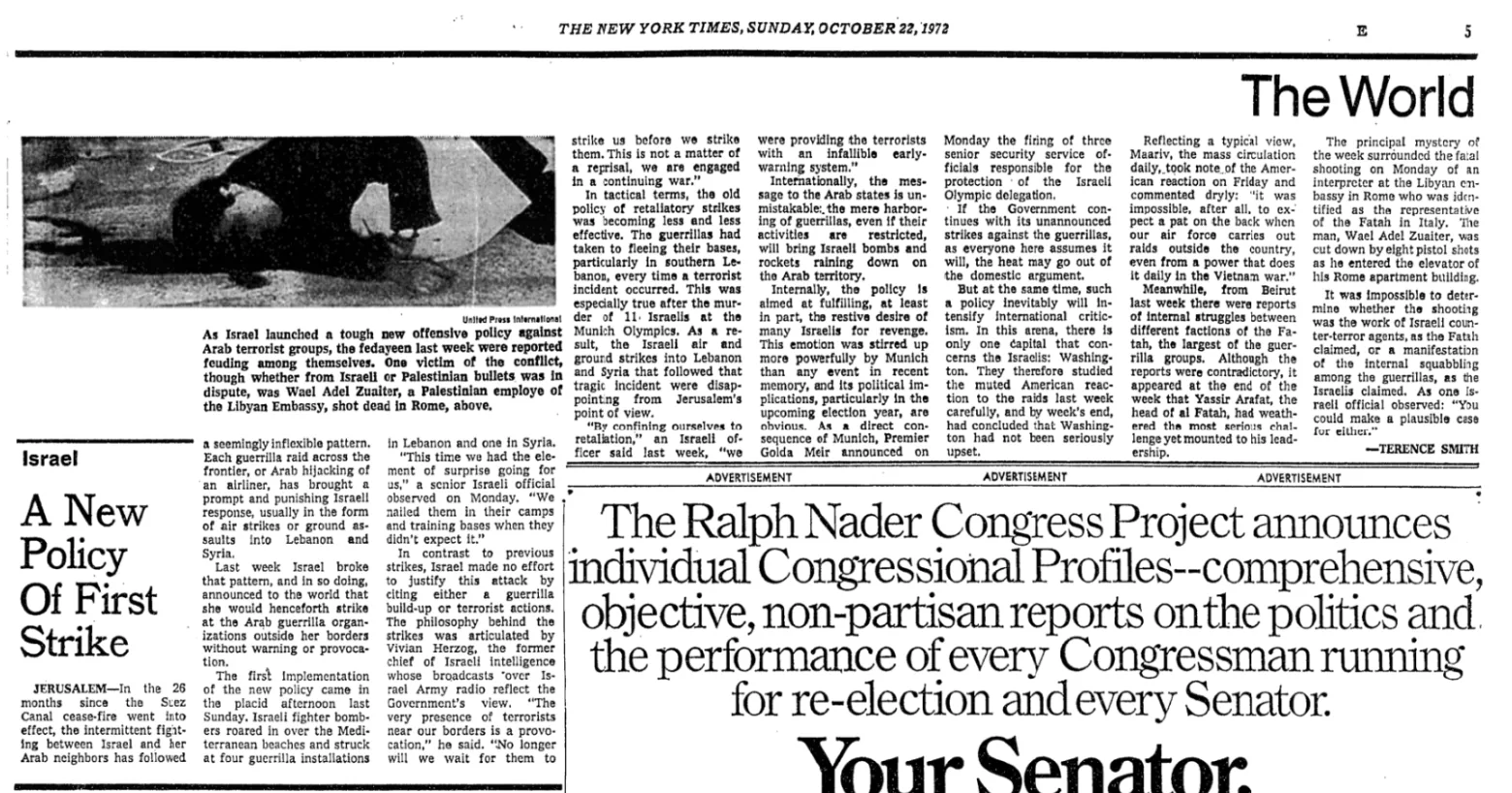
Transcribed from the clipping
JERUSALEM—In the 26 months since the Suez Canal cease-fire went into effect, the intermittent fighting between Israel and her Arab neighbors has followed a seemingly inflexible pattern.
Each guerrilla raid across the frontier, or Arab hijacking of an airliner, has brought a prompt and punishing Israeli response, usually in the form of air strikes or ground assaults into Lebanon and Syria.
Last week Israel broke that pattern, and in so doing, announced to the world that she would henceforth strike at the Arab guerrilla organizations outside her borders without warning or provocation. The first implementation of the new policy came in the placid afternoon last Sunday.
Israeli fighter bombers roared in over the Mediterranean beaches and struck at four guerrilla installations in Lebanon and one in Syria. “This time we had the element of surprise going for us,” a senior Israeli official observed on Monday. “We nailed them in their camps and training bases when they didn't expect it.”
In contrast to previous strikes, Israel made no effort to justify this attack by citing either a guerrilla build-up or terrorist actions. The philosophy behind the strikes was articulated by Vivian Herzog, the former chief of Israeli intelligence whose broadcasts over Israel Army radio reflect the Government's view.
“The very presence of terrorists near our borders is a provocation,” he said. “No longer will we wait for them to strike us before we strike them. This is not a matter of a reprisal, we are engaged in a continuing war.” In tactical terms, the old policy of retaliatory strikes was becoming less and less effective.
The guerrillas had taken to fleeing their bases, particularly in southern Lebanon, every time a terrorist incident occurred. This was especially true after the murder of 11 Israelis at the Munich Olympics. As a result, the Israeli air and ground strikes into Lebanon and Syria that followed that tragic incident were disappointing from Jerusalem's point of view.
“By confining ourselves to retaliation,” an Israeli officer said last week, “we were providing the terrorists with an infallible early-warning system.” Internationally, the message to the Arab states is unmistakable: the mere harboring of guerrillas, even if their activities are restricted, will bring Israeli bombs and rockets raining down on the Arab territory.
Internally, the policy is aimed at fulfilling, at least in part, the restive desire of many Israelis for revenge.
This emotion was stirred up more powerfully by Munich than any event in recent memory, and its political implications, particularly in the upcoming election year, are obvious. [Later in the same article:] The principal mystery of the week surrounded the fatal shooting on Monday of an interpreter at the Libyan embassy in Rome who was identified as the representative of the Fatah in Italy.
The man, Wael Adel Zuaiter, was cut down by eight pistol shots as he entered the elevator of his Rome apartment building. It was impossible to determine whether the shooting was the work of Israeli counter-terror agents, as the Fatah claimed, or a manifestation of the internal squabbling among the guerrillas, as the Israelis claimed.
As one Israeli official observed: “You could make a plausible case for either.”
How this transcription was made
One scan of a full page, read at 7x-11x across seven columns. Masthead strip reads THE NEW YORK TIMES, SUNDAY, OCTOBER 22, 1972; the page is numbered 5 with edition mark E, and carries the standing section head "The World." The word "Israel" set above the headline is a section flag, not a deck, so dek is left empty. The excerpt above joins the opening of the article to its two closing paragraphs; the intervening paragraphs (on Golda Meir's firing of three senior security officials, the muted American reaction, and reports of Fatah infighting) are summarized in `notable` rather than transcribed. A Ralph Nader Congress Project advertisement occupies the lower right of the page and is not part of the article.
Cite this clipping
"A New Policy Of First Strike," The New York Times, 22 October 1972, p. 5. Covering Palestine archive, CP-1972-040. https://coveringpalestine.org/archive/cp-1972-040
More from The New York Times
- The Maine Colony in PalestineThe New York Times · 12 November 1866
- Jewish Colonization in PalestineThe New York Times · 9 December 1883
- Jewish State in Palestine OpposedThe New York Times · 9 July 1897
- ZIONIST CONGRESS IN BASELThe New York Times · 31 August 1897
- ROME FEARS THE ZIONISTSThe New York Times · 12 September 1897
- PROGRESS OF ZIONISMThe New York Times · 16 December 1901
- 852 more from this paper in the full text →
More from the 1970s
- Beirut Moves Against Guerrillas To Quell Israeli RaidsThe Times · 29 February 1972
- Giant Step for Arab WomenThe New York Times · 29 February 1972
- Israeli Raid Forces Beirut To Face Up To Guerrilla ProblemColumbia Record · 3 March 1972
- Israel to Discipline Officers In Bedouins’ DisplacementThe New York Times · 27 March 1972
- Artist Seeking Mideast TogethernessThe Daily Progress · 3 May 1972
- Israel cites POW torture; Palestinians ask statehoodThe Morning Call · 10 June 1972
- All 338 clippings from the 1970s →
Last updated 2 November 2026
This record is part of Covering Palestine, an archive of American newspaper clippings about Palestinians, 1724 to 2023. Researched and assembled by Maria Robles.
The clipping belongs to the newspaper that printed it, or to the news agency that supplied the copy. It is reproduced here for research, criticism and commentary. A city here is where the newspaper was published, not where the story came from, and on most records it was taken from the masthead.
Something wrong here, or something you know about this clipping? The archive is still being built and corrections are wanted: maria@rozumstudio.com, quoting CP-1972-040.
Everything printed in 1972 · Printed on this day · See it in the archive reel · Full text of every clipping · Dataset