The New York Times · New York, New York · 26 December 1981
CP-1981-025
Israelis Drive Bedouins of Negev Into Closed Zones
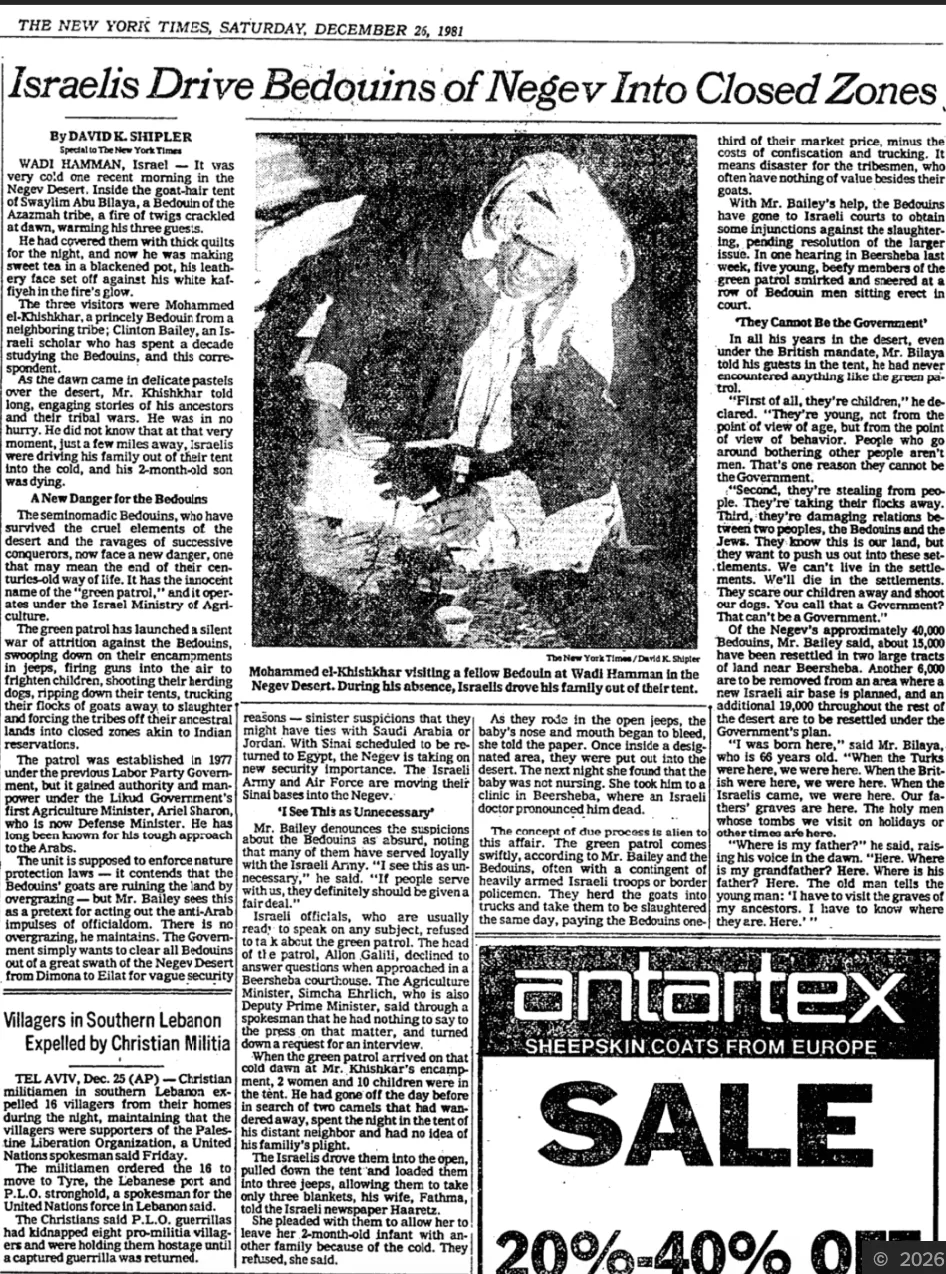
Transcribed from the clipping
WADI HAMMAN, Israel — It was very cold one recent morning in the Negev Desert. Inside the goat-hair tent of Swaylim Abu Bilaya, a Bedouin of the Azazmah tribe, a fire of twigs crackled at dawn, warming his three guests.
He had covered them with thick quilts for the night, and now he was making sweet tea in a blackened pot, his leathery face set off against his white kaffiyeh in the fire’s glow.
The three visitors were Mohammed el-Khishkhar, a princely Bedouin from a neighboring tribe; Clinton Bailey, an Israeli scholar who has spent a decade studying the Bedouins, and this correspondent. As the dawn came in delicate pastels over the desert, Mr. Khishkhar told long, engaging stories of his ancestors and their tribal wars. He was in no hurry.
He did not know that at that very moment, just a few miles away, Israelis were driving his family out of their tent into the cold, and his 2-month-old son was dying.
A New Danger for the Bedouins The seminomadic Bedouins, who have survived the cruel elements of the desert and the ravages of successive conquerors, now face a new danger, one that may mean the end of their centuries-old way of life. It has the innocent name of the “green patrol,” and it operates under the Israel Ministry of Agriculture.
The green patrol has launched a silent war of attrition against the Bedouins, swooping down on their encampments in jeeps, firing guns into the air to frighten children, shooting their herding dogs, ripping down their tents, trucking their flocks of goats away to slaughter and forcing the tribes off their ancestral lands into closed zones akin to Indian reservations.
The patrol was established in 1977 under the previous Labor Party Government, but it gained authority and manpower under the Likud Government’s first Agriculture Minister, Ariel Sharon, who is now Defense Minister. He has long been known for his tough approach to the Arabs.
The unit is supposed to enforce nature protection laws — it contends that the Bedouins’ goats are ruining the land by overgrazing — but Mr. Bailey sees this as a pretext for acting out the anti-Arab impulses of officialdom. There is no overgrazing, he maintains.
The Government simply wants to clear all Bedouins out of a great swath of the Negev Desert from Dimona to Eilat for vague security reasons — sinister suspicions that they might have ties with Saudi Arabia or Jordan. With Sinai scheduled to be returned to Egypt, the Negev is taking on new security importance.
The Israeli Army and Air Force are moving their Sinai bases into the Negev. ‘I See This as Unnecessary’ Mr. Bailey denounces the suspicions about the Bedouins as absurd, noting that many of them have served loyally with the Israeli Army. “I see this as unnecessary,” he said.
“If people serve with us, they definitely should be given a fair deal.” Israeli officials, who are usually ready to speak on any subject, refused to talk about the green patrol. The head of the patrol, Allon Galili, declined to answer questions when approached in a Beersheba courthouse.
The Agriculture Minister, Simcha Ehrlich, who is also Deputy Prime Minister, said through a spokesman that he had nothing to say to the press on that matter, and turned down a request for an interview. When the green patrol arrived on that cold dawn at Mr. Khishkar’s encampment, 2 women and 10 children were in the tent.
He had gone off the day before in search of two camels that had wandered away, spent the night in the tent of his distant neighbor and had no idea of his familiy’s plight. The Israelis drove them into the open, pulled down the tent and loaded them into three jeeps, allowing them to take only three blankets, his wife, Fathma, told the Israeli newspaper Haaretz.
She pleaded with them to allow her to leave her 2-month-old infant with another family because of the cold. They refused, she said. As they rode in the open jeeps, the baby’s nose and mouth began to bleed, she told the paper. Once inside a designated area, they were put out into the desert. The next night she found that the baby was not nursing.
She took him to a clinic in Beersheba, where an Israeli doctor pronounced him dead. The concept of due process is alien to this affair. The green patrol comes swiftly, according to Mr. Bailey and the Bedouins, often with a contingent of heavily armed Israeli troops or border policemen.
They herd the goats into trucks and take them to be slaughtered the same day, paying the Bedouins one-third of their market price, minus the costs of confiscation and trucking. It means disaster for the tribesmen, who often have nothing of value besides their goats. With Mr.
Bailey’s help, the Bedouins have gone to Israeli courts to obtain some injunctions against the slaughtering, pending resolution of the larger issue. In one hearing in Beersheba last week, five young, beefy members of the green patrol smirked and sneered at a row of Bedouin men sitting erect in court.
‘They Cannot Be the Government’ In all his years in the desert, even under the British mandate, Mr. Bilaya told his guests in the tent, he had never encountered anything like the green patrol. “First of all, they’re children,” he declared. “They’re young, not from the point of view of age, but from the point of view of behavior.
People who go around bothering other people aren’t men. That’s one reason they cannot be the Government. “Second, they’re stealing from people. They’re taking their flocks away. Third, they’re damaging relations between two peoples, the Bedouins and the Jews. They know this is our land, but they want to push us out into these settlements.
We can’t live in the settlements. We’ll die in the settlements. They scare our children away and shoot our dogs. You call that a Government? That can’t be a Government.” Of the Negev’s approximately 40,000 Bedouins, Mr. Bailey said, about 15,000 have been resettled in two large tracts of land near Beersheba.
Another 6,000 are to be removed from an area where a new Israeli air base is planned, and an additional 19,000 throughout the rest of the desert are to be resettled under the Government’s plan. “I was born here,” said Mr. Bilaya, who is 66 years old. “When the Turks were here, we were here. When the British were here, we were here.
When the Israelis came, we were here. Our fathers’ graves are here. The holy men whose tombs we visit on holidays or other times are here. “Where is my father?” he said, raising his voice in the dawn. “Here. Where is my grandfather? Here. Where is his father? Here. The old man tells the young man: ‘I have to visit the graves of my ancestors.
I have to know where they are. Here.’”
How this transcription was made
Read from the scan by a machine looking at the image of the page, not by optical character recognition and not by a person.
Context added by this archive
Date check: the masthead reads THE NEW YORK TIMES, SATURDAY, DECEMBER 26, 1981 — matches date and pub. No page number is printed on the surviving strip.
Cite this clipping
"Israelis Drive Bedouins of Negev Into Closed Zones," The New York Times, 26 December 1981. Covering Palestine archive, CP-1981-025. https://coveringpalestine.org/archive/cp-1981-025
More from The New York Times
- The Maine Colony in PalestineThe New York Times · 12 November 1866
- Jewish Colonization in PalestineThe New York Times · 9 December 1883
- Jewish State in Palestine OpposedThe New York Times · 9 July 1897
- ZIONIST CONGRESS IN BASELThe New York Times · 31 August 1897
- ROME FEARS THE ZIONISTSThe New York Times · 12 September 1897
- PROGRESS OF ZIONISMThe New York Times · 16 December 1901
- 852 more from this paper in the full text →
More from the 1980s
- Bedouin Member of the Israeli Parliament Is Shot to Death in JerusalemThe New York Times · 13 January 1981
- West Bank to have new Jewish outpostsThe Register-Guard · 26 January 1981
- Begin Gets Parliamentary OK For 3 West Bank SettlementsThe Town Talk · 27 January 1981
- Palestinian doctor sentenced as Soviet spySan Antonio Express News · 1 February 1981
- Israel seizes land to add to settlementThe Baltimore Sun · 9 February 1981
- Israel steps up its claims on Occupied West Bank landThe Miami Herald · 11 February 1981
- All 527 clippings from the 1980s →
Last updated 2 November 2026
This record is part of Covering Palestine, an archive of American newspaper clippings about Palestinians, 1724 to 2023. Researched and assembled by Maria Robles.
The clipping belongs to the newspaper that printed it, or to the news agency that supplied the copy. It is reproduced here for research, criticism and commentary. A city here is where the newspaper was published, not where the story came from, and on most records it was taken from the masthead.
Something wrong here, or something you know about this clipping? The archive is still being built and corrections are wanted: maria@rozumstudio.com, quoting CP-1981-025.
Everything printed in 1981 · Printed on this day · See it in the archive reel · Full text of every clipping · Dataset