The New York Times · 20 January 1988
CP-1988-109
In Jerusalem, Shopkeepers on the Front Line
By RONI C. RABIN, Special to The New York Times
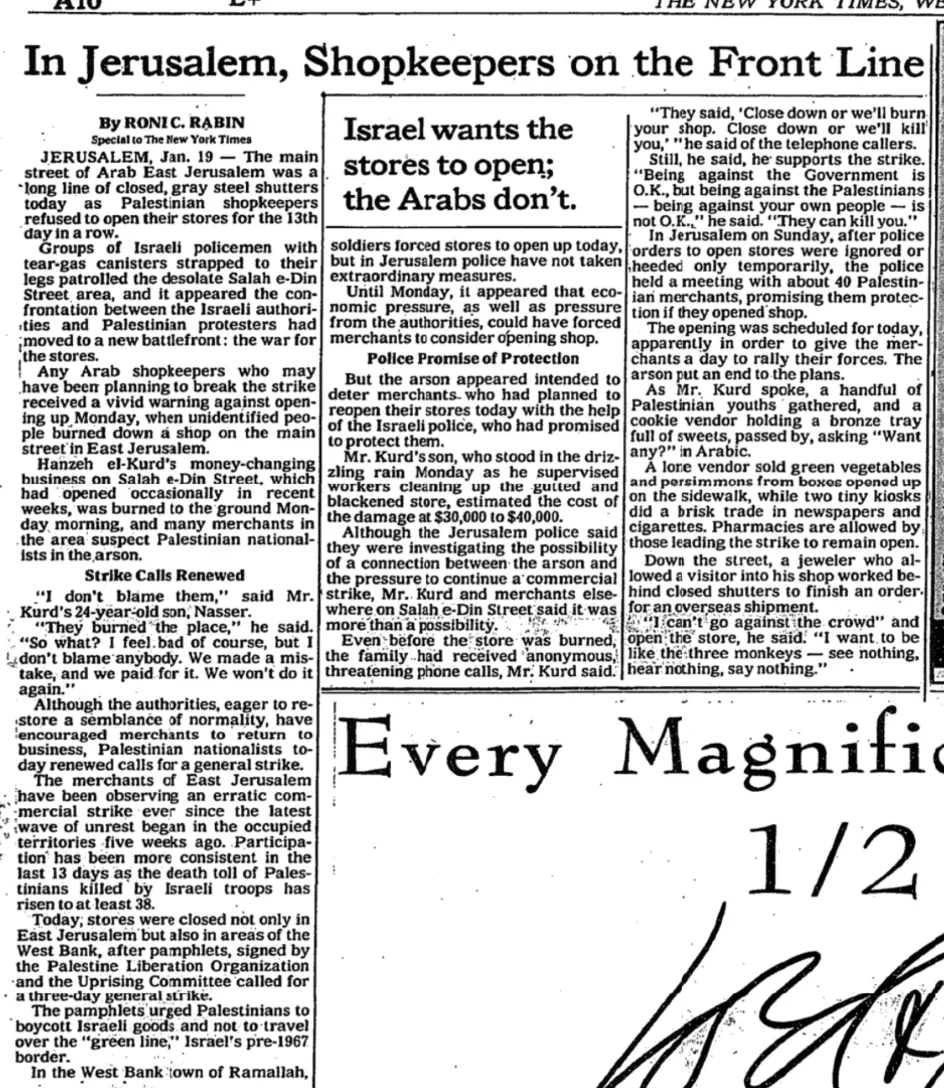
Transcribed from the clipping
JERUSALEM, Jan. 19 — The main street of Arab East Jerusalem was a long line of closed, gray steel shutters today as Palestinian shopkeepers refused to open their stores for the 13th day in a row.
Groups of Israeli policemen with tear-gas canisters strapped to their legs patrolled the desolate Salah e-Din Street area, and it appeared the confrontation between the Israeli authorities and Palestinian protesters had moved to a new battlefront: the war for the stores.
Any Arab shopkeepers who may have been planning to break the strike received a vivid warning against opening up Monday, when unidentified people burned down a shop on the main street in East Jerusalem.
Hanzeh el-Kurd’s money-changing business on Salah e-Din Street, which had opened occasionally in recent weeks, was burned to the ground Monday morning, and many merchants in the area suspect Palestinian nationalists in the arson. Strike Calls Renewed “I don’t blame them,” said Mr. Kurd’s 24-year-old son, Nasser.
“They burned the place,” he said. “So what? I feel bad of course, but I don’t blame anybody. We made a mistake, and we paid for it. We won’t do it again.” Although the authorities, eager to restore a semblance of normality, have encouraged merchants to return to business, Palestinian nationalists today renewed calls for a general strike.
The merchants of East Jerusalem have been observing an erratic commercial strike ever since the latest wave of unrest began in the occupied territories five weeks ago. Participation has been more consistent in the last 13 days as the death toll of Palestinians killed by Israeli troops has risen to at least 38.
Today, stores were closed not only in East Jerusalem but also in areas of the West Bank, after pamphlets, signed by the Palestine Liberation Organization and the Uprising Committee called for a three-day general strike. The pamphlets urged Palestinians to boycott Israeli goods and not to travel over the “green line,” Israel’s pre-1967 border.
Police Promise of Protection But the arson appeared intended to deter merchants who had planned to reopen their stores today with the help of the Israeli police, who had promised to protect them. Mr.
Kurd’s son, who stood in the drizzling rain Monday as he supervised workers cleaning up the gutted and blackened store, estimated the cost of the damage at $30,000 to $40,000. Although the Jerusalem police said they were investigating the possibility of a connection between the arson and the pressure to continue a commercial strike, Mr.
Kurd and merchants elsewhere on Salah e-Din Street said it was more than a possibility. Even before the store was burned, the family had received anonymous, threatening phone calls, Mr. Kurd said. “They said, ‘Close down or we’ll burn your shop. Close down or we’ll kill you,’” he said of the telephone callers.
Still, he said, he supports the strike. “Being against the Government is O.K., but being against the Palestinians — being against your own people — is not O.K.,” he said. “They can kill you.”
In Jerusalem on Sunday, after police orders to open stores were ignored or heeded only temporarily, the police held a meeting with about 40 Palestinian merchants, promising them protection if they opened shop. The opening was scheduled for today, apparently in order to give the merchants a day to rally their forces. The arson put an end to the plans. As Mr.
Kurd spoke, a handful of Palestinian youths gathered, and a cookie vendor holding a bronze tray full of sweets, passed by, asking “Want any?” in Arabic. A lone vendor sold green vegetables and persimmons from boxes opened up on the sidewalk, while two tiny kiosks did a brisk trade in newspapers and cigarettes.
Pharmacies are allowed by those leading the strike to remain open. Down the street, a jeweler who allowed a visitor into his shop worked behind closed shutters to finish an order for an overseas shipment. “I can’t go against the crowd” and open the store, he said. “I want to be like the three monkeys — see nothing, hear nothing, say nothing.”
How this transcription was made
Transcribed from the slide scan by a reader working off magnified crops, not by optical character recognition. The date, the page number and the newspaper are printed on the page: the running head reads “A10 L+” at left and “THE NEW YORK TIMES, WE—” at right, where the clipping’s edge cuts the weekday after two letters. WE can only be WEDNESDAY and 20 January 1988 was a Wednesday; the printed dateline, “JERUSALEM, Jan. 19”, agrees, and the year is corroborated by the article’s figure of at least 38 Palestinians killed since the unrest began five weeks earlier. The newspaper is printed again in the credit line “Special to The New York Times”. The excerpt is the whole article as the clipping prints it.
Cite this clipping
"In Jerusalem, Shopkeepers on the Front Line," The New York Times, 20 January 1988, p. A10. Covering Palestine archive, CP-1988-109. https://coveringpalestine.org/archive/cp-1988-109
More from The New York Times
- The Maine Colony in PalestineThe New York Times · 12 November 1866
- Jewish Colonization in PalestineThe New York Times · 9 December 1883
- Jewish State in Palestine OpposedThe New York Times · 9 July 1897
- ZIONIST CONGRESS IN BASELThe New York Times · 31 August 1897
- ROME FEARS THE ZIONISTSThe New York Times · 12 September 1897
- PROGRESS OF ZIONISMThe New York Times · 16 December 1901
- 852 more from this paper in the full text →
More from the 1980s
- Moderation Silenced by Israel RiotsThe Buffalo News · 3 January 1988
- Gaza Strip: the forgotten stepchildNorthwest Herald · 4 January 1988
- 'Iron Fist' Enslaves Gazans In Their LandThe Herald Sun · 6 January 1988
- Israel condemns U.N. vote on deportationsThe Birmingham News · 6 January 1988
- Israeli soldiers fire on protestersCarroll County Times · 6 January 1988
- Undaunted Palestinians resume violenceThe News & Observer · 6 January 1988
- All 527 clippings from the 1980s →
Last updated 2 November 2026
This record is part of Covering Palestine, an archive of American newspaper clippings about Palestinians, 1724 to 2023. Researched and assembled by Maria Robles.
The clipping belongs to the newspaper that printed it, or to the news agency that supplied the copy. It is reproduced here for research, criticism and commentary. A city here is where the newspaper was published, not where the story came from, and on most records it was taken from the masthead.
Something wrong here, or something you know about this clipping? The archive is still being built and corrections are wanted: maria@rozumstudio.com, quoting CP-1988-109.
Everything printed in 1988 · Printed on this day · See it in the archive reel · Full text of every clipping · Dataset